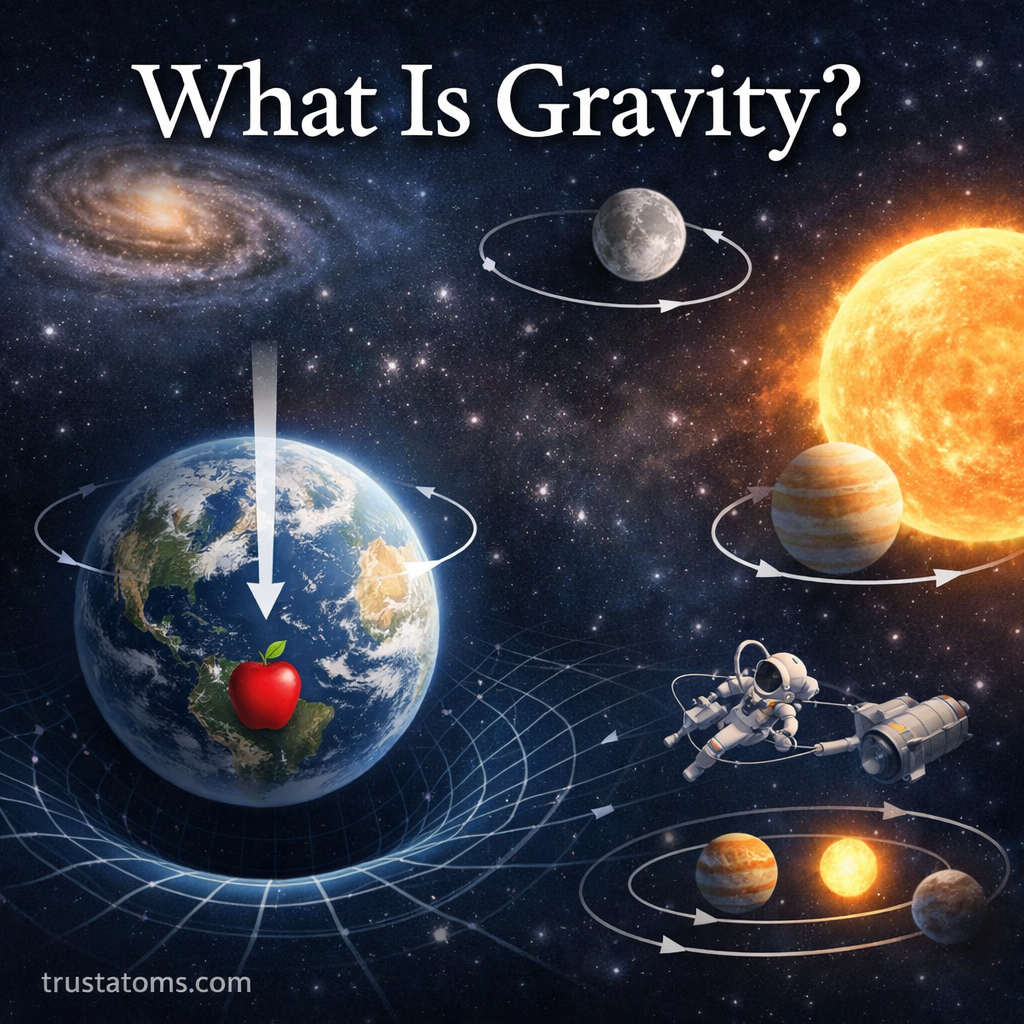
Gravity is one of the most familiar forces in the universe — yet it’s also one of the most fascinating.
It’s the reason you stay grounded on Earth, why the Moon orbits our planet, and why galaxies hold together across billions of miles of space.
In this guide, you’ll learn what gravity is, how it works, why it matters, and how scientists understand it today.
What Is Gravity?
Gravity is a natural force that pulls objects with mass toward one another.
Anything that has mass — from a tiny pebble to a massive star — produces gravity. The more mass an object has, the stronger its gravitational pull.
On Earth, gravity pulls everything toward the planet’s center. That’s why objects fall downward when dropped.
In simple terms:
Gravity = the force of attraction between masses.
Why Does Gravity Exist?
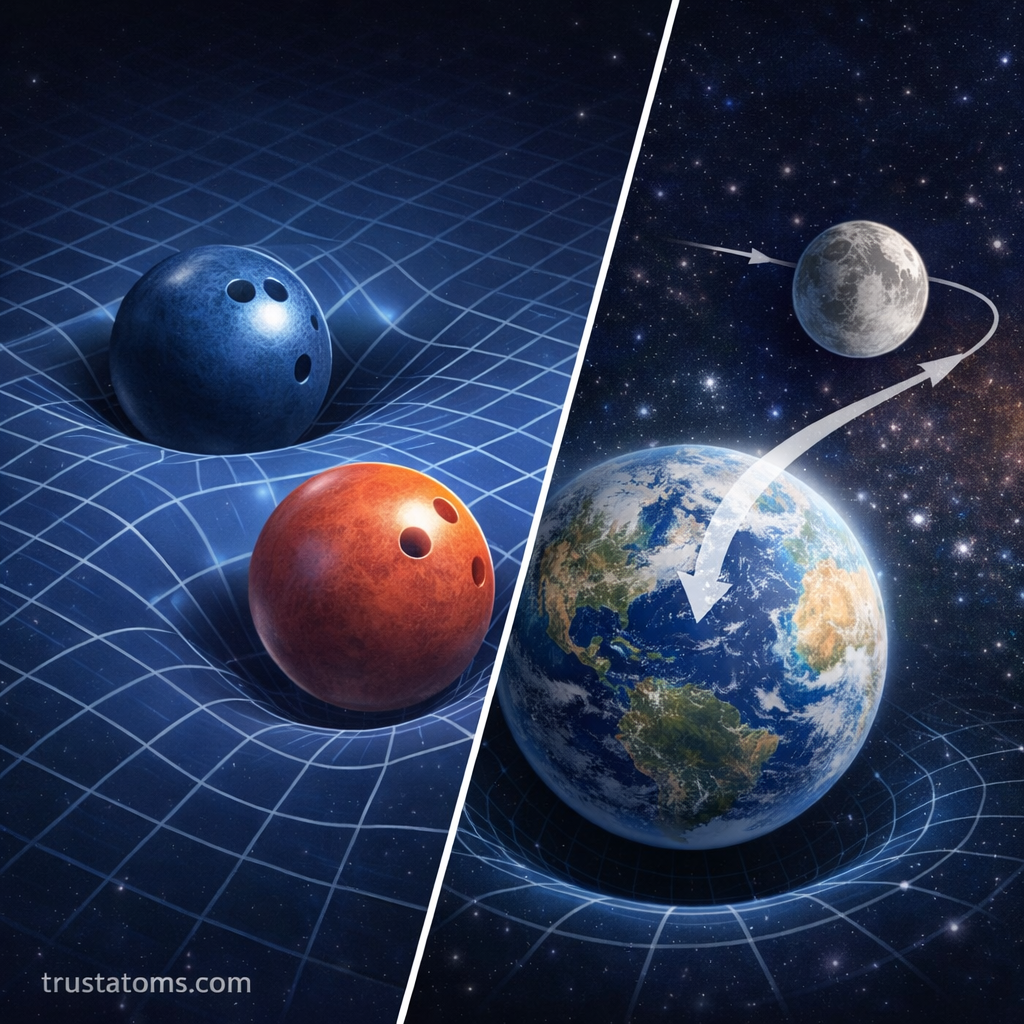
Gravity exists because mass bends space.
According to modern physics, especially Albert Einstein’s theory of relativity, massive objects curve the fabric of space and time around them. Smaller objects then move along these curves.
You can imagine it like this:
- Picture a stretched rubber sheet.
- Place a heavy bowling ball in the center.
- The sheet bends.
- Smaller balls placed nearby roll toward it.
That bending effect is similar to how gravity works in space.
The Law of Universal Gravitation
Before Einstein, Sir Isaac Newton described gravity mathematically in the 1600s.
Newton’s Law of Universal Gravitation states:
Every object in the universe attracts every other object with a force that depends on:
- Their masses
- The distance between them
The formula is:
F = G (m₁m₂ / r²)
Where:
- F = gravitational force
- G = gravitational constant
- m₁ and m₂ = masses of the two objects
- r = distance between their centers
Key takeaway:
- Larger mass → stronger gravity
- Greater distance → weaker gravity
Gravity gets weaker quickly as distance increases.
How Strong Is Gravity?
Gravity is actually the weakest of the four fundamental forces of nature:
- Gravity
- Electromagnetism
- Strong nuclear force
- Weak nuclear force
Despite being the weakest, gravity dominates on large scales because:
- It always attracts (never repels)
- It works over infinite distances
- It affects all matter
This is why gravity controls:
- Planetary motion
- Star formation
- Galaxy structure
- The expansion of the universe
How Gravity Works on Earth
On Earth, gravity gives objects weight.
Weight is simply the force of gravity acting on mass.
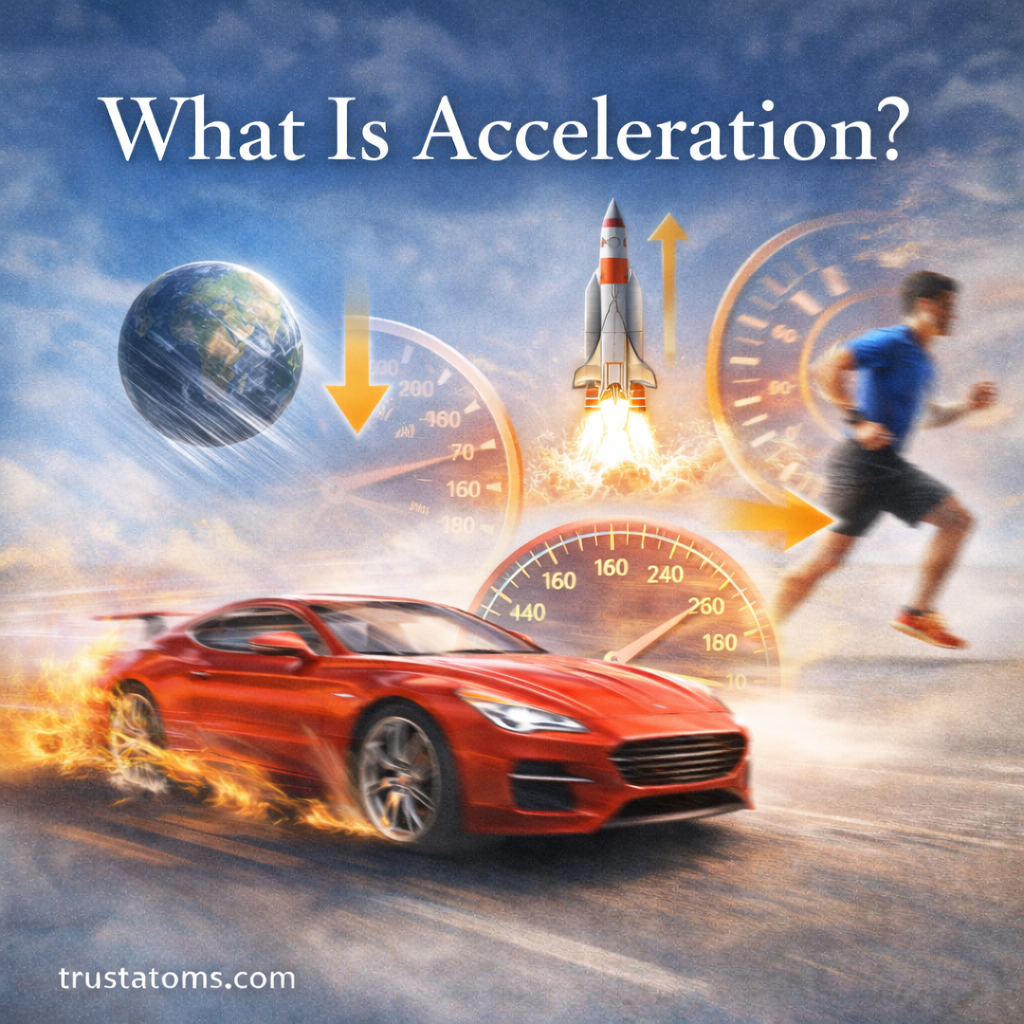
The acceleration due to gravity on Earth is approximately:
9.8 meters per second squared (9.8 m/s²)
This means:
- A falling object increases its speed by 9.8 m/s every second (ignoring air resistance).
If you drop a ball:
- After 1 second → moving 9.8 m/s
- After 2 seconds → about 19.6 m/s
- After 3 seconds → about 29.4 m/s
Gravity pulls everything downward at the same rate, regardless of mass (in a vacuum).
What Is Gravitational Pull?
Gravitational pull is the strength of gravity from a specific object.
For example:
- The Moon has weaker gravity than Earth.
- Jupiter has much stronger gravity than Earth.
That’s why:
- You would weigh less on the Moon.
- You would weigh more on Jupiter.
Your mass stays the same — but your weight changes depending on the gravitational pull.
Gravity in Space
Gravity doesn’t stop in space.
It keeps:
- The Moon orbiting Earth
- Earth orbiting the Sun
- The Sun orbiting within the Milky Way
- Galaxies clustered together
Orbits happen because objects are constantly falling toward each other — but moving sideways at the same time.
In other words, planets are in continuous free fall around stars.
What Is Microgravity?
Astronauts aboard the International Space Station appear weightless.
But gravity is still present.
They experience microgravity because:
- They are falling toward Earth
- The space station is also falling
- They fall together
This creates the feeling of weightlessness.
Why Gravity Is Essential for Life
Without gravity:
- Earth wouldn’t hold an atmosphere
- Oceans would drift into space
- The Moon wouldn’t stabilize Earth’s tilt
- Planets wouldn’t form
- Stars wouldn’t ignite
Gravity is responsible for structure in the universe — from atoms clustering into matter to galaxies forming across cosmic time.
Can Gravity Be Turned Off?
No.
Gravity cannot be switched off or blocked.
Scientists are still working to understand gravity at the quantum level. While we can measure it precisely, a full theory that unites gravity with quantum mechanics remains one of physics’ biggest challenges.
Final Thoughts
Gravity is the invisible force that shapes everything.
It keeps your feet on the ground.
It guides planets through space.
It binds galaxies together.
From a falling apple to the motion of distant stars, gravity connects the smallest everyday experiences to the largest structures in the universe.
Understanding gravity helps us understand how the universe itself works.