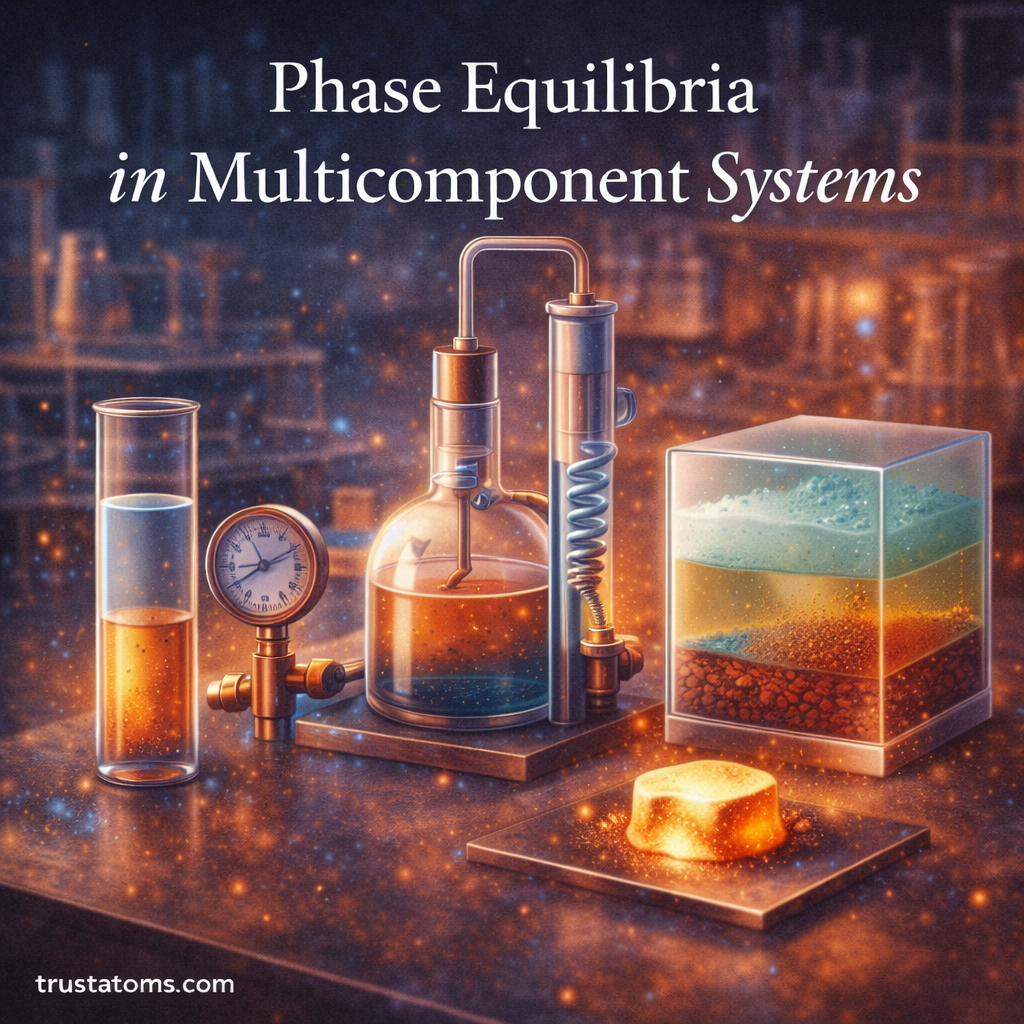
Phase equilibria describes the balance between different physical states—such as solid, liquid, and gas—within a chemical system. When multiple substances are present, the behavior of these phases becomes more complex. This situation is known as a multicomponent system.
Understanding phase equilibria in multicomponent systems is essential in chemistry, chemical engineering, materials science, and environmental science. It helps scientists predict how mixtures behave under different temperatures, pressures, and compositions.
These principles are widely used in industries such as petroleum refining, pharmaceuticals, metallurgy, and food processing.
What Is Phase Equilibrium?
Phase equilibrium occurs when multiple phases of matter coexist without any net change over time. At equilibrium, the rate of molecules moving between phases is balanced.
For example, in a closed container containing water and water vapor:
- Liquid molecules evaporate into the gas phase.
- Gas molecules condense back into the liquid.
When these rates become equal, the system reaches equilibrium.
In multicomponent systems, equilibrium must be maintained across multiple substances and phases simultaneously, making the analysis more complex.
Understanding Phases and Components
Before studying multicomponent equilibria, it is important to understand two key terms.
Phases
A phase is a physically uniform, homogeneous portion of a system with consistent chemical and physical properties.
Examples include:
- Liquid water
- Ice
- Water vapor
- Oil layers in mixtures
- Solid crystals
Different phases are separated by boundaries called phase interfaces.
Components
A component refers to a chemically independent substance present in a system.
Examples of components in mixtures include:
- Water
- Ethanol
- Carbon dioxide
- Salt
A multicomponent system contains two or more chemically distinct substances interacting within the same environment.
The Gibbs Phase Rule
One of the most important principles used to analyze phase equilibria is the Gibbs Phase Rule.
The rule relates the number of components, phases, and degrees of freedom in a system.
The general relationship is:
Degrees of Freedom = Components − Phases + 2
The degrees of freedom represent how many variables—such as temperature, pressure, or composition—can change without disturbing equilibrium.
Example
Consider a system with:
- Two components (such as water and ethanol)
- Two phases (liquid and vapor)
Applying the Gibbs Phase Rule:
Degrees of Freedom = 2 − 2 + 2 = 2
This means two independent variables must be defined to determine the system’s state.
Types of Multicomponent Phase Systems
Multicomponent systems can form several types of phase combinations depending on temperature, pressure, and composition.
Liquid–Liquid Equilibria
Liquid–liquid equilibrium occurs when two liquid phases coexist but do not fully mix.
Examples include:
- Oil and water mixtures
- Polymer solutions
- Some solvent extraction systems
In these systems, each liquid phase contains different proportions of the components.
Vapor–Liquid Equilibria
Vapor–liquid equilibrium (VLE) occurs when liquid and vapor phases coexist.
This type of equilibrium is particularly important in:
- Distillation processes
- Chemical separations
- Petroleum refining
In multicomponent mixtures, each component distributes differently between liquid and vapor phases.
Solid–Liquid Equilibria
Solid–liquid equilibrium describes conditions where solid and liquid phases coexist.
Examples include:
- Crystallization processes
- Freezing of mixtures
- Alloy formation in metallurgy
Understanding these equilibria helps control material purity and structure.
Phase Diagrams for Multicomponent Systems
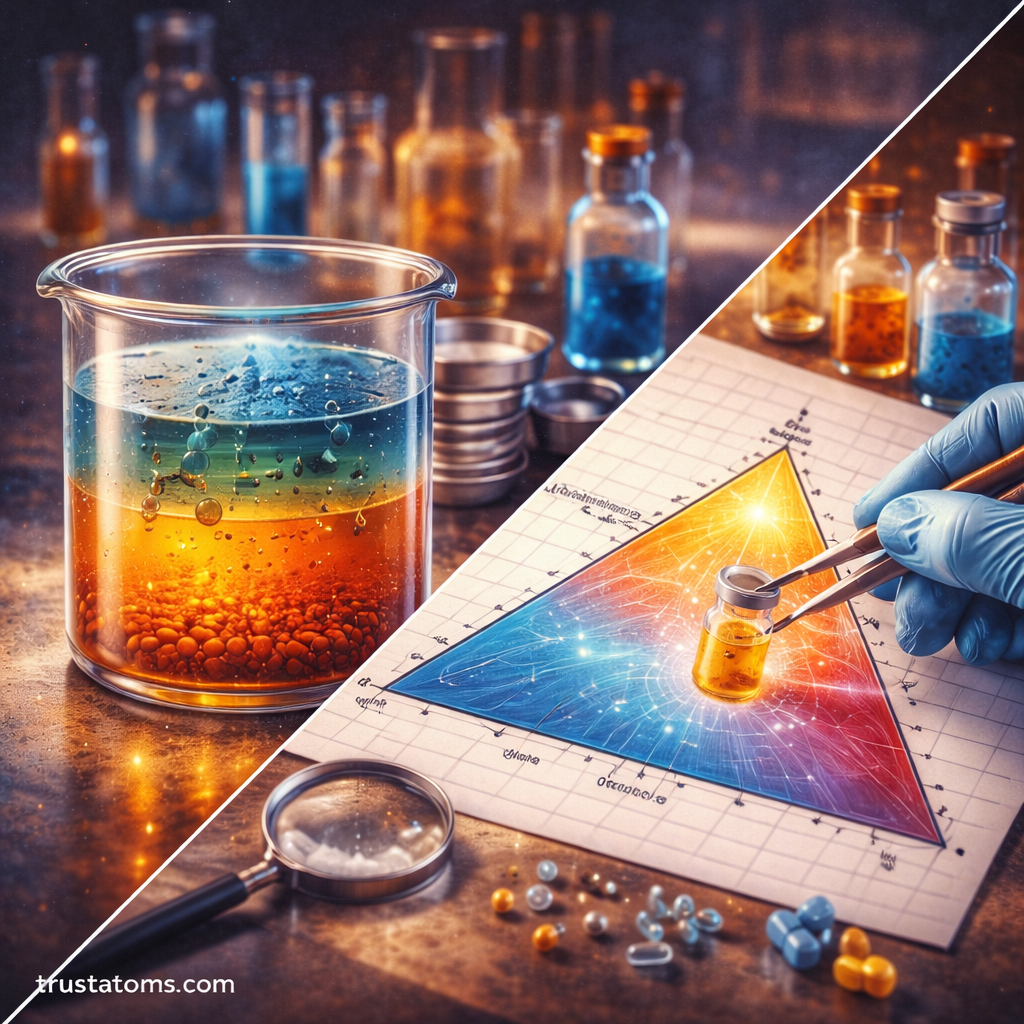
Phase diagrams are graphical representations that show how phases change under different conditions.
For multicomponent systems, diagrams often illustrate relationships between:
- Temperature
- Pressure
- Composition
These diagrams help predict how mixtures behave during heating, cooling, or pressure changes.
Binary Phase Diagrams
Binary phase diagrams involve two components.
Common examples include:
- Metal alloy systems
- Salt–water mixtures
- Organic solvent mixtures
These diagrams often show:
- Liquid regions
- Solid regions
- Mixed-phase regions
Ternary Phase Diagrams
Ternary diagrams represent systems containing three components.
These diagrams are typically displayed as triangular graphs, where each corner represents a pure component.
They are commonly used in:
- Pharmaceutical formulations
- Polymer blends
- Petroleum mixtures
Applications of Multicomponent Phase Equilibria
Understanding phase equilibria helps engineers design efficient chemical processes.
Chemical Separation
Phase equilibrium principles are used in separation techniques such as:
- Distillation
- Liquid–liquid extraction
- Absorption processes
These methods separate mixtures based on differences in phase behavior.
Petroleum Refining
Crude oil contains hundreds of different hydrocarbons.
Phase equilibrium analysis helps determine how these components separate during refining operations like:
- Fractional distillation
- Gas processing
- Hydrocarbon recovery
Materials Science
Multicomponent phase equilibria are essential for designing alloys and advanced materials.
Examples include:
- Steel production
- Semiconductor materials
- Ceramic systems
Phase diagrams guide scientists in controlling material structure and properties.
Pharmaceutical Development
Drug formulations often contain multiple ingredients.
Phase equilibrium analysis helps determine:
- Solubility limits
- Stability of formulations
- Optimal storage conditions
Factors That Influence Phase Equilibria
Several physical and chemical variables influence equilibrium in multicomponent systems.
Temperature
Changes in temperature can shift equilibrium conditions and alter phase compositions.
Pressure
Pressure strongly affects vapor–liquid equilibria, especially for gases and volatile compounds.
Composition
The relative amounts of each component determine how phases form and separate.
Intermolecular Interactions
Attractive or repulsive forces between molecules affect miscibility and phase stability.
Challenges in Multicomponent Systems
Studying multicomponent equilibria becomes increasingly complex as more substances are added to the system.
Common challenges include:
- Complex mathematical modeling
- Limited experimental data
- Non-ideal interactions between molecules
- Difficulties predicting behavior at extreme conditions
Advanced computational methods are now helping scientists simulate these systems more accurately.
The Role of Phase Equilibria in Modern Chemistry
Phase equilibria in multicomponent systems provide a framework for understanding how mixtures behave in real-world conditions.
These principles guide the design of chemical processes, energy systems, materials, and pharmaceuticals. By predicting how substances distribute across phases, chemists and engineers can control reactions, improve efficiency, and develop better products.
As industrial processes and material technologies continue to advance, the study of multicomponent phase equilibria remains a foundational part of chemistry and chemical engineering.