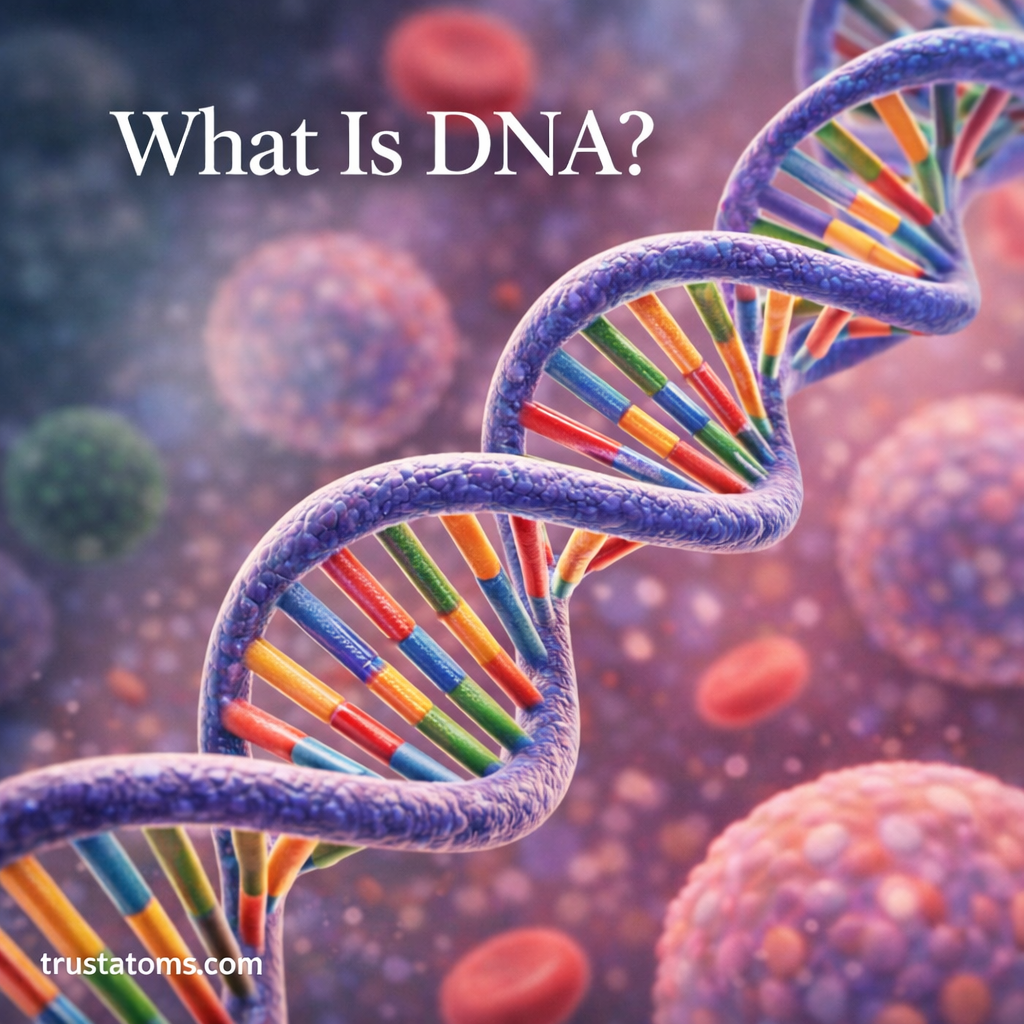
DNA is the molecule that carries the genetic instructions used to build, maintain, and reproduce living organisms. Nearly every cell in the human body contains DNA, and this remarkable molecule stores the biological information that determines how organisms grow, function, and develop.
The term DNA stands for deoxyribonucleic acid, and it acts as the blueprint for life. From physical traits like eye color to the processes that allow cells to function, DNA contains the instructions that guide biological activity.
Understanding DNA is central to modern biology, genetics, medicine, and biotechnology.
The Basic Definition of DNA
DNA is a complex molecule that stores genetic information in living organisms.
It contains the instructions needed for:
- Building proteins
- Controlling cell activity
- Passing traits from parents to offspring
- Supporting growth and development
These instructions are encoded in a sequence of chemical components that form a biological code.
DNA exists inside the cells of nearly all living organisms, including:
- Humans
- Animals
- Plants
- Fungi
- Many microorganisms
Where DNA Is Found in Cells
In eukaryotic cells, such as those found in humans, DNA is primarily located in the nucleus.
However, small amounts of DNA can also be found in other structures like:
- Mitochondria, which produce energy for the cell
In prokaryotic cells, such as bacteria, DNA is not enclosed within a nucleus. Instead, it exists in a region of the cell called the nucleoid.
Despite differences in cellular organization, DNA performs the same fundamental role in all forms of life: storing genetic information.
The Structure of DNA
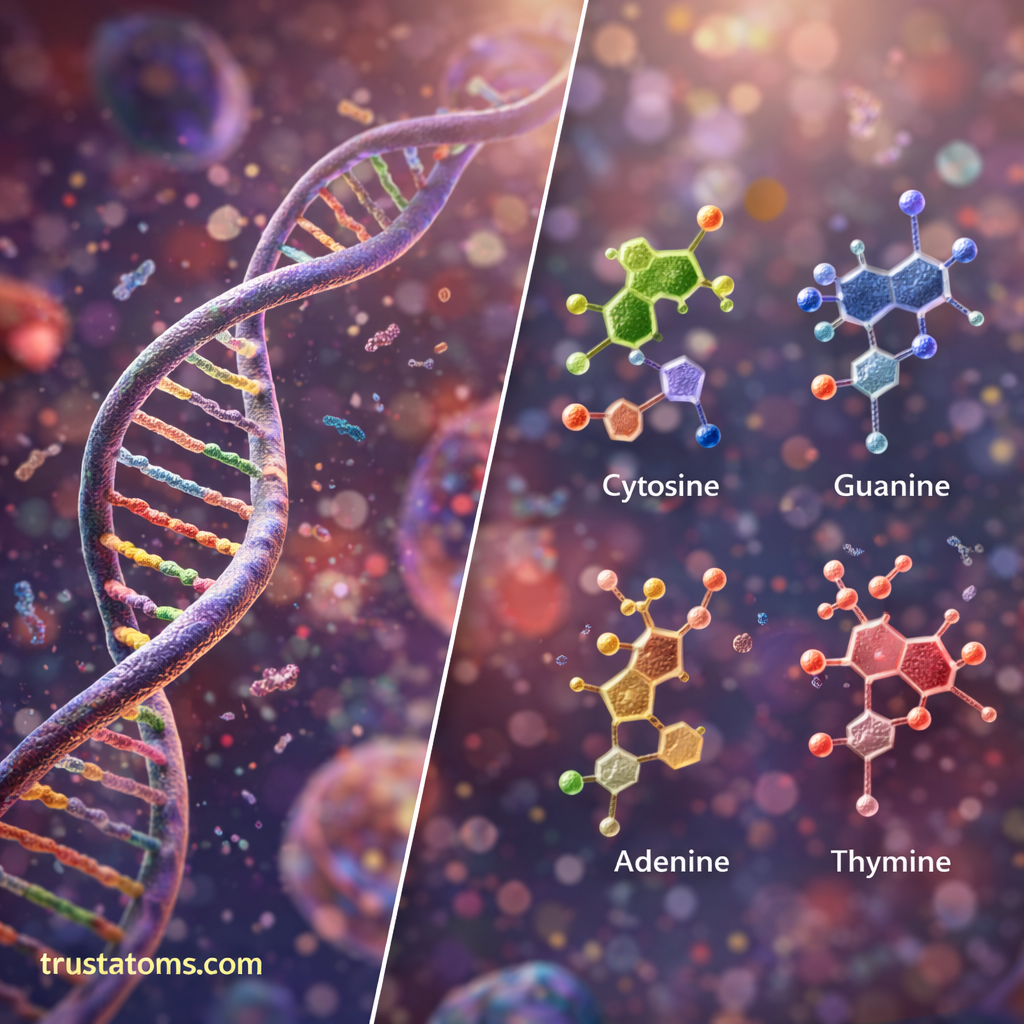
DNA has a distinctive three-dimensional shape known as the double helix.
This structure looks like a twisted ladder and consists of two strands that wind around each other.
The structure of DNA includes several key components.
Nucleotides
DNA is made up of repeating units called nucleotides.
Each nucleotide contains three parts:
- A sugar molecule
- A phosphate group
- A nitrogenous base
These nucleotides link together to form the long strands that make up the DNA molecule.
The Four DNA Bases
The genetic information in DNA is encoded by four nitrogenous bases:
- Adenine (A)
- Thymine (T)
- Cytosine (C)
- Guanine (G)
These bases pair in specific ways:
- Adenine pairs with thymine
- Cytosine pairs with guanine
This pairing system forms the “rungs” of the DNA ladder and ensures accurate replication.
The Double Helix Shape
The two strands of DNA twist together to form a spiral structure called the double helix.
This design provides several advantages:
- Stability for storing genetic information
- Protection for the genetic code
- Efficient copying during cell division
The double helix structure was famously described in 1953 by scientists James Watson and Francis Crick, building on earlier research from multiple scientists studying molecular genetics.
How DNA Stores Genetic Information
DNA stores information through the sequence of its bases.
The order of the four bases (A, T, C, G) forms a biological code that cells use to build proteins.
Proteins perform many important tasks in the body, including:
- Building cellular structures
- Supporting chemical reactions as enzymes
- Transporting molecules
- Regulating biological processes
A gene is a specific segment of DNA that contains instructions for making a particular protein.
Humans have roughly 20,000 genes encoded in their DNA.
DNA Replication
Before a cell divides, it must copy its DNA so that each new cell receives a complete set of genetic instructions.
This process is called DNA replication.
DNA replication involves several steps:
- The double helix unwinds.
- The two strands separate.
- Each strand serves as a template for building a new complementary strand.
- New nucleotides attach according to base-pairing rules.
The result is two identical DNA molecules, each containing one original strand and one newly formed strand.
This process ensures genetic continuity across generations of cells.
DNA and Inheritance
DNA is responsible for heredity, the process by which traits are passed from parents to offspring.
When organisms reproduce, they pass their DNA to the next generation. This genetic information influences many characteristics, including:
- Physical appearance
- Biological functions
- Susceptibility to certain diseases
Genetic variation occurs when differences appear in DNA sequences. These variations contribute to the diversity seen within populations of living organisms.
Why DNA Is Essential to Life
DNA plays a central role in nearly every biological process.
Its importance includes:
- Storing genetic instructions
- Guiding protein production
- Supporting cell growth and repair
- Passing genetic information between generations
- Enabling evolution through genetic variation
Without DNA, cells would not have the instructions needed to carry out life-sustaining activities.
DNA in Modern Science
The study of DNA has transformed science and medicine.
Advances in genetics have made it possible to:
- Identify inherited diseases
- Develop targeted medical treatments
- Study evolutionary relationships
- Use DNA in forensic science
- Explore biotechnology and genetic engineering
DNA analysis is now used in fields ranging from healthcare and agriculture to criminal investigations and ancestry research.
Final Thoughts
DNA is one of the most important molecules in biology. It stores the instructions that determine how organisms develop, function, and reproduce.
From the structure of the double helix to the sequences that encode genes, DNA forms the foundation of genetic inheritance and biological diversity. By studying DNA, scientists continue to uncover the mechanisms that shape life at the molecular level.
Understanding what DNA is—and how it works—provides valuable insight into the processes that make life possible.