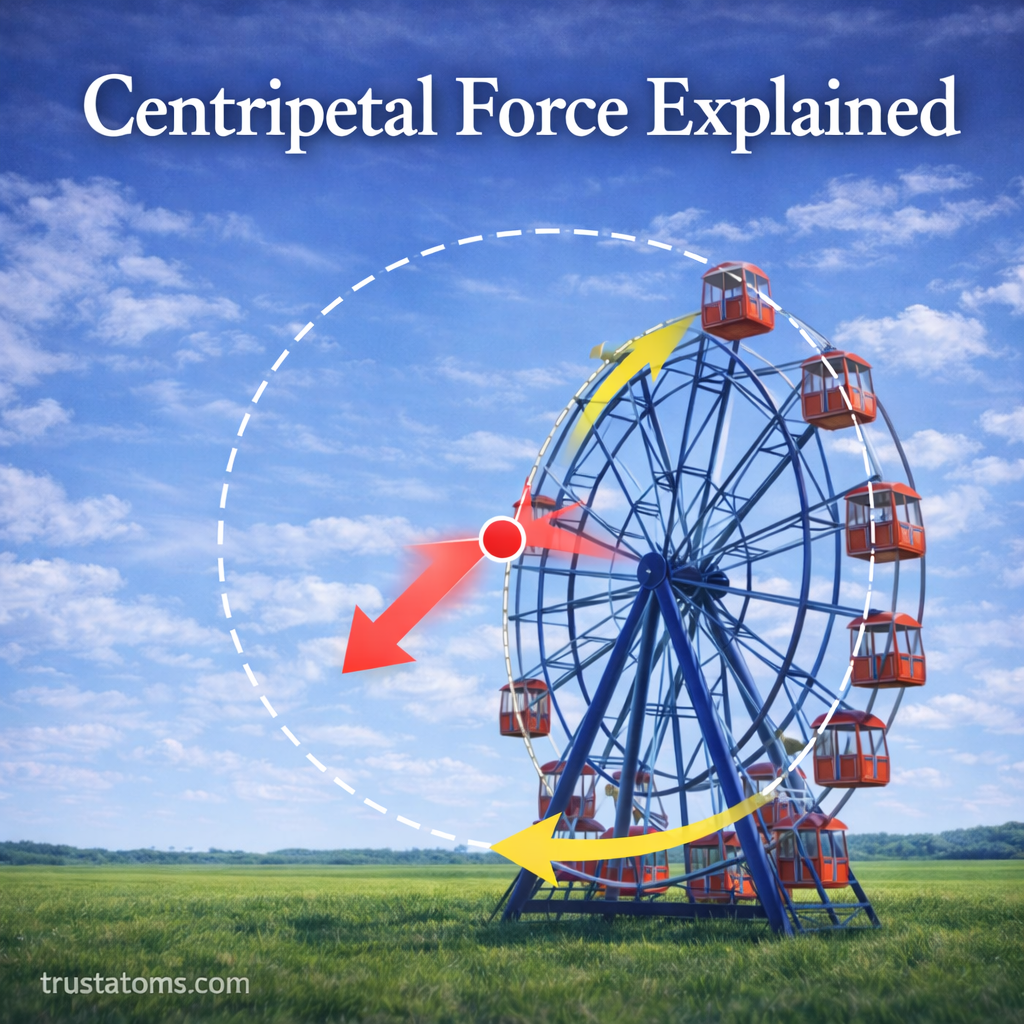
Centripetal force is the inward force that keeps an object moving in a circular path.
Without it, objects would move in straight lines due to inertia. From a car turning on a curved road to planets orbiting the Sun, centripetal force is what makes circular motion possible.
In this guide, you’ll learn:
- What centripetal force really means
- Why it’s not a “new” type of force
- The formula and how it works
- Real-world examples
- Common mistakes students make
What Is Centripetal Force?
Centripetal force is the force directed toward the center of a circular path.
The word “centripetal” comes from Latin:
- Centrum = center
- Petere = to seek
So centripetal literally means “center-seeking.”
Whenever something moves in a circle, there must be a force pulling it inward.
If that force disappears, the object flies off in a straight line.
Why Circular Motion Requires a Force
According to Newton’s First Law of Motion:
An object in motion stays in motion in a straight line unless acted upon by a force.
Since circular motion constantly changes direction, the object is continuously accelerating.
And acceleration requires force.
That inward acceleration is called centripetal acceleration.
The force causing it is centripetal force.
The Centripetal Force Formula
The formula for centripetal force is:
F = mv² / r
Where:
- F = centripetal force
- m = mass of the object
- v = speed
- r = radius of the circular path
This formula shows three important relationships:
- Greater speed → greater force required
- Greater mass → greater force required
- Smaller radius → greater force required
Faster motion or tighter turns demand stronger inward force.
Centripetal Force Is Not a New Type of Force
This is one of the most misunderstood ideas.
Centripetal force is not a separate physical force like gravity or friction.
Instead, it is the name we give to whatever force is acting inward in a circular motion.
Examples:
- Tension provides centripetal force for a ball on a string.
- Gravity provides centripetal force for planets in orbit.
- Friction provides centripetal force for a car turning.
- Normal force can provide centripetal force on a roller coaster loop.
The type of force changes depending on the situation — but the direction is always inward.
Real-World Examples of Centripetal Force
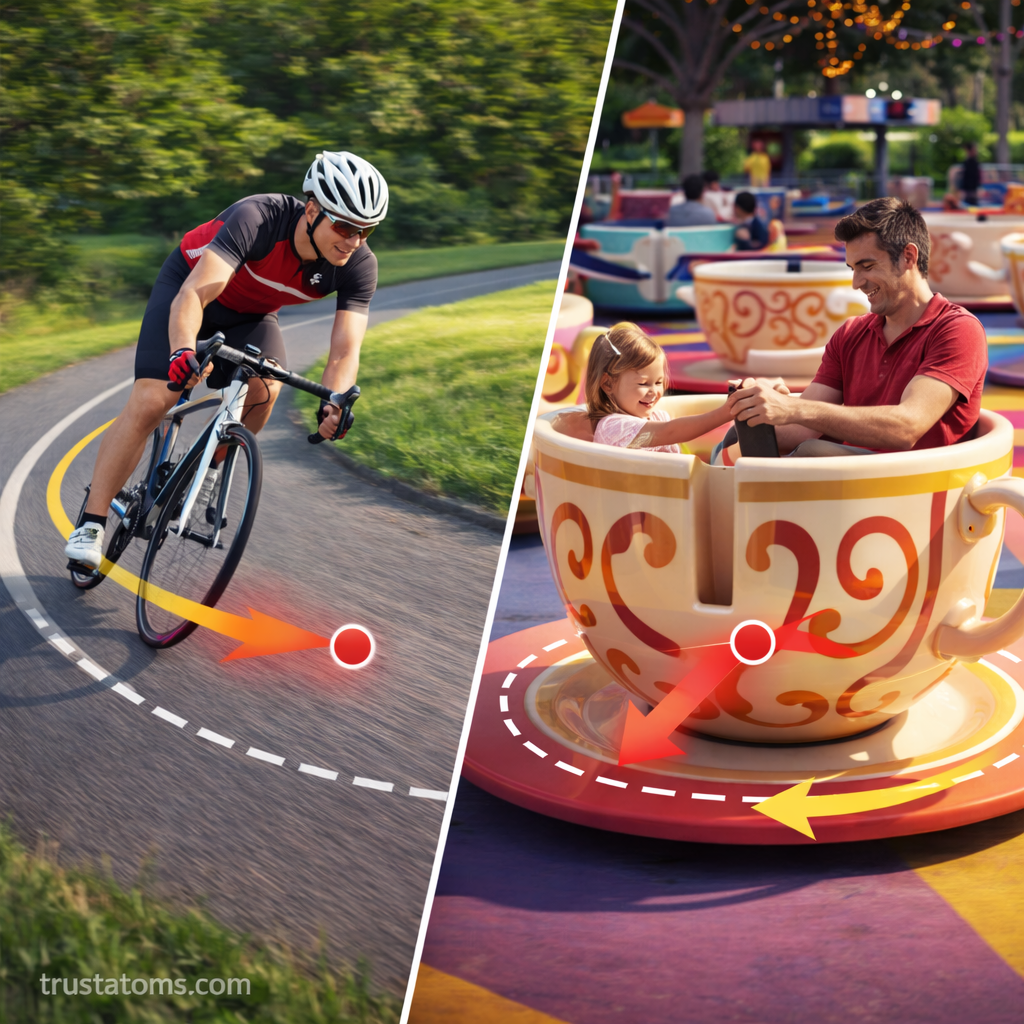
Centripetal force appears in many everyday situations:
- A car rounding a curve
- A spinning washing machine
- A Ferris wheel
- A satellite orbiting Earth
- A ball tied to a rope and swung overhead
In each case, something is pulling inward toward the center.
What Happens Without Centripetal Force?
If the inward force suddenly disappears:
- The object moves in a straight line tangent to the circle.
For example:
If a string breaks while spinning a ball, the ball does not fly outward in a curve.
It flies straight in the direction it was moving at that instant.
This straight-line motion is due to inertia.
Centripetal Force vs. Centrifugal Force
Students often confuse centripetal and centrifugal force.
Centripetal force:
- Acts inward
- Keeps the object in circular motion
Centrifugal force:
- Is an apparent outward force
- Is experienced in a rotating reference frame
If you feel pushed outward on a spinning ride, that sensation is often described as centrifugal force. But from an outside (inertial) frame, the real force acting is inward — centripetal force.
Uniform vs. Non-Uniform Circular Motion
Uniform Circular Motion
Occurs when:
- Speed is constant
- Direction changes
- Only centripetal force is present
Non-Uniform Circular Motion
Occurs when:
- Speed changes
- Direction changes
In this case, there are two forces involved:
- Centripetal force (inward)
- Tangential force (changes speed)
Why Speed Matters So Much
Notice that speed is squared in the formula.
This means:
If speed doubles → centripetal force becomes four times larger.
That’s why:
- High-speed turns are dangerous
- Race cars require strong tire grip
- Roller coasters are carefully engineered
Small increases in speed dramatically increase required inward force.
Common Mistakes to Avoid
Students often:
- Think centripetal force pushes outward
- Forget that direction change means acceleration
- Confuse centripetal force with centrifugal force
- Forget to use radius (not diameter) in calculations
Always check the direction: centripetal force points toward the center.
Why Centripetal Force Matters
Understanding centripetal force helps explain:
- Planetary orbits
- Satellite motion
- Mechanical rotation
- Vehicle safety
- Amusement park ride design
It is a foundational concept in classical mechanics and engineering.
Final Thoughts
Centripetal force is the inward force that keeps objects moving in circles.
It is not a new force — it is simply the name given to any force directed toward the center of a circular path.
Without it, circular motion would not exist.
From orbiting planets to turning cars, centripetal force is one of the key ideas that connects motion, force, and acceleration in physics.
Mastering this concept strengthens your understanding of how motion works in the real world.