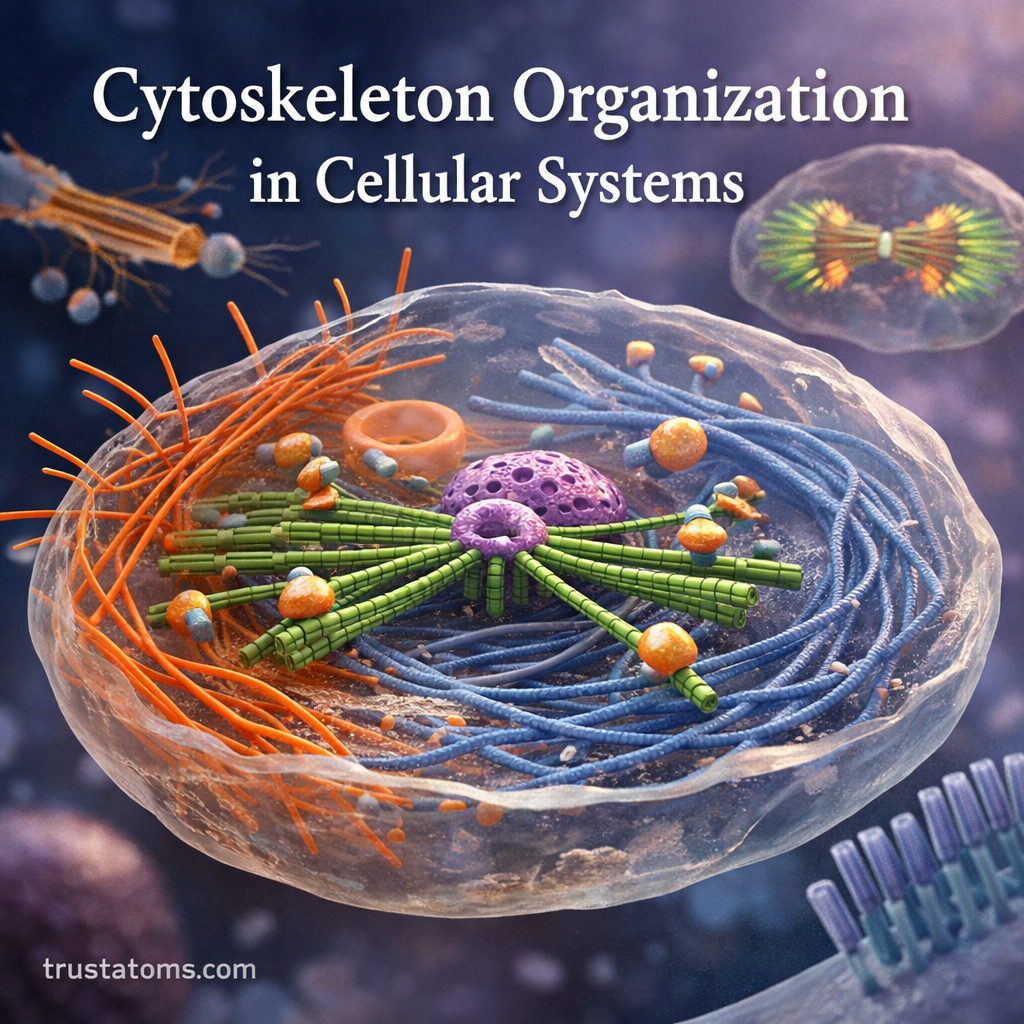
Cells may appear simple under a microscope, but internally they contain an incredibly complex structural network that maintains shape, supports movement, and organizes internal components. This network is known as the cytoskeleton.
The cytoskeleton is not a rigid skeleton like bones in animals. Instead, it is a dynamic system of protein filaments that constantly assemble and disassemble to help cells adapt, divide, transport materials, and maintain structural integrity.
Understanding cytoskeleton organization is essential in biology because it explains how cells move, maintain stability, and coordinate vital processes inside the cellular environment.
What Is the Cytoskeleton?
The cytoskeleton is a network of protein fibers distributed throughout the cytoplasm of a cell. It acts as an internal framework that gives the cell structure while also enabling movement and intracellular transport.
Rather than being static, the cytoskeleton is constantly reorganizing in response to cellular needs.
Key functions of the cytoskeleton include:
- Maintaining cell shape and mechanical strength
- Organizing organelles within the cytoplasm
- Enabling cell movement and motility
- Supporting intracellular transport
- Assisting in cell division
- Facilitating communication within the cell
Both eukaryotic cells and some prokaryotic cells contain cytoskeletal structures, though the systems are more complex in eukaryotes.
The Three Main Components of the Cytoskeleton
The cytoskeleton is composed of three major types of protein filaments. Each type has unique properties and performs specialized roles.
Microfilaments (Actin Filaments)
Microfilaments are the thinnest cytoskeletal fibers and are primarily made of the protein actin.
These filaments play a major role in cell movement and surface structure.
Key characteristics:
- Diameter of about 7 nanometers
- Highly flexible and dynamic
- Located near the cell membrane
- Rapid assembly and disassembly
Functions of microfilaments include:
- Cell crawling and migration
- Muscle contraction
- Maintaining cell shape
- Formation of cellular protrusions such as microvilli
Microfilaments are especially important in processes like wound healing and immune cell movement.
Intermediate Filaments
Intermediate filaments provide mechanical strength and stability to cells.
They are thicker than microfilaments but thinner than microtubules, giving them their name.
Key characteristics:
- Diameter of about 10 nanometers
- More stable and durable than other cytoskeletal elements
- Found throughout the cytoplasm
Functions include:
- Reinforcing cell structure
- Maintaining tissue integrity
- Anchoring organelles in place
- Resisting mechanical stress
Examples of intermediate filament proteins include keratin, which helps strengthen skin cells and hair.
Microtubules
Microtubules are the largest cytoskeletal structures and serve as tracks for intracellular transport.
They are hollow tubes built from the protein tubulin.
Key characteristics:
- Diameter of about 25 nanometers
- Hollow cylindrical structure
- Rapidly assembled and disassembled
Major roles of microtubules include:
- Transporting vesicles and organelles
- Forming the mitotic spindle during cell division
- Creating structures such as cilia and flagella
- Maintaining cell polarity
Motor proteins such as kinesin and dynein move cargo along microtubules throughout the cell.
How Cytoskeleton Organization Supports Cellular Function
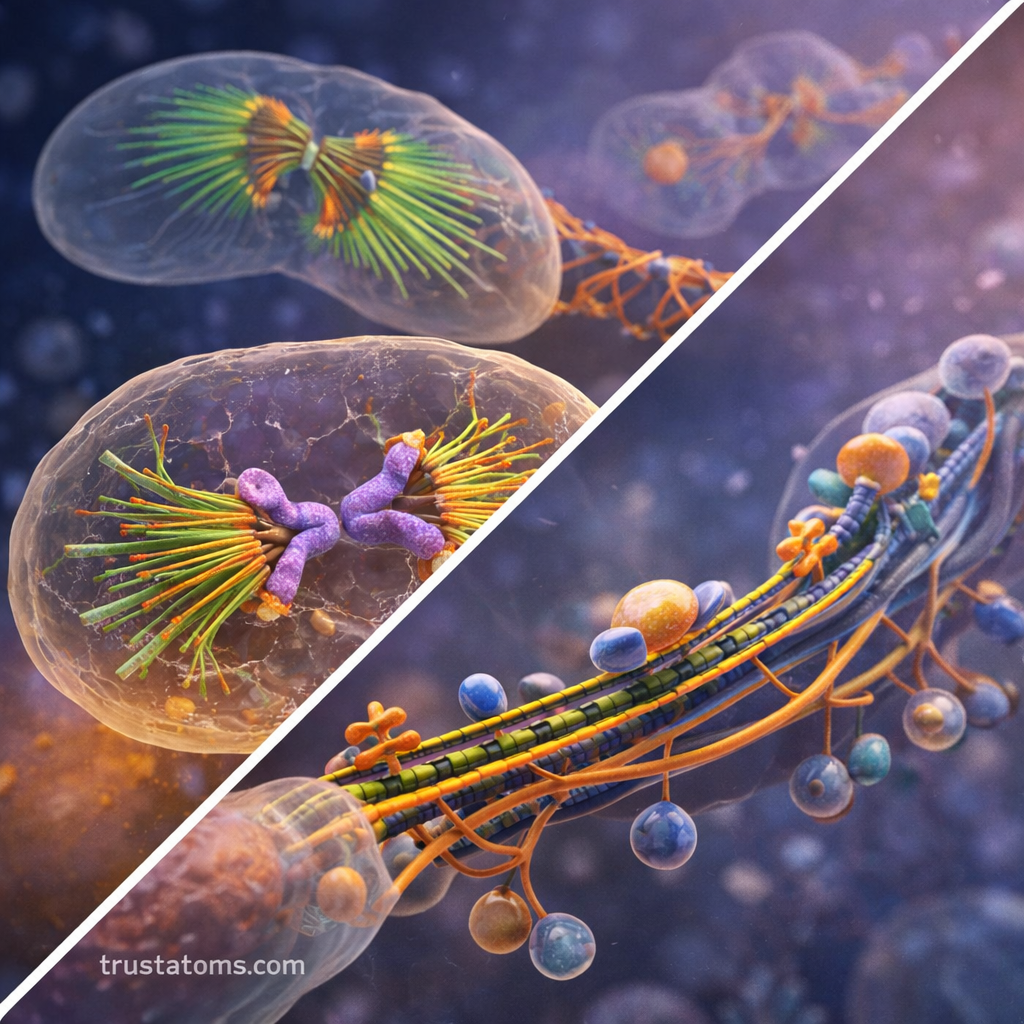
The cytoskeleton is carefully organized so that each filament system contributes to overall cellular efficiency.
This organization allows the cell to coordinate multiple activities simultaneously.
Structural Support
The cytoskeleton provides the internal architecture that prevents cells from collapsing or losing their shape.
Without this support:
- Cells would become unstable
- Organelles would drift randomly
- Mechanical stress could damage cellular components
Intracellular Transport
Cells must move proteins, vesicles, and organelles efficiently across the cytoplasm.
Microtubules serve as transport highways, while motor proteins carry cargo along these tracks.
Examples of transported materials include:
- Protein-containing vesicles
- Mitochondria
- Signaling molecules
- Membrane components
This transport system is crucial for maintaining cellular organization and communication.
Cell Movement and Shape Changes
Cells frequently change shape or move in response to environmental signals.
The cytoskeleton makes these changes possible.
Examples include:
- Immune cells moving toward infection sites
- Cells migrating during embryonic development
- Tissue repair after injury
Actin filaments are particularly important for forming cellular protrusions that drive movement.
Cell Division
During mitosis, the cytoskeleton reorganizes to ensure accurate distribution of chromosomes.
Microtubules form the mitotic spindle, which pulls duplicated chromosomes apart into daughter cells.
This process ensures that each new cell receives a complete set of genetic material.
Cytoskeleton Dynamics and Regulation
One of the most remarkable features of the cytoskeleton is its dynamic nature.
Filaments constantly grow and shrink depending on the cell’s needs.
This dynamic behavior is controlled by:
- Regulatory proteins
- Energy molecules such as ATP and GTP
- Cellular signaling pathways
Cells can rapidly reorganize their cytoskeleton to respond to:
- Environmental changes
- Mechanical forces
- Chemical signals
- Developmental processes
This flexibility allows cells to adapt and function effectively in complex biological systems.
Cytoskeleton Organization in Different Cell Types
Different cells organize their cytoskeleton in specialized ways depending on their function.
Examples include:
Muscle Cells
- Dense networks of actin filaments
- Organized for contraction and force generation
Nerve Cells
- Microtubules support long axons
- Enable transport of neurotransmitters over long distances
Epithelial Cells
- Intermediate filaments provide mechanical strength
- Help tissues resist physical stress
These variations illustrate how cytoskeletal organization adapts to meet the demands of different biological systems.
Cytoskeleton Malfunctions and Disease
Disruptions in cytoskeletal organization can lead to serious health conditions.
Examples include:
- Neurodegenerative diseases, where transport along microtubules becomes impaired
- Cancer, where cytoskeleton changes allow abnormal cell migration and invasion
- Skin disorders, caused by mutations in keratin intermediate filaments
Because of its central role in cellular function, the cytoskeleton is an important focus of medical and biological research.
Why Cytoskeleton Organization Matters in Biology
The cytoskeleton is fundamental to nearly every cellular process.
Its organization allows cells to:
- Maintain structural stability
- Transport molecules efficiently
- Adapt shape and movement
- Divide accurately
- Coordinate internal activities
Without this dynamic structural system, cells would lose the ability to function as organized biological units.
For scientists studying biology, medicine, and biotechnology, the cytoskeleton provides key insights into how life operates at the microscopic level.