Cells are constantly exchanging materials with their surrounding environment. Nutrients must enter, waste products must exit, and ions and molecules must move between different cellular compartments. These movements occur through specialized mechanisms collectively known as cellular transport.
Cellular transport systems allow substances to cross the cell membrane, a selectively permeable barrier that regulates what enters and leaves the cell. These transport mechanisms are essential for maintaining internal balance, also known as homeostasis.
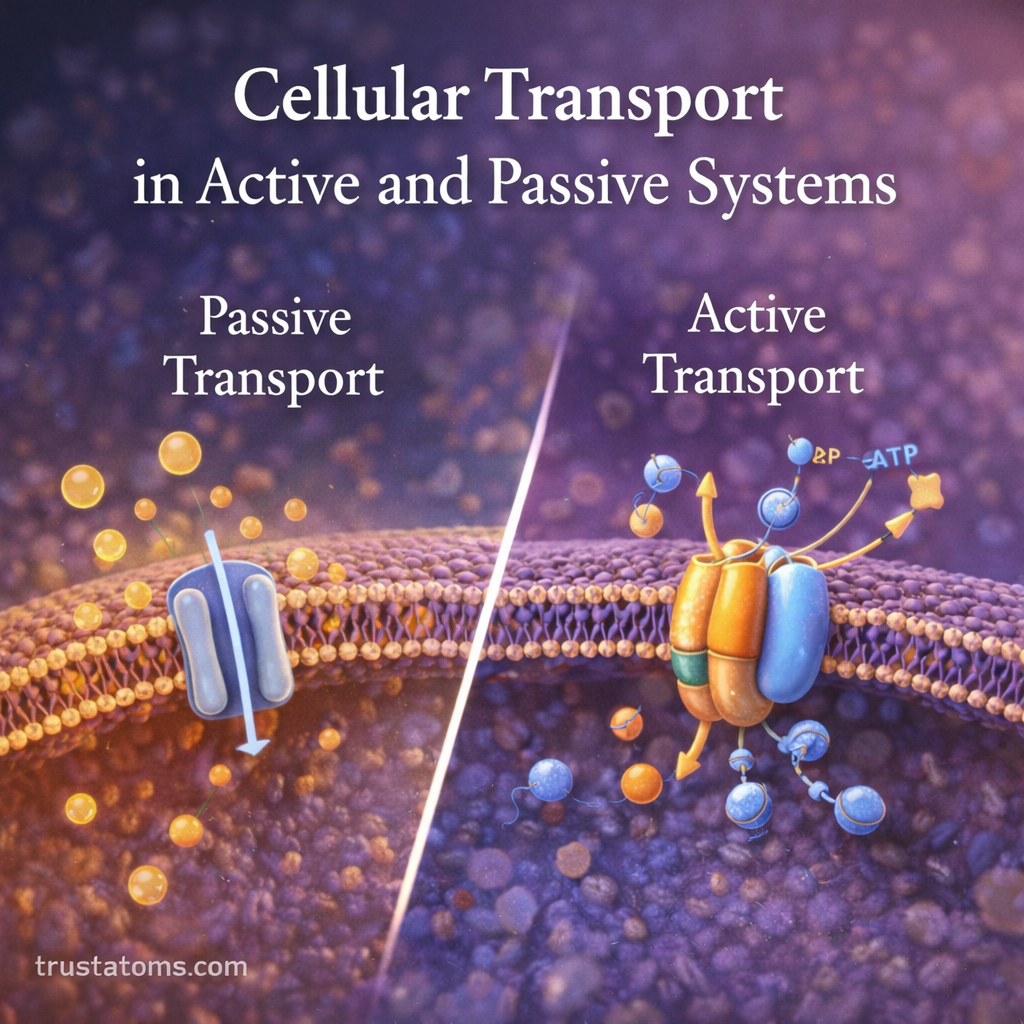
In biology, cellular transport is typically categorized into two major types: passive transport and active transport. Each system uses different strategies to move substances across the membrane.
The Cell Membrane and Selective Permeability
The cell membrane, also called the plasma membrane, is composed mainly of a phospholipid bilayer embedded with proteins. This structure creates a barrier that controls the movement of molecules.
The membrane is described as selectively permeable, meaning:
- Some substances can cross easily
- Others require assistance
- Some are prevented from crossing entirely
Factors that influence transport include:
- Molecule size
- Electrical charge
- Polarity
- Concentration gradients
Transport proteins embedded in the membrane help regulate these movements.
Passive Transport
Passive transport moves substances across the membrane without using cellular energy. Instead, molecules move along their concentration gradient, which means they travel from an area of higher concentration to an area of lower concentration.
Passive transport plays a major role in distributing nutrients and gases within cells.
Types of Passive Transport
Several mechanisms fall under passive transport.
Diffusion
Diffusion is the simplest form of passive transport.
In diffusion:
- Molecules spread from regions of high concentration to low concentration
- No energy or transport proteins are required
- Movement continues until equilibrium is reached
Examples include:
- Oxygen entering cells
- Carbon dioxide leaving cells
Small nonpolar molecules move most easily through diffusion.
Facilitated Diffusion
Some molecules cannot cross the membrane directly because they are too large or charged.
In facilitated diffusion, specialized transport proteins assist molecules across the membrane.
Two types of proteins are involved:
- Channel proteins, which form pores for ions or small molecules
- Carrier proteins, which bind and change shape to move molecules across
Examples include:
- Glucose transport into cells
- Ion movement through membrane channels
Although proteins assist the movement, no cellular energy is required.
Osmosis
Osmosis is the diffusion of water across a selectively permeable membrane.
Water moves toward areas with higher concentrations of dissolved substances.
This process is crucial for maintaining proper cell volume and internal balance.
Cells may experience different osmotic conditions:
- Isotonic solutions – equal solute concentration inside and outside the cell
- Hypotonic solutions – lower solute concentration outside the cell
- Hypertonic solutions – higher solute concentration outside the cell
These conditions influence whether cells swell, shrink, or remain stable.
Active Transport
Active transport moves substances against their concentration gradient, meaning from areas of lower concentration to higher concentration.
Because this movement opposes natural diffusion, the cell must use energy, usually in the form of ATP.
Active transport is essential for maintaining proper internal conditions.
Primary Active Transport
In primary active transport, ATP directly powers the transport process.
Specialized membrane proteins known as pumps move ions or molecules across the membrane.
One of the most well-known examples is the sodium-potassium pump.
This pump:
- Moves sodium ions out of the cell
- Moves potassium ions into the cell
- Uses ATP to power the exchange
The sodium-potassium pump helps maintain electrical gradients needed for nerve impulses and muscle contractions.
Secondary Active Transport
Secondary active transport uses energy indirectly.
Instead of ATP directly powering the transport protein, the process relies on existing ion gradients created by primary active transport.
These systems often move two substances at the same time.
Two major mechanisms exist:
- Symport transporters – move substances in the same direction
- Antiport transporters – move substances in opposite directions
For example, glucose can be transported into cells along with sodium ions through a symport system.
Vesicular Transport
Some molecules are too large to cross the membrane through transport proteins.
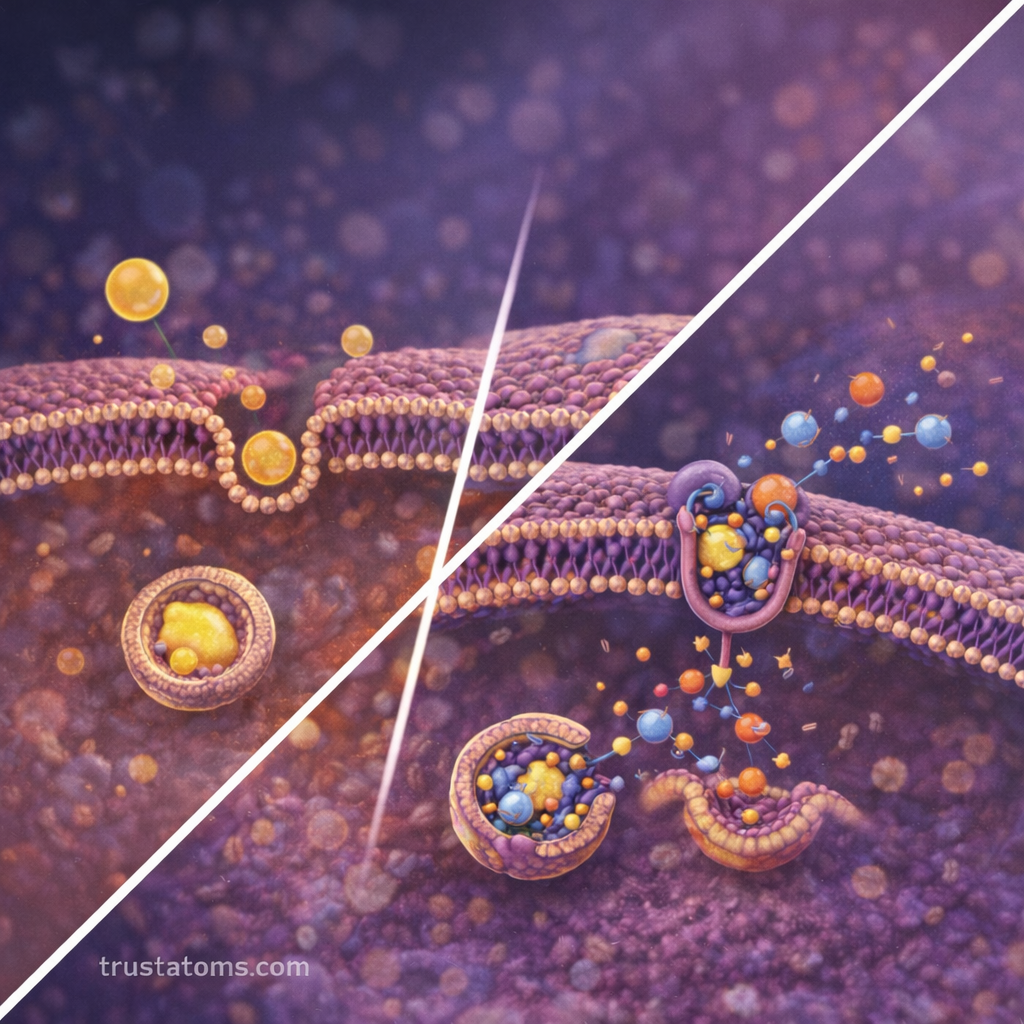
Cells use vesicular transport to move these substances.
This process involves membrane-bound vesicles that carry materials into or out of the cell.
Endocytosis
Endocytosis allows cells to bring materials into the cell.
During this process:
- The membrane folds inward
- A vesicle forms around the material
- The vesicle moves into the cytoplasm
Types of endocytosis include:
- Phagocytosis – engulfing large particles
- Pinocytosis – uptake of fluids
- Receptor-mediated endocytosis – highly selective uptake using receptors
Immune cells often use phagocytosis to destroy pathogens.
Exocytosis
Exocytosis moves materials out of the cell.
In this process:
- Vesicles containing materials move toward the cell membrane
- The vesicle fuses with the membrane
- The contents are released outside the cell
Exocytosis is important for:
- Secretion of hormones
- Release of neurotransmitters
- Export of cellular waste
This system allows cells to communicate with other cells and maintain internal balance.
Comparing Passive and Active Transport
Passive and active transport systems differ primarily in energy usage and direction of movement.
Passive transport characteristics:
- No cellular energy required
- Movement down concentration gradients
- Includes diffusion, facilitated diffusion, and osmosis
Active transport characteristics:
- Requires cellular energy
- Moves substances against concentration gradients
- Uses pumps and transport proteins
Both systems work together to maintain a stable internal environment within the cell.
Why Cellular Transport Is Essential
Cellular transport systems allow cells to survive and function efficiently.
These systems help cells:
- Obtain nutrients
- Remove waste products
- Maintain ion balance
- Control cell volume
- Regulate internal chemical conditions
Without transport systems, cells would quickly lose their ability to maintain homeostasis.
Because these processes are fundamental to life, cellular transport remains a central topic in cell biology, physiology, and biomedical research.