Cells rely on electrical signals to perform many essential biological functions. One of the key electrical properties of cells is the membrane potential, a voltage difference that exists across the cell membrane. This electrical gradient plays a vital role in processes such as nerve signaling, muscle contraction, and ion transport.
Membrane potential arises from differences in ion concentration inside and outside the cell, along with the selective permeability of the cell membrane. By controlling the movement of charged particles, cells create electrical conditions that allow them to communicate and respond to their environment.
Understanding membrane potential is essential for studying physiology, neuroscience, and cellular biology.
What Is Membrane Potential?
Membrane potential refers to the difference in electrical charge between the inside and outside of a cell.
This voltage difference occurs because:
- Certain ions are more concentrated inside the cell
- Others are more concentrated outside the cell
- The cell membrane selectively allows specific ions to move across it
As a result, the inside of the cell typically carries a negative charge relative to the outside.
Membrane potential is usually measured in millivolts (mV).
Most resting cells maintain a membrane potential of approximately:
- –70 mV in neurons
- –90 mV in muscle cells
This electrical gradient forms the foundation for many cellular activities.
The Role of Ions in Membrane Potential
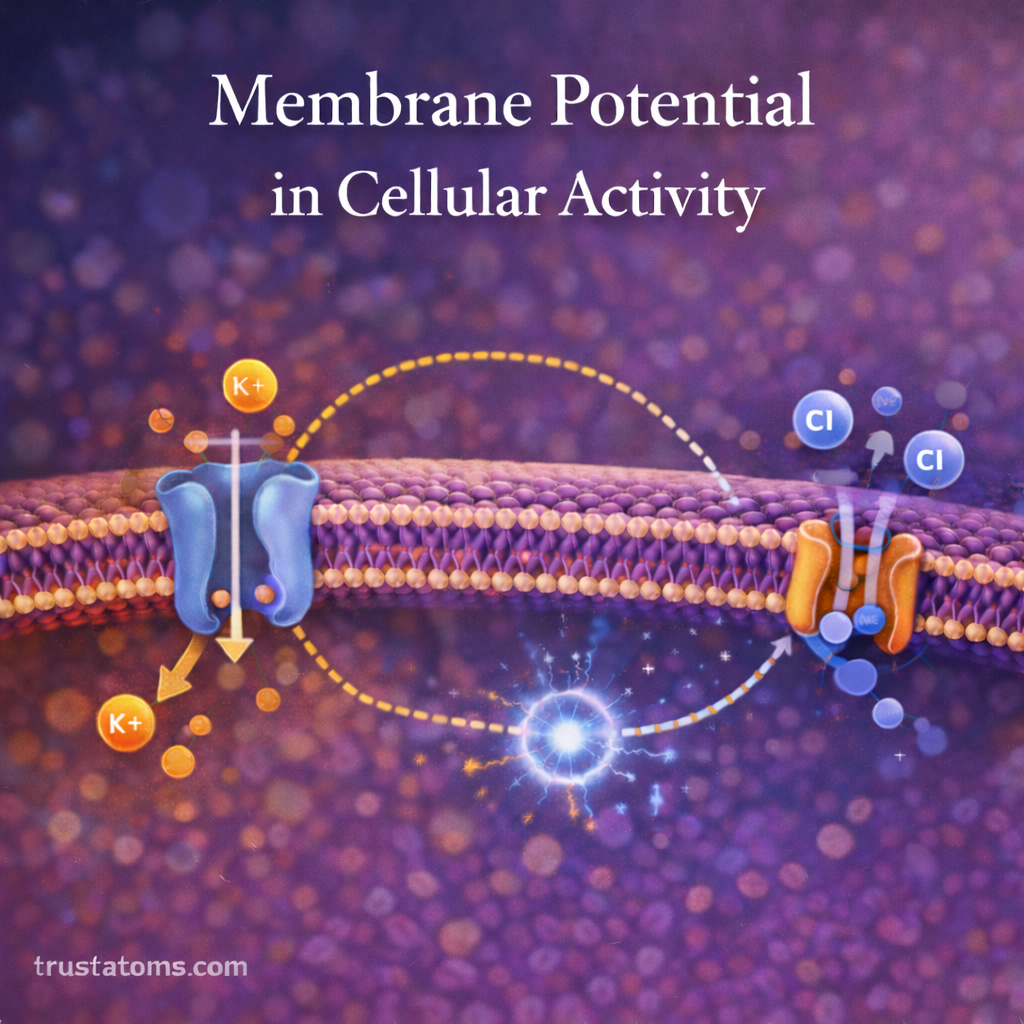
Membrane potential is primarily determined by the distribution of ions across the cell membrane.
Key ions involved include:
- Sodium (Na⁺)
- Potassium (K⁺)
- Calcium (Ca²⁺)
- Chloride (Cl⁻)
These ions move across the membrane through specialized ion channels and transport proteins.
The unequal distribution of these ions generates electrical forces that contribute to membrane potential.
The Sodium-Potassium Pump
One of the most important components maintaining membrane potential is the sodium-potassium pump.
This active transport protein moves ions across the membrane using ATP.
The pump operates through the following cycle:
- Three sodium ions are transported out of the cell.
- Two potassium ions are transported into the cell.
- ATP provides the energy needed for the exchange.
Because more positive charges leave the cell than enter, this process contributes to the negative charge inside the cell.
The sodium-potassium pump is essential for maintaining ion gradients that support electrical activity.
Resting Membrane Potential
The resting membrane potential is the stable electrical charge difference when a cell is not actively sending signals.
Several factors contribute to this resting state:
- Selective permeability of the membrane
- Ion concentration gradients
- Activity of ion pumps
- Leakage of potassium ions through channels
Potassium ions tend to diffuse out of the cell through leak channels, leaving behind negatively charged molecules.
This movement is one of the primary reasons the interior of the cell becomes negatively charged.
Ion Channels and Electrical Signals
Ion channels allow specific ions to move across the membrane.
These channels can open or close in response to different signals.
Common types include:
- Voltage-gated channels – open in response to electrical changes
- Ligand-gated channels – open when molecules bind to receptors
- Mechanically gated channels – respond to physical pressure or stretching
When ion channels open, ions rapidly flow across the membrane, altering the membrane potential.
This rapid change forms the basis of many electrical signals in biological systems.
Action Potentials
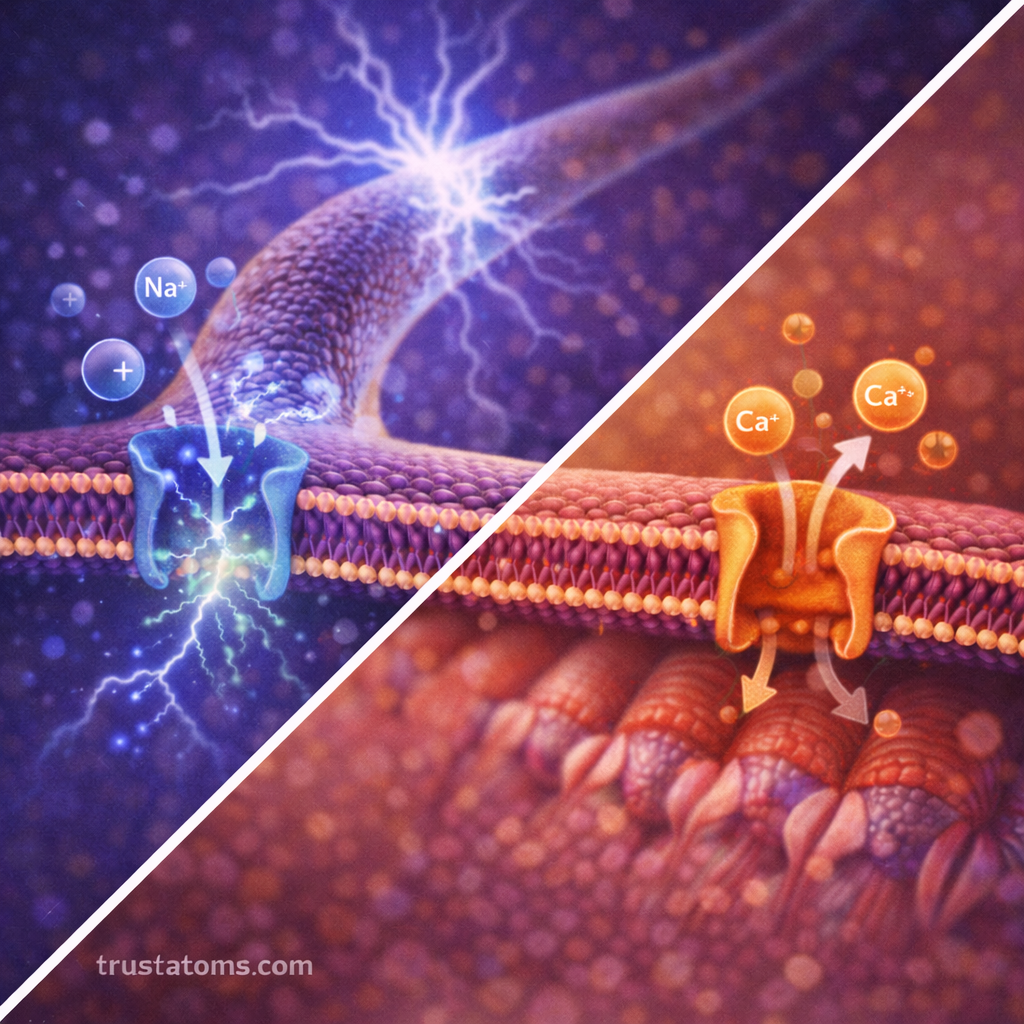
An action potential is a rapid change in membrane potential that allows electrical signals to travel along nerve cells.
This process occurs in several stages.
Depolarization
During depolarization:
- Voltage-gated sodium channels open
- Sodium ions rapidly enter the cell
- The membrane potential becomes more positive
This change triggers the electrical signal.
Repolarization
During repolarization:
- Sodium channels close
- Potassium channels open
- Potassium ions leave the cell
This movement restores the negative membrane potential.
Hyperpolarization
In some cases, potassium ions continue leaving the cell briefly, causing the membrane potential to become slightly more negative than its resting level.
The membrane then returns to its normal resting state.
Membrane Potential in Neurons
Neurons rely heavily on membrane potential to transmit information.
Electrical signals travel along the neuron through action potentials.
These signals allow the nervous system to perform tasks such as:
- Processing sensory information
- Controlling muscle movements
- Coordinating reflexes
- Supporting learning and memory
Without membrane potential, neurons would not be able to transmit signals across long distances in the body.
Membrane Potential in Muscle Cells
Muscle cells also depend on membrane potential to function.
Electrical signals trigger muscle contraction by allowing calcium ions to enter the muscle cell.
This process activates proteins responsible for muscle movement.
Membrane potential therefore plays a central role in activities such as:
- Heartbeats
- Skeletal muscle movement
- Smooth muscle contractions in organs
Regulation of Membrane Potential
Cells must carefully regulate membrane potential to maintain proper function.
Several mechanisms help maintain balance:
- Ion pumps that restore gradients
- Ion channels that regulate ion movement
- Cellular signaling pathways
- Feedback systems that adjust ion flow
If membrane potential becomes unstable, cells may lose their ability to transmit signals effectively.
Membrane Potential and Human Health
Disruptions in membrane potential can lead to serious medical conditions.
Examples include:
- Cardiac arrhythmias, caused by abnormal electrical activity in heart cells
- Epilepsy, involving uncontrolled neuronal firing
- Neurological disorders, linked to ion channel dysfunction
- Muscle disorders, affecting electrical signaling in muscle fibers
Because membrane potential is essential for cellular communication, it is a major focus of research in neuroscience and physiology.
Why Membrane Potential Matters in Biology
Membrane potential allows cells to generate and control electrical signals.
These signals are crucial for:
- Nervous system communication
- Muscle contraction
- Ion balance
- Cellular signaling
- Physiological regulation
By maintaining electrical gradients across membranes, cells can respond rapidly to stimuli and coordinate complex biological processes.
For scientists studying cellular activity, membrane potential provides key insight into how electrical and chemical signals work together to support life.