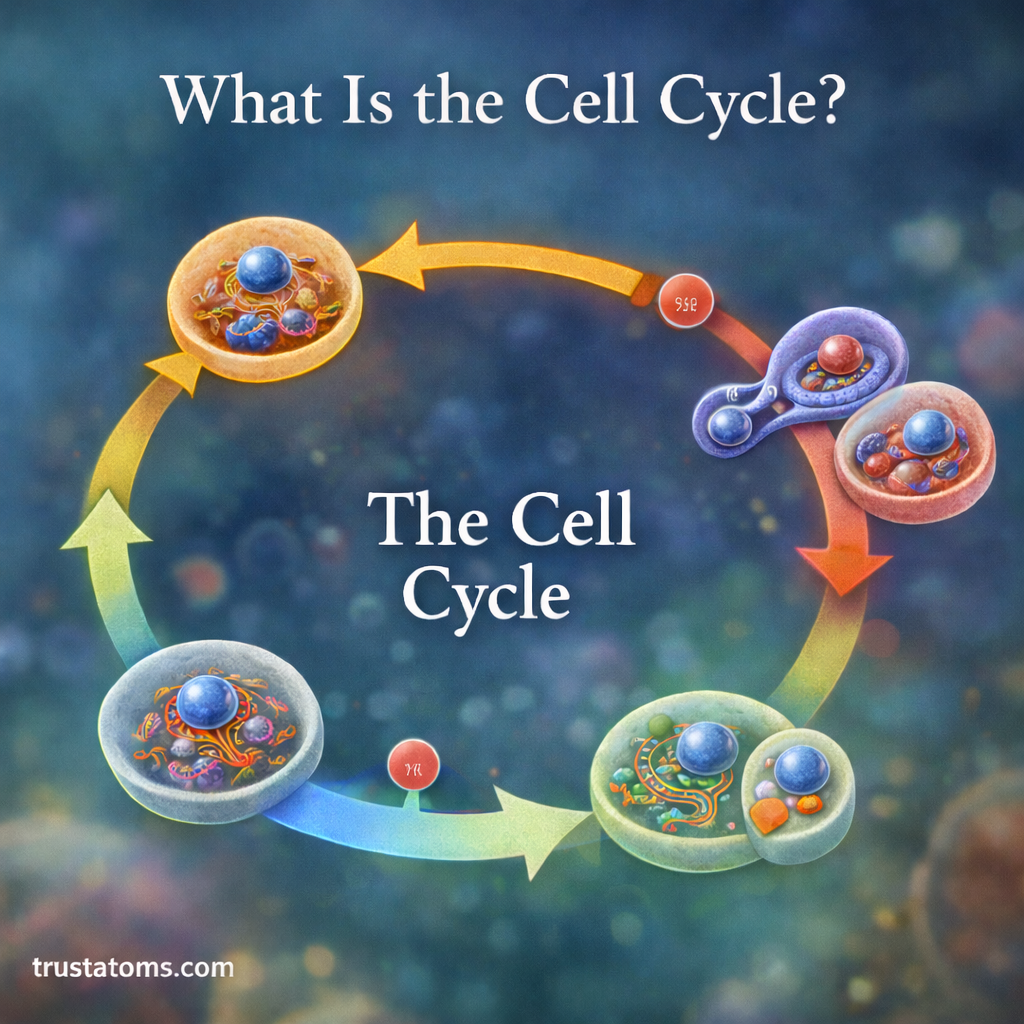
The cell cycle is the series of stages a cell goes through as it grows, prepares to divide, and ultimately produces two new daughter cells. This process is essential for life because it allows organisms to grow, repair damaged tissues, and reproduce.
In multicellular organisms like humans, billions of cells divide every day. The cell cycle ensures that each new cell receives a complete and accurate copy of genetic information. Because of this, the cycle is tightly regulated and carefully controlled.
Understanding the cell cycle helps explain how organisms develop, how tissues regenerate, and why disruptions in this process can lead to diseases such as cancer.
Overview of the Cell Cycle
The cell cycle is a repeating sequence of events that leads to cell division. It includes several stages where the cell grows, copies its DNA, and splits into two cells.
The cycle is divided into two main phases:
- Interphase
- Mitotic phase (M phase)
Interphase occupies most of the cell cycle, while the mitotic phase is when the cell actually divides.
Interphase: The Preparation Stage
Interphase is the longest stage of the cell cycle and is when the cell prepares for division. During this time, the cell grows, carries out its normal functions, and duplicates its genetic material.
Interphase consists of three subphases:
G1 Phase (First Gap Phase)
During the G1 phase, the cell grows and performs its regular metabolic activities.
Key events in G1 include:
- Cell growth
- Production of proteins and enzymes
- Duplication of some cellular components
- Preparation for DNA replication
Cells may remain in G1 for different lengths of time depending on the organism and cell type.
S Phase (Synthesis Phase)
The S phase is when the cell duplicates its DNA.
Each chromosome is copied to produce two identical sister chromatids. These chromatids remain connected until the cell divides.
Important events during S phase include:
- DNA replication
- Chromosome duplication
- Histone protein production
- Preparation for chromosome separation
Accurate DNA replication is critical to ensure that each new cell receives a full set of genetic instructions.
G2 Phase (Second Gap Phase)
The G2 phase is the final preparation stage before cell division.
During this phase, the cell:
- Continues to grow
- Produces proteins required for mitosis
- Checks DNA for errors
- Prepares structures needed for chromosome separation
Cells use molecular checkpoints during this stage to ensure that DNA replication has occurred correctly.
The Mitotic Phase (M Phase)
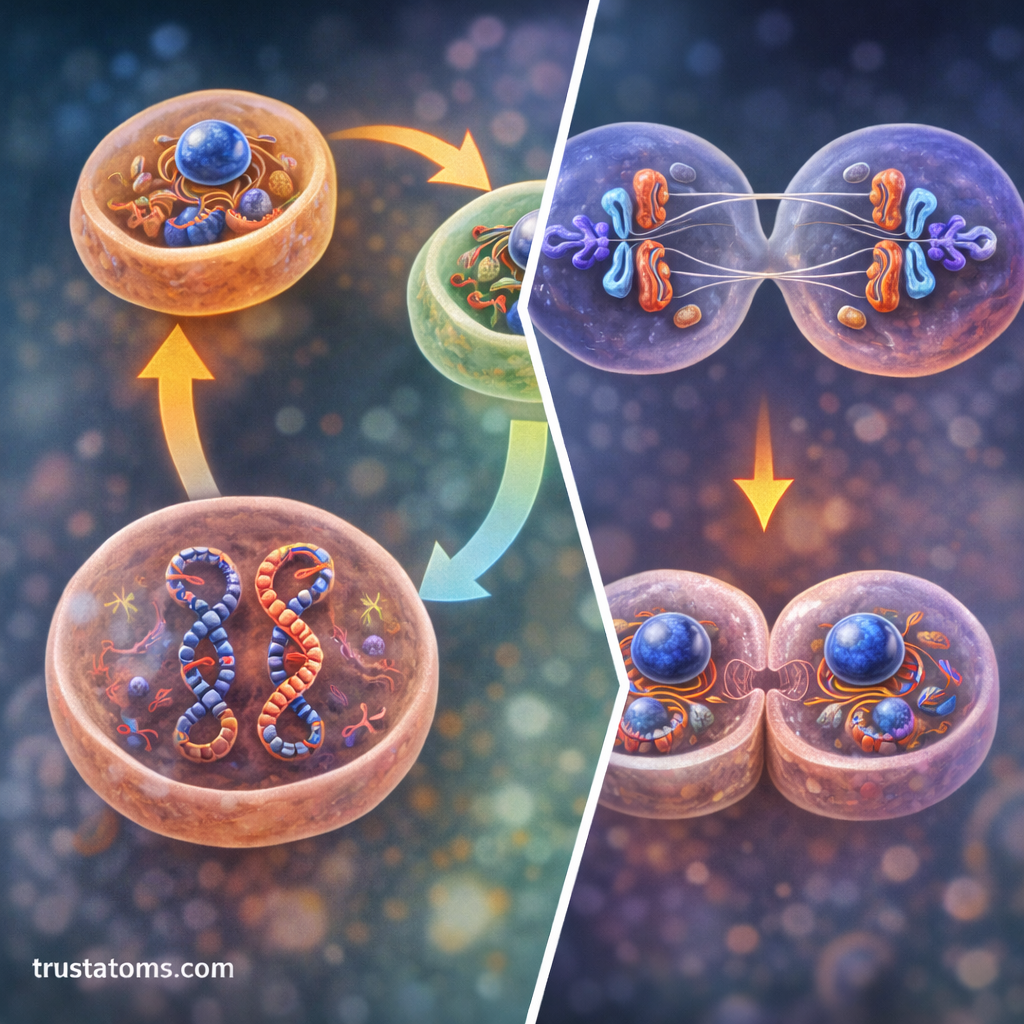
The mitotic phase is when the cell divides into two daughter cells. It includes two main processes:
- Mitosis (division of the nucleus)
- Cytokinesis (division of the cytoplasm)
Together, these processes create two genetically identical cells.
Stages of Mitosis
Mitosis occurs in several organized stages that ensure chromosomes are evenly distributed.
Prophase
In prophase, the chromosomes condense and become visible under a microscope.
Key events include:
- Chromosomes condense into compact structures
- The nuclear membrane begins to break down
- Spindle fibers start forming
Spindle fibers will later help separate the chromosomes.
Metaphase
During metaphase, chromosomes align along the center of the cell.
Important characteristics include:
- Chromosomes line up at the metaphase plate
- Spindle fibers attach to each chromosome
- The cell prepares for chromosome separation
This alignment ensures equal distribution of genetic material.
Anaphase
In anaphase, the sister chromatids separate and move toward opposite ends of the cell.
Key events include:
- Spindle fibers shorten
- Chromatids are pulled apart
- Each half of the cell receives identical chromosomes
This stage guarantees that both daughter cells receive the same genetic information.
Telophase
Telophase marks the end of nuclear division.
During this stage:
- New nuclear membranes form around each set of chromosomes
- Chromosomes begin to uncoil
- The spindle apparatus breaks down
Two nuclei are now present within the same cell.
Cytokinesis: Dividing the Cell
After mitosis, cytokinesis divides the cell’s cytoplasm.
This process results in two separate daughter cells.
In animal cells, cytokinesis typically occurs through a cleavage furrow, where the cell membrane pinches inward until the cell splits in two.
In plant cells, a cell plate forms in the center of the cell and develops into a new cell wall separating the two daughter cells.
Cell Cycle Checkpoints
Cells use regulatory checkpoints to ensure the cell cycle proceeds correctly.
These checkpoints prevent damaged or incomplete cells from dividing.
Major checkpoints include:
G1 Checkpoint
Determines whether the cell has enough resources and whether DNA is undamaged before replication.
G2 Checkpoint
Ensures that DNA replication has been completed successfully.
M Checkpoint
Confirms that chromosomes are properly attached to spindle fibers before separation.
These safeguards help maintain genetic stability.
Why the Cell Cycle Is Important
The cell cycle plays a crucial role in maintaining life and biological organization.
Its functions include:
- Growth and development of organisms
- Tissue repair and regeneration
- Replacement of damaged or dead cells
- Asexual reproduction in some organisms
Without a properly functioning cell cycle, organisms could not grow or maintain healthy tissues.
Cell Cycle and Disease
When the regulation of the cell cycle fails, cells may divide uncontrollably.
This uncontrolled division is a key feature of cancer.
Cancer cells often bypass normal checkpoints and continue dividing even when DNA is damaged. Because of this, many cancer treatments target proteins that regulate the cell cycle.
Research into the cell cycle has helped scientists develop therapies that slow or stop abnormal cell division.
Final Thoughts
The cell cycle is one of the most fundamental processes in biology. Through carefully regulated stages, cells grow, duplicate their genetic material, and divide into new cells.
From early development to tissue repair, the cell cycle supports life by ensuring that cells replicate accurately and efficiently.
By studying this process, scientists gain valuable insights into how organisms grow, how diseases develop, and how cellular functions are maintained at the microscopic level.