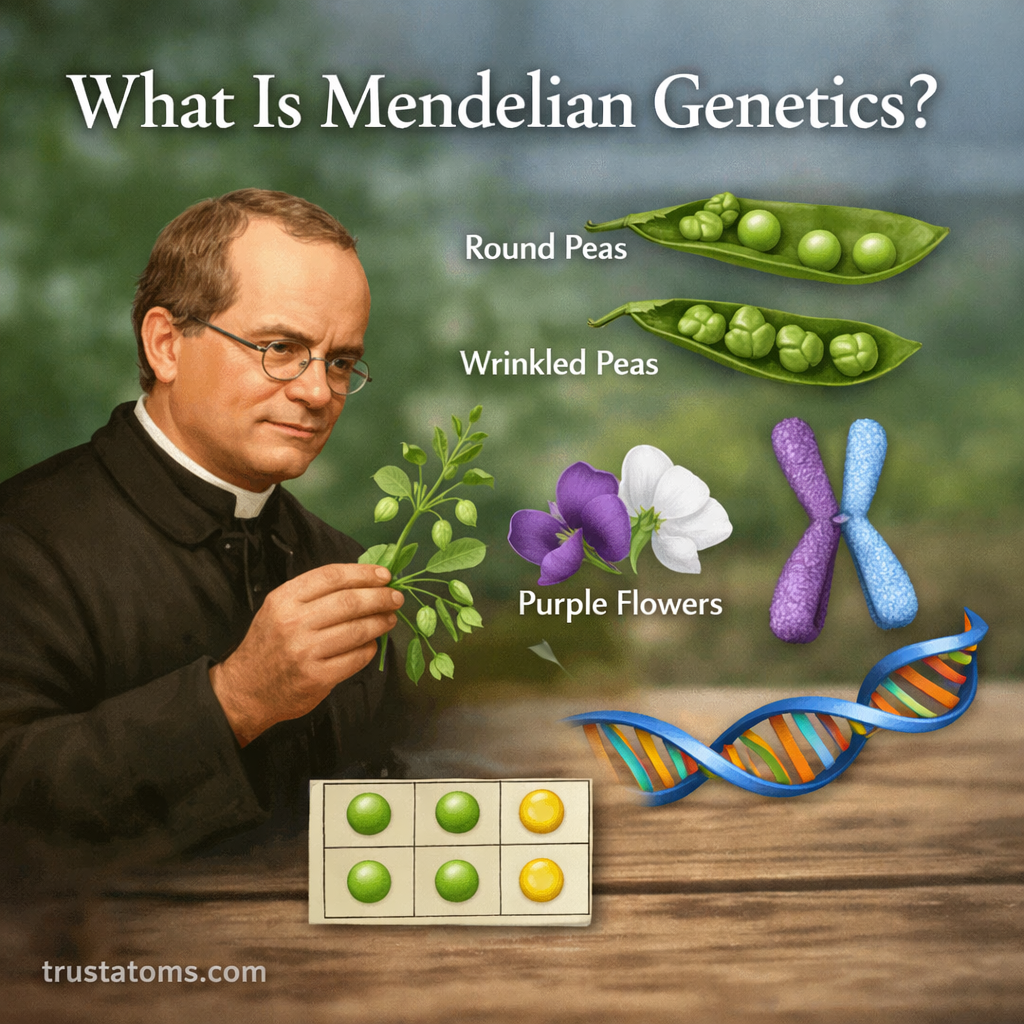
Mendelian genetics is the study of how traits are passed from parents to offspring according to principles first discovered by Austrian monk and scientist Gregor Mendel in the 1800s. By carefully breeding pea plants and observing their traits across generations, Mendel uncovered patterns of inheritance that form the foundation of modern genetics.
These patterns explain how characteristics such as eye color, flower color, or seed shape can be inherited through discrete units called genes. Mendel’s work introduced the concepts of dominant and recessive traits and demonstrated that inheritance follows predictable rules.
Today, Mendelian genetics remains one of the most important frameworks for understanding how genes influence biological traits in plants, animals, and humans.
The Origins of Mendelian Genetics
Gregor Mendel conducted experiments in the mid-19th century using garden pea plants (Pisum sativum). He chose peas because they grow quickly, reproduce easily, and have clearly distinguishable traits.
Some of the traits Mendel studied included:
- Flower color (purple or white)
- Seed shape (round or wrinkled)
- Seed color (yellow or green)
- Pod shape (inflated or constricted)
- Plant height (tall or short)
By controlling pollination between plants and tracking traits over several generations, Mendel observed consistent inheritance patterns.
From these observations, he proposed that traits are controlled by factors (now known as genes) that are passed from parents to offspring in predictable ways.
What Are Genes and Alleles?
In Mendelian genetics, traits are determined by genes, which are segments of DNA that contain instructions for specific biological characteristics.
Each gene can exist in different versions called alleles.
For example:
- A gene for flower color may have a purple allele and a white allele.
- A gene for seed shape may have round or wrinkled alleles.
Organisms inherit two alleles for each gene:
- One allele from the mother
- One allele from the father
The combination of these alleles determines the organism’s genetic makeup for that trait.
Dominant and Recessive Traits
One of Mendel’s most important discoveries was that some alleles dominate others when determining a trait.
Dominant Alleles
A dominant allele expresses its trait even if only one copy is present.
Example:
- Purple flower allele (dominant)
- If a plant has one purple allele and one white allele, the flowers appear purple.
Recessive Alleles
A recessive allele only appears if two copies are present.
Example:
- White flower allele (recessive)
- A plant must inherit two white alleles to produce white flowers.
If a dominant and recessive allele are present together, the dominant trait will mask the recessive one.
Genotype vs Phenotype
Mendelian genetics distinguishes between two key concepts:
Genotype
The genotype refers to the genetic makeup of an organism.
Examples include:
- AA
- Aa
- aa
These letters represent combinations of alleles inherited from parents.
Phenotype
The phenotype refers to the observable physical trait.
Examples include:
- Purple flowers
- White flowers
- Tall plants
- Short plants
Different genotypes can sometimes produce the same phenotype if a dominant allele is present.
Mendel’s Three Laws of Inheritance
Mendel summarized his discoveries into three fundamental laws that explain how genes are inherited.
1. Law of Segregation
The Law of Segregation states that organisms carry two alleles for each trait, but these alleles separate during the formation of reproductive cells (gametes).
This means:
- Each parent passes only one allele for each gene to their offspring.
Example:
If a plant has genotype Aa, it can pass either:
- A allele
- a allele
Each offspring receives one allele from each parent.
2. Law of Independent Assortment
The Law of Independent Assortment states that genes for different traits are inherited independently of each other.
For example:
The inheritance of seed color does not influence the inheritance of seed shape.
This allows for many combinations of traits in offspring.
However, modern genetics has shown that this law mainly applies to genes located on different chromosomes or far apart on the same chromosome.
3. Law of Dominance
The Law of Dominance states that when two different alleles are present, the dominant allele determines the phenotype.
Example:
- A = dominant allele
- a = recessive allele
Possible outcomes:
- AA → dominant trait
- Aa → dominant trait
- aa → recessive trait
This explains why recessive traits may disappear for a generation and then reappear later.
Mendelian Crosses
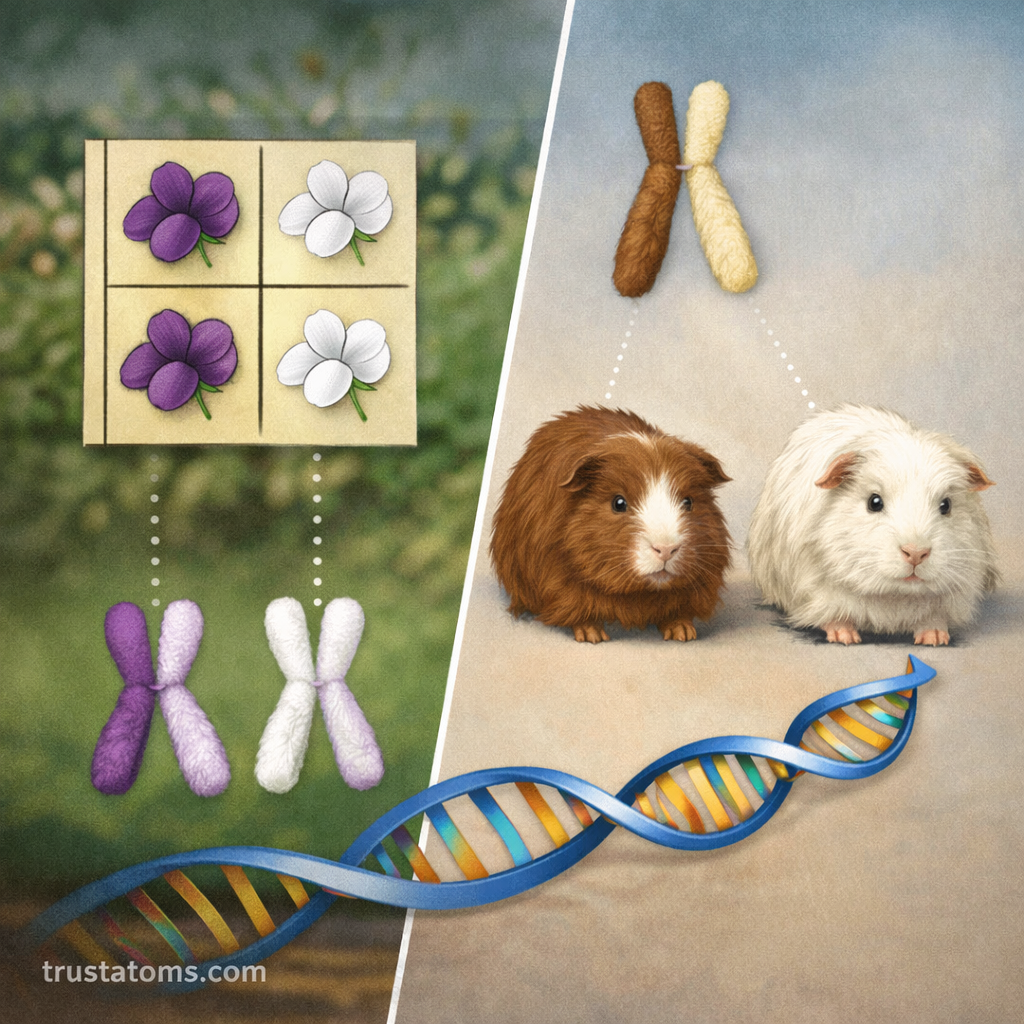
Mendelian genetics often studies inheritance using breeding experiments called genetic crosses.
These crosses examine how traits pass from parents to offspring.
Monohybrid Cross
A monohybrid cross studies the inheritance of a single trait.
Example:
Plant height:
- T = tall (dominant)
- t = short (recessive)
Cross:
Tt × Tt
Possible offspring genotypes:
- TT
- Tt
- Tt
- tt
Resulting ratio:
- 3 tall plants
- 1 short plant
This 3:1 ratio is a classic Mendelian inheritance pattern.
Dihybrid Cross
A dihybrid cross examines two traits simultaneously.
Example:
- Seed color (Y = yellow, y = green)
- Seed shape (R = round, r = wrinkled)
Cross:
YyRr × YyRr
Possible phenotypic ratio:
- 9 yellow round
- 3 yellow wrinkled
- 3 green round
- 1 green wrinkled
This 9:3:3:1 ratio illustrates the Law of Independent Assortment.
Real-World Examples of Mendelian Traits
Many simple traits in living organisms follow Mendelian inheritance patterns.
Examples include:
Human Traits
Some traits influenced by single genes include:
- Widow’s peak hairline
- Attached vs detached earlobes
- Ability to taste certain bitter compounds
- Some genetic diseases (e.g., cystic fibrosis, Huntington’s disease)
Plant Traits
In plants, Mendelian inheritance can determine:
- Flower color
- Fruit shape
- Seed texture
Animal Traits
Examples include:
- Coat color in mice
- Fur patterns in rabbits
- Eye color variations in fruit flies
However, not all traits follow simple Mendelian patterns.
When Mendelian Genetics Does Not Apply
Modern genetics has revealed that many traits are more complex than Mendel originally observed.
Some exceptions include:
Incomplete Dominance
In incomplete dominance, neither allele completely dominates.
Example:
- Red flower × White flower → Pink flower
Codominance
Both alleles are expressed simultaneously.
Example:
Human blood type AB expresses both A and B alleles.
Polygenic Traits
Some traits are controlled by multiple genes.
Examples include:
- Human height
- Skin color
- Intelligence
These traits show continuous variation rather than simple dominant/recessive patterns.
Why Mendelian Genetics Is Important
Mendelian genetics forms the foundation of modern genetics and molecular biology.
Its importance includes:
Understanding Heredity
It explains how traits pass through generations.
Predicting Genetic Outcomes
Scientists can predict probabilities of inherited traits in offspring.
Medical Genetics
Mendelian inheritance helps doctors understand genetic diseases and inheritance risks.
Agricultural Science
Plant breeders use Mendelian principles to develop crops with desired traits.
Mendelian Genetics and Modern Biology
Although modern genetics has expanded far beyond Mendel’s original discoveries, his principles still serve as the starting point for studying inheritance.
Advances such as:
- DNA sequencing
- Genome mapping
- Genetic engineering
- CRISPR gene editing
all build upon the fundamental idea that genes carry hereditary information.
Mendel’s work helped transform biology from a descriptive science into one grounded in mathematical and experimental principles.
Final Thoughts
Mendelian genetics explains how traits are inherited through genes and alleles using predictable patterns. Through experiments with pea plants, Gregor Mendel discovered the principles of dominance, segregation, and independent assortment, which continue to shape our understanding of heredity.
While many biological traits involve more complex genetic interactions, Mendel’s laws remain essential for learning how genes function and how genetic information passes from one generation to the next.
From agriculture to medicine to evolutionary biology, Mendelian genetics remains one of the most influential scientific discoveries in the study of life.