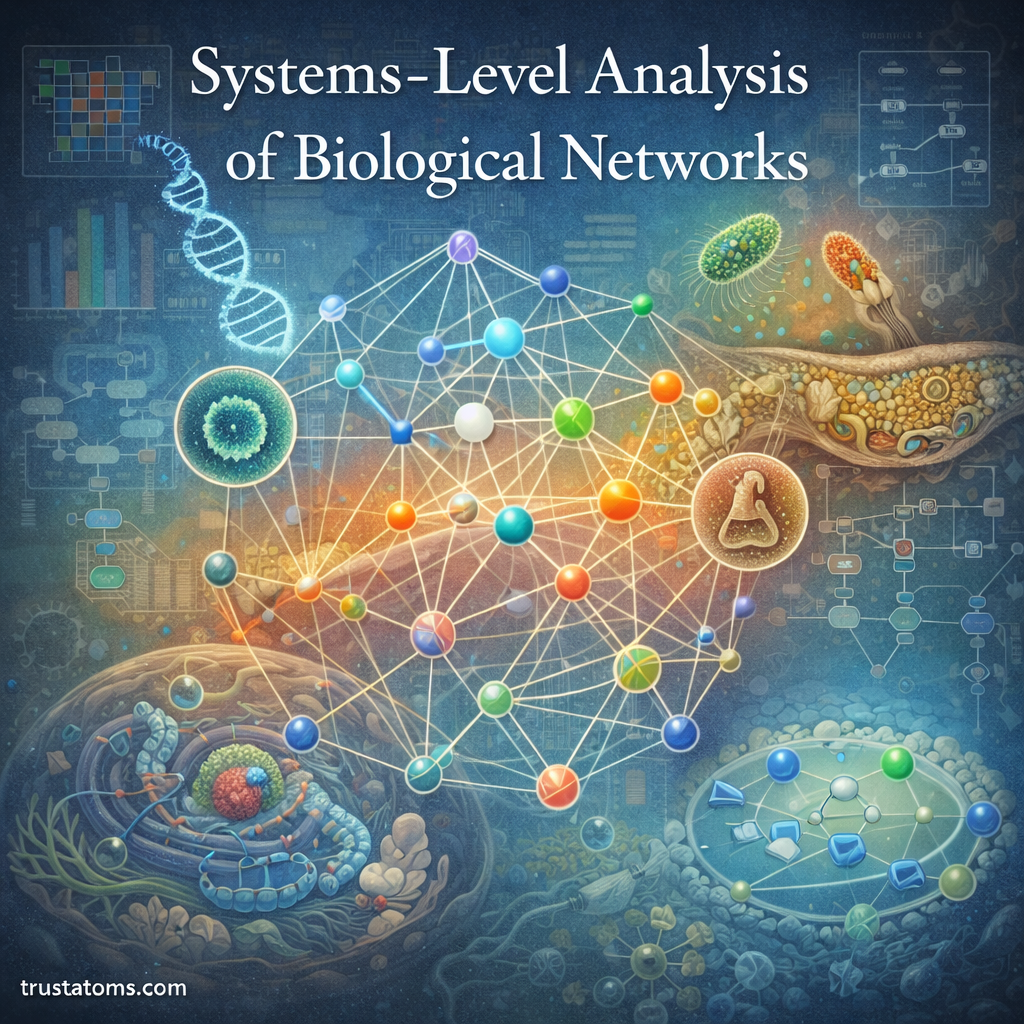
Biological network analysis is the study of how genes, proteins, and other components of living cells interact to produce biological functions. Instead of examining each molecule separately, scientists map the connections between them to understand how cells operate as coordinated systems. This approach builds on fundamental concepts in the study of biology and uses computational tools to investigate relationships that are difficult to observe individually.
Systems-level analysis of biological networks is a core approach in modern systems biology. By examining the complex interactions among genes, proteins, metabolites, and regulatory pathways, researchers can identify patterns, predict system behavior, and understand how biological processes emerge from interconnected components.
For example, when a cell receives a growth signal, multiple proteins may activate one another, alter gene expression, and influence whether the cell divides. Studying the entire network helps researchers understand how these events are coordinated and what happens when part of the process malfunctions.
What Are Biological Networks?
A biological network is a representation of relationships among biological components. Scientists use networks to organize information about interactions within cells, tissues, or larger biological systems.
Most network diagrams contain two basic elements:
- Nodes: Individual components such as genes, proteins, metabolites, or cells.
- Edges: Connections representing interactions or relationships between components.
For example, two proteins that physically bind to each other can be represented by connected nodes. Researchers studying Protein–Protein Interactions use these connections to investigate molecular complexes, signaling pathways, and cellular functions.
Not every connection represents physical contact. An edge might instead describe a regulatory influence, a chemical reaction, or a statistical association. Understanding what each connection means is necessary for interpreting a network correctly.
The Four Main Types of Biological Networks
Biological networks can be classified according to the components and relationships being studied. Four common types help explain different aspects of cellular activity.
Gene Regulatory Networks
Gene regulatory networks describe how gene expression is controlled. Regulatory proteins called transcription factors can bind to specific DNA regions and increase or decrease the transcription of particular genes.
These networks help explain how cells with similar genetic information can develop different functions, such as muscle cells and nerve cells. They also help researchers investigate responses to stress, immune signals, and developmental changes.
Protein Interaction Networks
Proteins often work together rather than independently. Some form molecular complexes, while others interact temporarily to transmit signals or regulate biochemical reactions.
Mapping these interactions can reveal groups of proteins involved in particular cellular functions. Researchers can also examine how a disrupted interaction might interfere with a biological process.
Metabolic Networks
Metabolic networks represent the chemical reactions through which cells process nutrients, release usable energy, and produce essential molecules. Enzymes catalyze reactions that convert starting substances into products.
Examples include glycolysis, the citric acid cycle, and pathways involved in fatty acid metabolism. Because many reactions share intermediate molecules, a change in one pathway can influence others.
Cellular Signaling Networks
Signaling networks allow cells to detect and respond to information. A signal may bind to a receptor, activating a series of proteins that ultimately changes enzyme activity, gene expression, or cell behavior.
These networks regulate processes such as growth, immune responses, and programmed cell death, also called apoptosis. Their interconnected structure allows cells to respond differently depending on the signals they receive.
How Network Structure Influences Cell Behavior
Two networks containing similar components may behave differently if their connections are organized differently. Researchers therefore study network structure alongside the biological activity of individual components.
Hubs and Highly Connected Components
A hub is a node with many connections. In a protein interaction network, a hub protein may interact with numerous other proteins. In a regulatory network, a transcription factor may influence several genes.
Highly connected components can influence multiple processes, although having many connections does not automatically make a molecule essential. Its biological importance must be established through additional evidence.
Modules and Functional Groups
Network modules are groups of components that interact more closely with one another than with the rest of the network. They may correspond to protein complexes, regulatory circuits, or related metabolic reactions.
Cellular Network Modeling helps researchers examine these structures and test how changes in particular components could affect cellular behavior.
Scientists also investigate Integrated Biological Network Systems to understand how gene regulation, protein interactions, and metabolism connect across different levels of biological organization.
Feedback Loops
Feedback occurs when the output of a biological process influences the process itself. Negative feedback counteracts changes and can help maintain stable conditions. Positive feedback reinforces changes and can produce stronger responses or transitions between cellular states.
These mechanisms help explain how cells maintain homeostasis while remaining capable of responding to new conditions.
How Scientists Analyze Biological Networks
Collecting Biological Data

Researchers begin by collecting information about biological components and their interactions. High-throughput technologies allow scientists to measure many molecules within a single experiment.
- DNA sequencing: Identifies genetic sequences and variations.
- RNA sequencing: Measures RNA abundance to investigate gene expression.
- Proteomics: Examines proteins, their abundance, and sometimes their interactions or modifications.
- Metabolomics: Measures small molecules involved in cellular metabolism.
These methods provide complementary information. However, measuring two molecules together does not necessarily demonstrate that they interact directly.
Building and Testing Network Models
Scientists combine experimental observations with existing biological knowledge to construct networks. Computational tools can identify highly connected nodes, detect modules, compare conditions, and simulate changes.
Researchers then test predictions using additional experiments. This distinction matters because a computationally predicted interaction is not the same as an experimentally confirmed relationship.
Real-World Example: Analyzing Insulin Signaling
Insulin signaling provides a practical example of how biological network analysis connects molecular events to cellular behavior.
When insulin binds to its receptor on certain cells, it activates a signaling network that helps regulate glucose metabolism. Researchers can represent this process as connected molecular components:
- Signal detection: Insulin binds to the insulin receptor at the cell surface.
- Signal transmission: Receptor activation influences intracellular proteins, including insulin receptor substrates and components of the PI3K-Akt pathway.
- Cellular response: In muscle and fat cells, signaling promotes movement of GLUT4 glucose transporters to the cell membrane.
- Glucose uptake: Increased GLUT4 availability allows these cells to take up more glucose from their surroundings.
A researcher could compare signaling measurements from insulin-responsive and insulin-resistant cells. Network analysis might reveal altered activity in particular pathways, helping identify mechanisms worth investigating experimentally.
The example also shows why individual molecules cannot always explain a biological outcome. Receptor activity, downstream signaling, transporter movement, and metabolic regulation must work together to produce the response.
Applications in Disease Research and Biotechnology
Biological network analysis helps scientists investigate how disruptions in molecular interactions contribute to disease. In cancer research, for example, researchers examine networks controlling cell division, DNA damage responses, and survival signaling.
Network information can also help identify potential drug targets and investigate how a treatment might affect several pathways. These predictions require laboratory testing and clinical evaluation before they can support treatment decisions.
Metabolic research provides another application. Systems-Level Regulation of Metabolism examines how cells coordinate interconnected biochemical pathways in response to nutrient availability and changing energy demands.
In biotechnology, researchers use network models to investigate how modifying enzymes or regulatory pathways might improve microbial production of useful chemicals, pharmaceuticals, or other biological products.
Limitations of Biological Network Analysis
Biological networks are useful representations, but they are not complete copies of living systems. Several limitations affect how confidently researchers can interpret them.
- Incomplete information: Many molecular interactions remain unknown or insufficiently characterized.
- Measurement uncertainty: Experimental noise and differences between methods can affect network construction.
- Changing conditions: Interactions may differ between cell types, developmental stages, and environmental conditions.
- Correlation versus causation: A statistical association between components does not prove that one directly controls another.
Researchers address these challenges by combining multiple data sources, checking model assumptions, and validating important predictions experimentally. Artificial intelligence and multi-omics approaches may improve network reconstruction, but their results still require careful evaluation.
Frequently Asked Questions
What is the purpose of biological network analysis?
Its purpose is to understand how interacting biological components collectively produce cellular functions. Researchers use network analysis to identify patterns, investigate regulatory mechanisms, generate predictions, and study how disruptions affect biological systems.
What is the difference between a biological pathway and a network?
A biological pathway usually describes a defined sequence or group of related molecular events, such as reactions in glycolysis. A biological network represents a broader collection of connections that may include multiple overlapping pathways, branches, and feedback loops.
Can biological network analysis help develop new medicines?
Yes. Network analysis can help researchers identify disease-associated pathways, prioritize possible drug targets, and predict interactions that deserve further investigation. It supports drug discovery research but does not independently establish whether a treatment is safe or effective.
Biological network analysis connects molecular measurements with the larger processes that allow cells to function. By examining interactions among genes, proteins, metabolites, and signaling pathways, scientists can investigate how coordinated cellular responses arise and how disruptions may contribute to disease. Its strongest conclusions come from combining computational models with reliable experimental evidence.
Sources: National Center for Biotechnology Information, Bookshelf resources on systems biology; National Human Genome Research Institute, Genomics and Systems Biology resources; Uri Alon, An Introduction to Systems Biology: Design Principles of Biological Circuits.