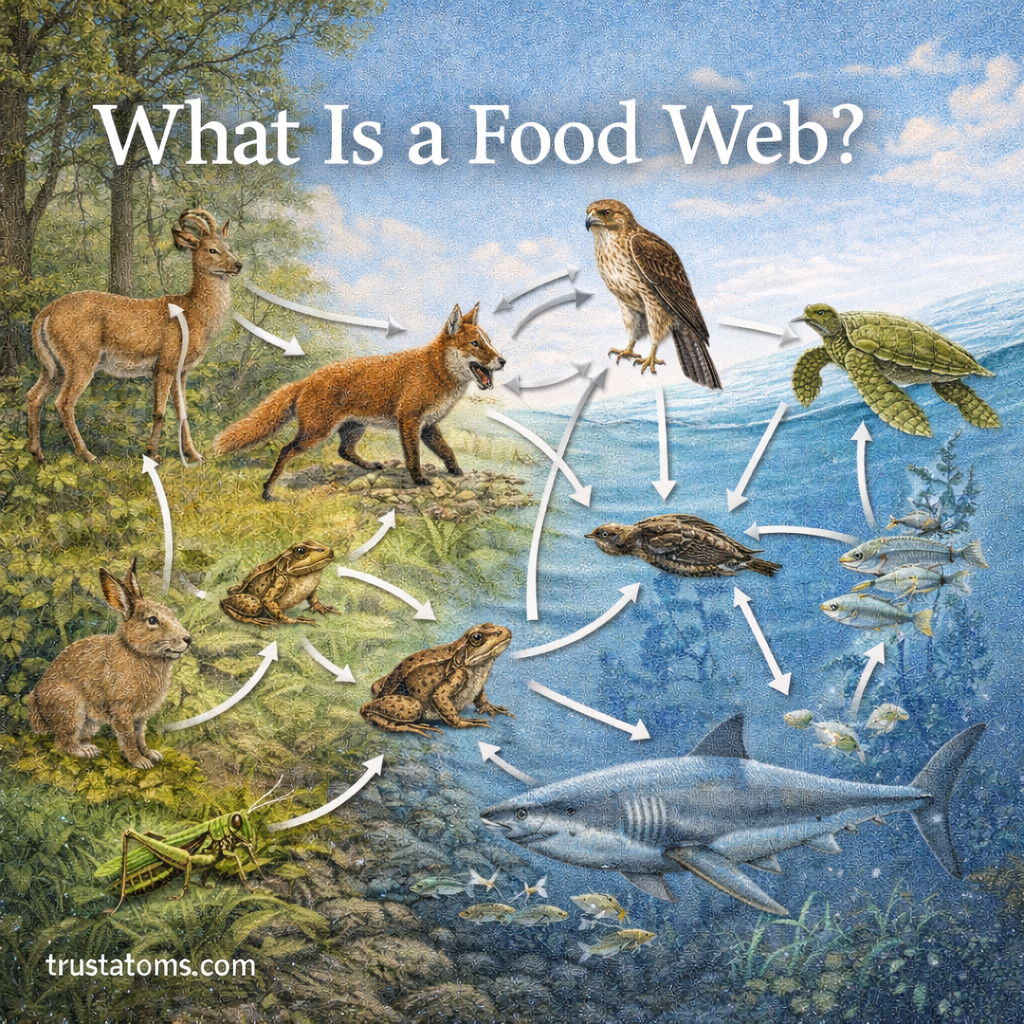
A food web is a network of interconnected food chains that shows how energy and nutrients move through an ecosystem. Instead of a single pathway of energy flow, a food web illustrates the many feeding relationships that exist between organisms.
In nature, most species eat more than one type of food and are eaten by multiple predators. Because of this complexity, ecosystems function through food webs rather than simple food chains.
Understanding food webs helps scientists study biodiversity, ecosystem stability, and how environmental changes affect the balance of life.
The Basic Definition of a Food Web
In biology, a food web is a diagram that shows the feeding connections between organisms in an ecosystem.
Unlike a food chain, which shows a single path of energy transfer, a food web shows multiple overlapping food chains.
For example, in a grassland ecosystem:
- Grass may be eaten by rabbits, insects, and deer.
- Rabbits may be eaten by foxes, hawks, or snakes.
- Foxes may also eat insects or small birds.
These interconnected relationships form a complex web of energy transfer.
The Main Components of a Food Web
Food webs include several categories of organisms that occupy different roles in energy flow.
Producers
Producers form the base of every food web. They create energy through photosynthesis by converting sunlight into chemical energy.
Examples of producers include:
- Plants
- Algae
- Phytoplankton
Because producers generate energy for ecosystems, they support all other organisms in the web.
Primary Consumers
Primary consumers are herbivores that eat producers.
Examples include:
- Rabbits
- Grasshoppers
- Deer
- Zooplankton
These organisms transfer energy from plants to higher levels of the food web.
Secondary Consumers
Secondary consumers eat herbivores and may also consume smaller predators.
Examples include:
- Frogs
- Small fish
- Lizards
- Birds that eat insects
These organisms occupy a middle position within the food web.
Tertiary Consumers
Tertiary consumers are larger predators that eat other carnivores or omnivores.
Examples include:
- Snakes
- Larger fish
- Hawks
- Owls
They help regulate populations of smaller animals.
Apex Predators
Apex predators sit at the top of the food web and typically have no natural predators.
Examples include:
- Lions
- Wolves
- Sharks
- Eagles
These predators play an important role in maintaining ecosystem balance.
Decomposers
Decomposers break down dead plants, animals, and waste material.
Examples include:
- Fungi
- Bacteria
- Certain insects
Decomposers recycle nutrients back into the soil or water, allowing producers to grow again.
Food Webs vs Food Chains
Food chains and food webs both show how energy flows through ecosystems, but they differ in complexity.
Food Chain
A food chain represents a single pathway of energy flow.
Example:
- Grass
- Grasshopper
- Frog
- Snake
- Hawk
Food Web
A food web represents multiple interconnected food chains.
In a food web:
- One species may eat many types of food.
- One organism may have several predators.
- Energy moves through many pathways.
Food webs provide a more realistic representation of natural ecosystems.
Why Food Webs Are Important
Food webs are important because they show how species depend on each other for survival.
They help scientists understand:
- Predator–prey relationships
- Energy flow through ecosystems
- Population balance
- Ecosystem resilience
Because ecosystems contain many interconnected relationships, food webs help explain why changes to one species can affect many others.
Food Webs in Different Ecosystems
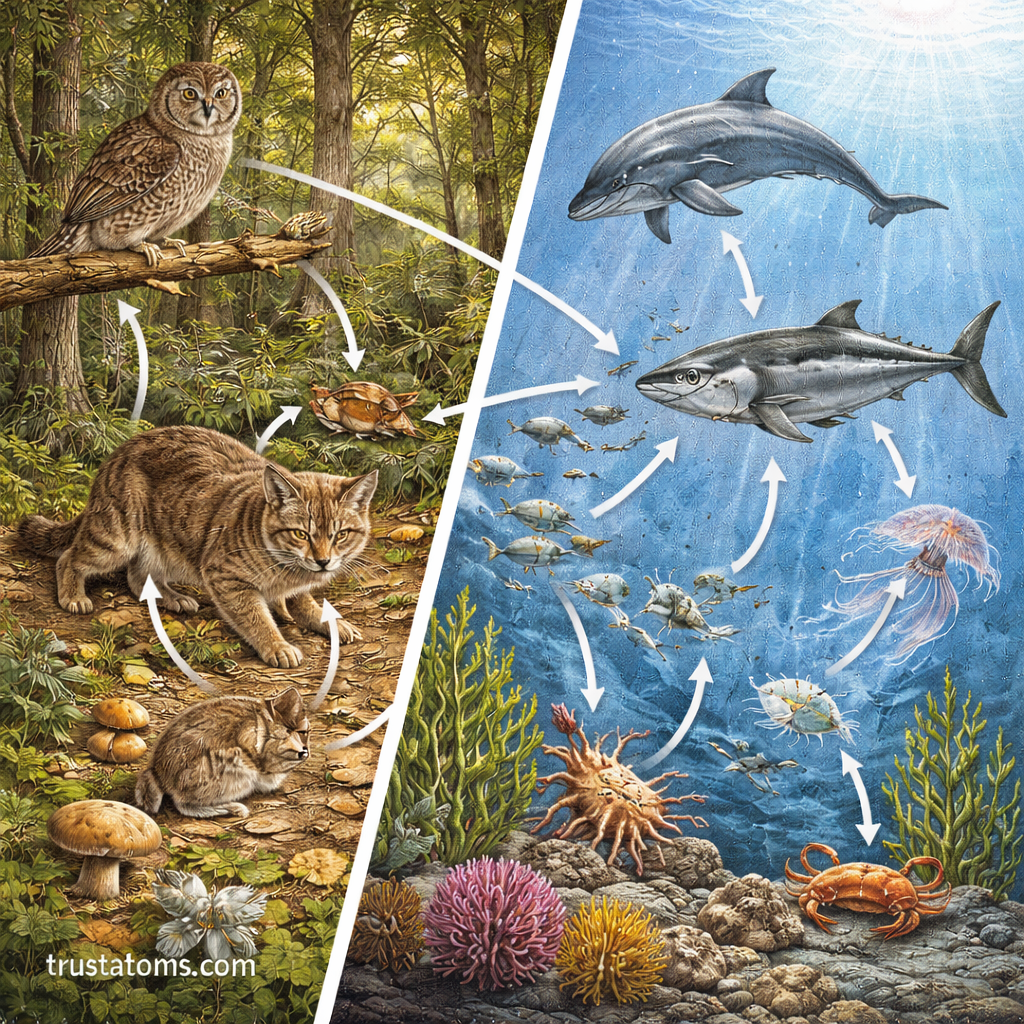
Food webs vary depending on the environment in which they occur.
Forest Food Web
In a forest ecosystem, a food web may include:
- Trees and plants as producers
- Insects and deer as herbivores
- Birds and foxes as predators
- Wolves or large birds of prey as apex predators
These organisms interact through many overlapping feeding relationships.
Marine Food Web
In marine environments, food webs often begin with microscopic organisms.
Example marine food web components include:
- Phytoplankton as producers
- Zooplankton as primary consumers
- Small fish as secondary consumers
- Larger fish and marine mammals as predators
- Sharks or orcas as apex predators
Ocean food webs can be extremely complex due to the diversity of marine species.
The Role of Biodiversity in Food Webs
High biodiversity strengthens food webs.
When ecosystems contain many species:
- Multiple organisms can fill similar ecological roles.
- If one species declines, others may help maintain ecosystem function.
- Energy flow remains more stable.
Diverse ecosystems tend to be more resilient to environmental changes.
Human Impact on Food Webs
Human activities can disrupt food webs in several ways.
Examples include:
- Overfishing removing important predator or prey species
- Pollution harming lower trophic levels such as plankton
- Habitat destruction reducing biodiversity
- Climate change altering species distribution
Because species are interconnected, removing one organism can cause ripple effects throughout the food web.
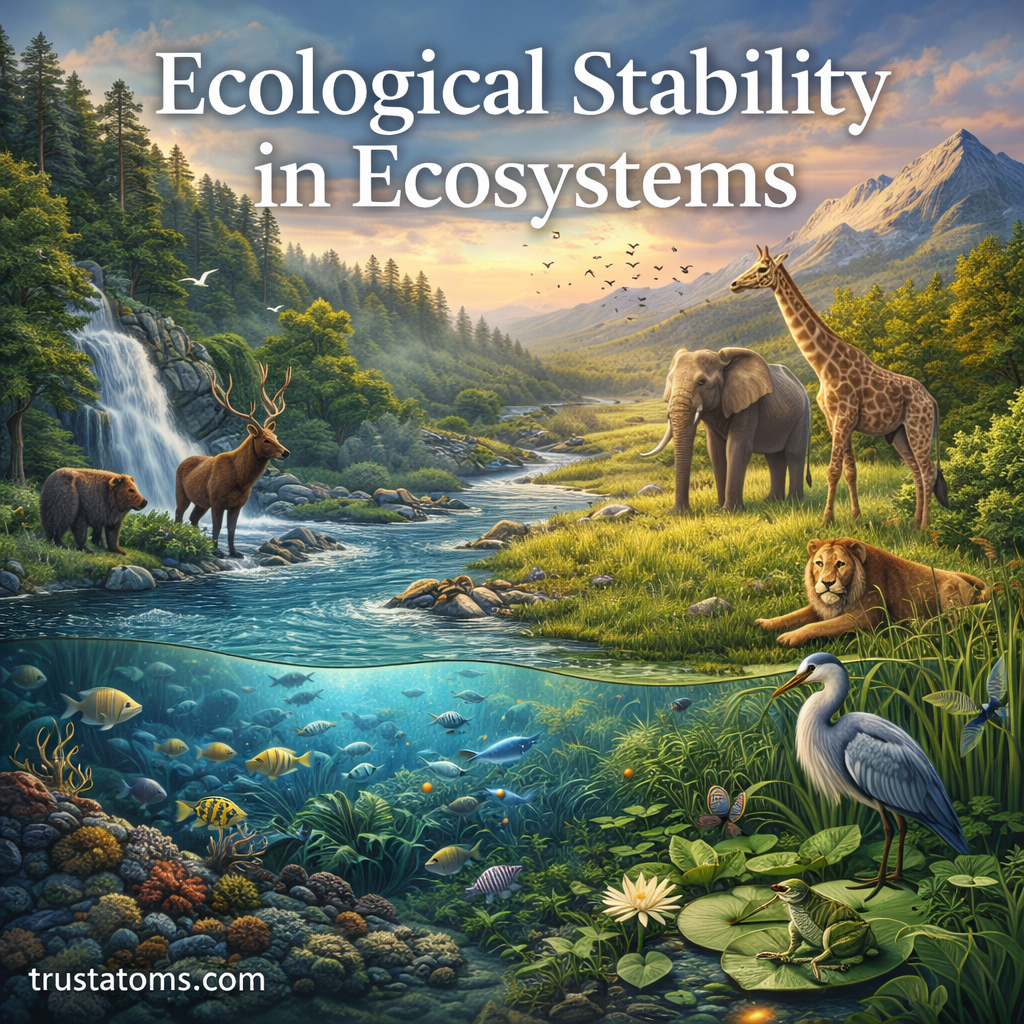
Food Webs and Ecosystem Stability
Food webs help maintain balance within ecosystems by regulating populations and energy flow.
Healthy food webs allow ecosystems to:
- support diverse species
- maintain stable predator–prey relationships
- recover from disturbances
When food webs remain intact, ecosystems are more likely to remain productive and resilient.
Understanding food webs is essential for conservation, environmental management, and protecting biodiversity across the planet.