A food web is a network of interconnected food chains that shows how energy and nutrients move through an ecosystem. Instead of a single pathway of energy flow, a food web illustrates the many feeding relationships that exist between organisms.
In nature, most species eat more than one type of food and may be eaten by multiple predators in their environment. Because of this complexity, ecosystems function through overlapping feeding relationships rather than isolated food chains.
In the study of biology, food webs help scientists investigate how species depend on one another, how energy moves through communities, and what happens when populations increase or decline.
How a Food Web Works
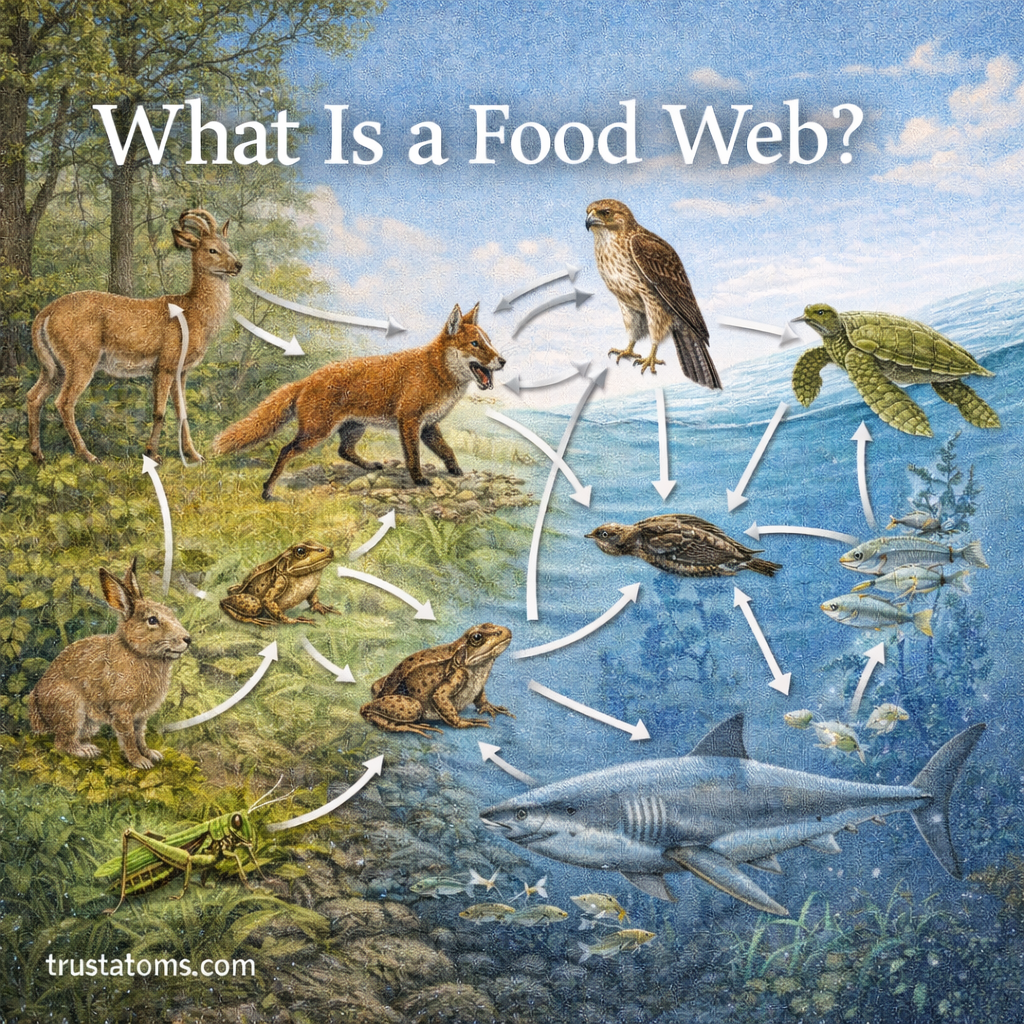
A food web is a diagram showing feeding connections among organisms living in the same ecosystem. Each arrow points from an organism being eaten toward the organism consuming it, indicating the direction of energy transfer.
Consider a grassland where grass feeds grasshoppers, rabbits, and mice. Grasshoppers may be eaten by frogs and birds, while rabbits and mice may be eaten by foxes or hawks.
These relationships overlap because several consumers share food sources and some predators eat multiple prey species. A food web combines these pathways into one connected diagram.
Food webs are simplified models. Scientists may include only the most important feeding relationships rather than every organism and interaction in an ecosystem.
The Main Components of a Food Web
Producers
Producers form the foundation of most food webs. Plants, algae, and phytoplankton use photosynthesis to convert sunlight into chemical energy stored in organic molecules.
Some ecosystems, including those near deep-sea hydrothermal vents, depend on microorganisms that use chemical energy instead of sunlight.
Primary Consumers
Primary consumers are herbivores that eat producers. Examples include rabbits, deer, grasshoppers, and certain zooplankton.
These organisms transfer energy stored in plants or algae to animals that feed on them.
Secondary and Tertiary Consumers
Secondary consumers eat primary consumers. Examples include frogs eating plant-feeding insects and small fish consuming herbivorous zooplankton.
Tertiary consumers feed on secondary consumers. Snakes, larger fish, and birds of prey may occupy this position, depending on their diets.
Many animals occupy more than one feeding level because they consume different kinds of prey.
Apex Predators
Apex predators occupy the highest feeding positions in particular ecosystems and have few or no natural predators as adults. Examples include orcas and certain large sharks.
These animals can influence prey populations and behavior, although their ecological effects vary with local conditions.
Decomposers and Detritivores
Decomposers, including bacteria and fungi, break down dead organisms and organic waste. Detritivores, such as earthworms, consume fragments of dead material.
These organisms help return nutrients to soil and water. Nutrients can be reused by producers, while energy eventually dissipates as heat.
Food Webs Compared With Food Chains
Food chains and food webs describe the same general process of feeding and energy transfer, but they represent different levels of complexity.
| Feature | Food Chain | Food Web |
|---|---|---|
| Structure | One feeding pathway | Multiple connected pathways |
| Relationships | Shows a sequence of organisms | Shows overlapping diets and predators |
| Complexity | Simple model | More detailed model |
| Best use | Explaining individual energy transfers | Studying community feeding relationships |
For example, a chain might show grass being eaten by a grasshopper, which is eaten by a frog. A web adds other grasshopper predators, alternative frog prey, and additional connections.
Examples of Food Webs in Different Ecosystems
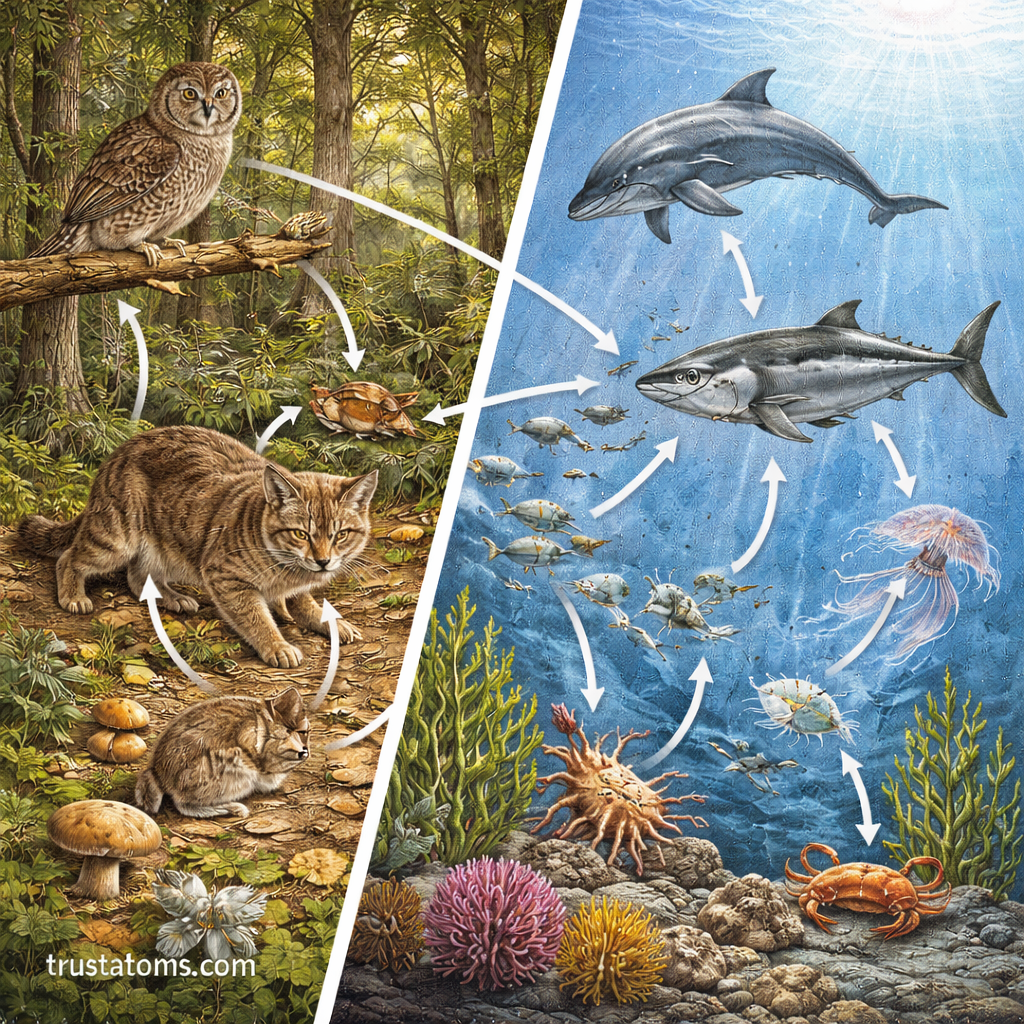
Forest Food Web
Forest food webs often begin with trees, shrubs, grasses, and other plants. Caterpillars eat leaves, mice consume seeds, and deer browse vegetation.
Birds may eat insects, while owls, foxes, and bobcats consume small mammals. Because these predators share some prey species, changes in one population can influence several feeding relationships.
Marine Food Web
Marine food webs frequently begin with phytoplankton. Zooplankton feed on phytoplankton, small fish consume zooplankton, and larger fish eat smaller fish.
Dolphins, sharks, seabirds, and other predators connect additional pathways. Some marine organisms feed at several levels, making ocean food webs particularly interconnected.
A Concrete Example of Food Web Connections
Imagine a small meadow containing three prey species: grasshoppers, mice, and rabbits. Grasshoppers eat grass, mice consume seeds and insects, and rabbits feed on vegetation.
Suppose hawks hunt all three species, while foxes eat mice and rabbits. This simplified web contains five predator–prey connections involving just two predators.
If rabbit numbers decline, hawks and foxes may consume more mice, provided mice remain available and suitable as prey. However, increased competition could also affect predator populations.
This example shows why predicting ecological changes requires examining multiple feeding relationships rather than one chain.
How Biodiversity Influences Food Web Stability
Biodiversity can influence how ecosystems respond to disturbances. When several species perform similar ecological functions, one may partly compensate if another declines.
However, greater biodiversity does not automatically guarantee stability. The strength of feeding relationships, species specialization, and environmental conditions also determine how disturbances spread.
Species with unusually strong effects on their communities are sometimes called keystone species. Removing one can produce changes that extend across several feeding levels.
How Human Activities Disrupt Food Webs
Human activities can alter food webs by changing habitats, reducing populations, or introducing substances that harm organisms.
- Overfishing: Removing large numbers of fish can affect both their prey and predators.
- Pollution: Contaminants can harm organisms at lower trophic levels such as plankton and may accumulate through feeding relationships.
- Habitat destruction: Forest clearing and wetland drainage can eliminate food sources and breeding areas.
- Climate change: Shifts in temperature and seasonal timing can separate predators from their usual prey.
These disturbances may produce indirect effects. For example, removing a predator can increase some prey populations, potentially changing vegetation or competition among other species.
How Scientists Study Food Webs
Ecologists construct food webs using field observations, diet studies, and other evidence of feeding relationships. They may examine stomach contents, analyze stable isotopes in tissues, or monitor organisms directly.
Computer models can then help researchers explore how changes in species abundance or environmental conditions might affect the wider community.
These models are useful for conservation planning, fisheries management, and identifying species whose decline could have widespread consequences.
Frequently Asked Questions
What do arrows mean in a food web?
Arrows show the direction of energy transfer. They point from the organism being consumed toward the organism that eats it, such as from grass to a rabbit.
Can an organism occupy more than one trophic level?
Yes. An omnivore may eat plants and animals, placing it at different feeding levels depending on its meal. Some predators also consume prey from several trophic levels.
What happens when a species disappears from a food web?
Its predators may lose a food source, while organisms it previously consumed may increase. The overall effect depends on whether other species can replace its ecological functions and how strongly the remaining organisms are connected.
A food web reveals how organisms are connected through multiple feeding pathways rather than isolated chains. These connections help explain why changes in prey, predators, or producers can affect an entire ecological community. Studying food webs gives scientists a practical way to investigate energy transfer, biodiversity, and ecosystem responses to disturbance.
Sources: OpenStax, Biology 2e; Campbell Biology, Pearson; Encyclopaedia Britannica, “Food Web.”