Population growth refers to the increase or decrease in the number of individuals within a population over time. In biology and ecology, population growth is a key concept used to understand how species expand, stabilize, or decline within an environment.
Scientists study population growth to understand how organisms respond to environmental conditions, how ecosystems maintain balance, and how human activities influence wildlife and natural systems.
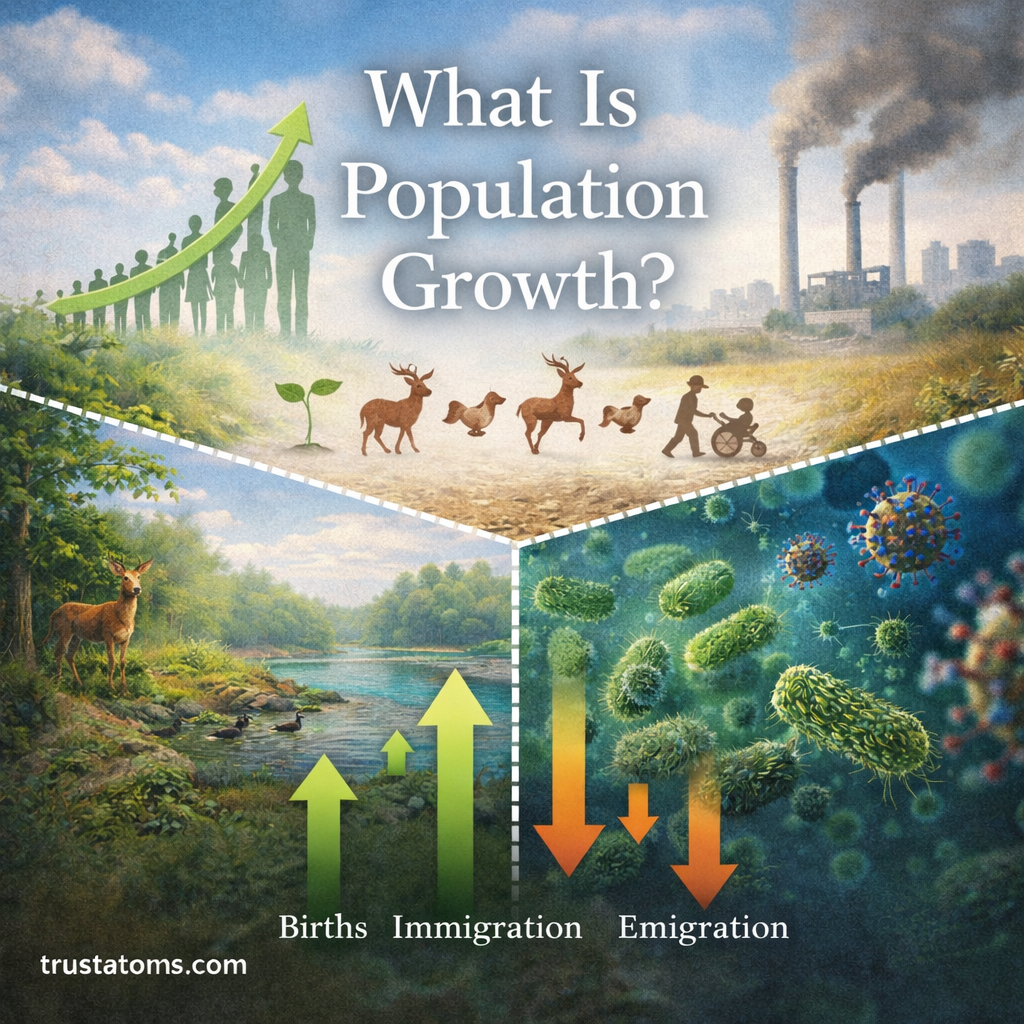
Population growth occurs through a combination of births, deaths, and the movement of individuals into or out of a population.
The Basic Definition of Population Growth
Population growth describes the change in population size over a specific period of time.
The number of individuals in a population changes due to four main factors:
- Birth rate (natality)
- Death rate (mortality)
- Immigration (movement into the population)
- Emigration (movement out of the population)
When births and immigration exceed deaths and emigration, a population grows. When deaths and emigration exceed births and immigration, the population declines.
Understanding these changes helps biologists predict population trends and ecological outcomes.
Key Components of Population Growth
Several biological processes determine how quickly a population grows.
Birth Rate
The birth rate is the number of individuals born into a population during a given period.
Higher birth rates typically lead to population growth. Birth rates can vary depending on:
- Species reproduction strategies
- Availability of resources
- Environmental conditions
- Population density
For example, some insects produce hundreds of offspring, while large mammals may produce only a few.
Death Rate
The death rate measures the number of individuals that die within a population over time.
Death rates are influenced by factors such as:
- Disease
- Predation
- Environmental stress
- Limited resources
- Aging
When death rates increase, population growth slows or declines.
Immigration
Immigration occurs when individuals from other populations move into a new area.
This process increases population size and may introduce new genetic diversity.
Examples include:
- Birds migrating into new breeding areas
- Animals moving into regions with better food availability
- Marine species expanding their habitat ranges
Emigration
Emigration happens when individuals leave a population.
This reduces the number of individuals in the population and may occur due to:
- Competition for resources
- Environmental changes
- Seasonal migration
- Habitat destruction
The balance between immigration and emigration strongly influences population size.
Types of Population Growth
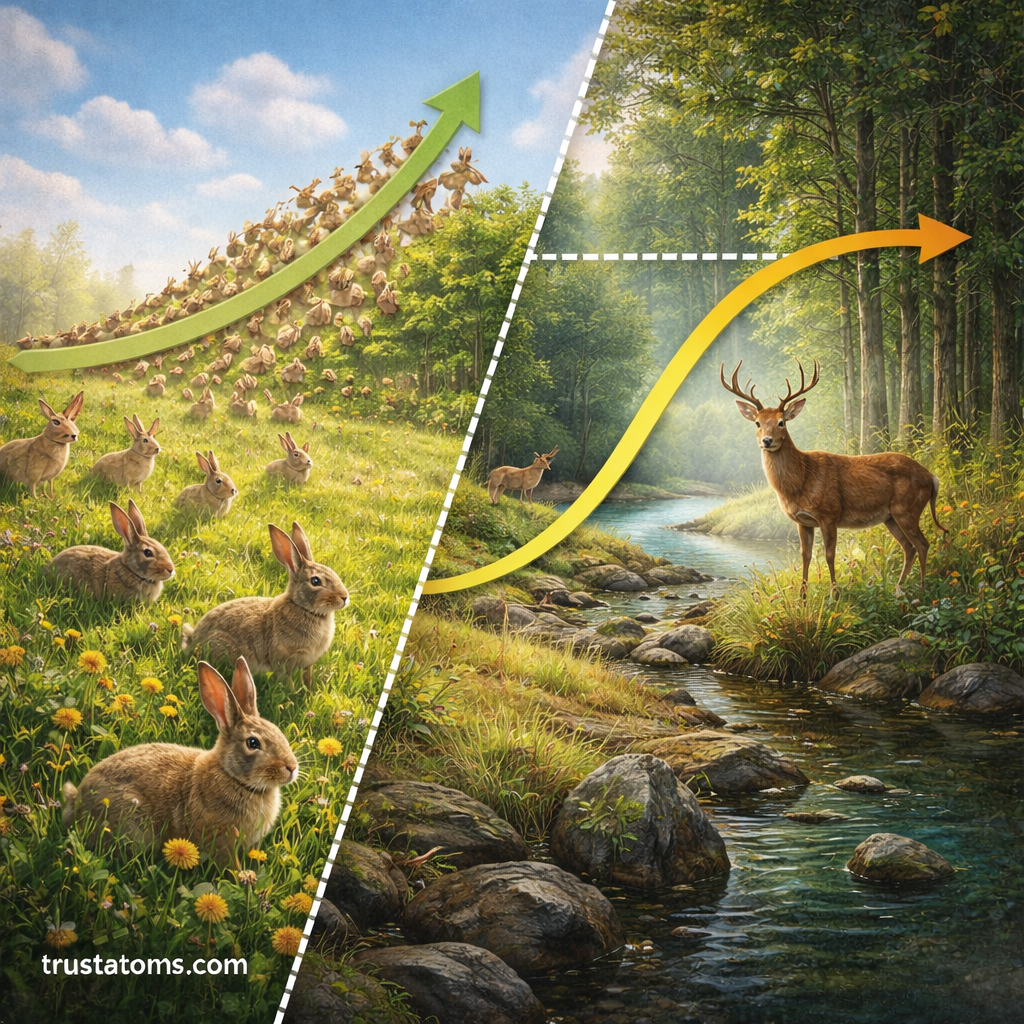
Biologists often describe population growth using two major models.
Exponential Growth
Exponential growth occurs when a population increases rapidly under ideal conditions.
In this model:
- Resources are abundant
- Competition is minimal
- Environmental resistance is low
As a result, the population grows at an accelerating rate.
Characteristics of exponential growth include:
- Rapid population expansion
- Large numbers of offspring
- Minimal environmental limitations
This pattern is often observed in bacteria, insects, or species entering new environments.
However, exponential growth rarely continues indefinitely because environmental resources eventually become limited.
Logistic Growth
Logistic growth occurs when population growth slows as environmental limits are reached.
Every ecosystem has a carrying capacity, which is the maximum number of individuals the environment can sustainably support.
As the population approaches this limit:
- Resources become scarce
- Competition increases
- Growth rates slow down
Eventually, the population stabilizes near the carrying capacity.
Logistic growth is common in natural ecosystems where resources such as food, water, and space are limited.
Carrying Capacity
Carrying capacity is the maximum population size an environment can support over time without degrading the ecosystem.
Several environmental factors determine carrying capacity:
- Food availability
- Water supply
- Habitat space
- Climate conditions
- Predator populations
- Disease presence
If a population exceeds its carrying capacity, resource shortages can cause population declines.
In some cases, populations overshoot the carrying capacity and then experience sudden crashes.
Environmental Resistance
Environmental resistance refers to the collection of environmental factors that limit population growth.
These limiting factors include:
- Predation
- Competition
- Disease
- Limited food
- Natural disasters
- Climate conditions
Environmental resistance prevents populations from growing indefinitely.
Without these limits, ecosystems would quickly become unstable.
Density-Dependent and Density-Independent Factors
Population growth is influenced by two categories of limiting factors.
Density-Dependent Factors
Density-dependent factors become stronger as population density increases.
Examples include:
- Competition for food
- Spread of disease
- Limited nesting space
- Increased predation
These factors regulate populations by slowing growth as populations become crowded.
Density-Independent Factors
Density-independent factors affect populations regardless of population size.
Examples include:
- Floods
- Fires
- Extreme weather
- Droughts
- Temperature changes
These events can drastically affect populations even when densities are low.
Population Growth and Ecosystems
Population growth plays an important role in ecosystem balance.
Changes in one population often influence other populations in the food web.
For example:
- An increase in herbivore populations may reduce plant abundance.
- A decline in predators may allow prey populations to expand rapidly.
- A disease outbreak may reduce population density and alter ecosystem dynamics.
Because ecosystems are interconnected, population growth patterns help scientists understand how ecological communities function.
Human Influence on Population Growth
Human activities can significantly affect population growth patterns.
Major influences include:
- Habitat destruction
- Climate change
- Pollution
- Overhunting or overfishing
- Introduction of invasive species
In some cases, human actions cause population declines or even species extinction.
In other situations, human environments can create conditions where certain populations grow rapidly.
Examples include:
- Urban pigeon populations
- Agricultural pest populations
- Invasive species expanding in new ecosystems
Understanding population growth helps conservationists manage wildlife populations and protect ecosystems.
Why Studying Population Growth Matters
Studying population growth provides valuable insights into the functioning of ecosystems and species survival.
Population research helps scientists:
- Predict wildlife population trends
- Manage endangered species
- Control disease outbreaks
- Understand ecological balance
- Plan sustainable resource use
Population growth models are also widely used in conservation biology, environmental management, and public health.
Final Thoughts
Population growth describes how the number of individuals within a species changes over time. By examining birth rates, death rates, migration patterns, and environmental limits, scientists can understand how populations expand, stabilize, or decline.
This knowledge helps researchers predict ecological changes, manage natural resources, and protect biodiversity.
As ecosystems face increasing environmental pressures, understanding population growth remains a critical part of biological science.