Population dynamics is the study of how and why populations change over time. In biology and ecology, it focuses on the patterns of population growth, decline, stability, and interactions within ecosystems.
Scientists examine population dynamics to understand how species survive, reproduce, compete for resources, and respond to environmental changes. These patterns help researchers predict future population trends and manage ecosystems more effectively.
Population dynamics connects several important biological concepts, including population growth, environmental limits, species interactions, and evolutionary processes.
What Are Population Dynamics?
Population dynamics refers to the changes in the size, structure, and distribution of populations over time.
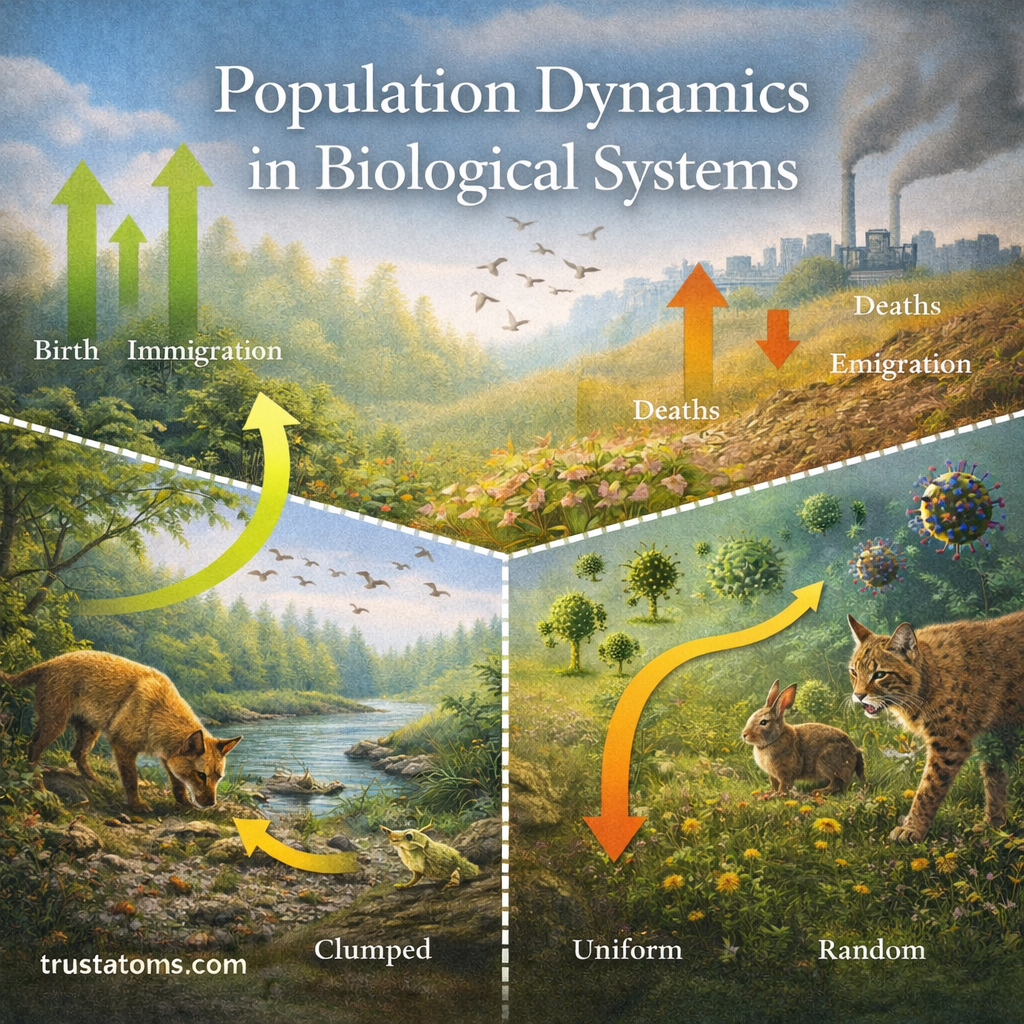
These changes occur because of four primary factors:
- Birth rates
- Death rates
- Immigration (movement into a population)
- Emigration (movement out of a population)
Together, these factors determine whether a population grows, shrinks, or remains stable.
For example:
- A population of fish in a lake may grow if reproduction rates are high and predators are few.
- A population of birds may decline if food sources become scarce or habitat is lost.
By studying these patterns, scientists gain insight into how biological populations function within ecosystems.
Key Components of Population Dynamics
Population dynamics includes several measurable characteristics that help scientists analyze population changes.
Population Size
Population size refers to the total number of individuals in a population.
Population size can fluctuate due to:
- Seasonal breeding cycles
- Environmental changes
- Migration patterns
- Predator–prey relationships
Monitoring population size helps researchers detect population growth or decline.
Population Density
Population density measures how many individuals live in a given area.
It is typically expressed as:
- Individuals per square kilometer
- Individuals per square meter
- Individuals per cubic meter (in aquatic systems)
High population density often leads to increased competition for limited resources such as food, water, and territory.
Population Distribution
Population distribution describes how individuals are spaced within a habitat.
Three common distribution patterns exist:
- Clumped distribution
Individuals group together in clusters.
Example: fish schools or elephant herds. - Uniform distribution
Individuals are evenly spaced due to competition.
Example: territorial animals or evenly spaced plants. - Random distribution
Individuals occur unpredictably across a landscape.
Example: plants dispersed by wind-dropped seeds.
Distribution patterns reveal how organisms interact with their environment and each other.
Factors That Influence Population Dynamics

Many biological and environmental forces influence how populations change.
Resource Availability
Access to essential resources strongly affects population survival.
Important resources include:
- Food
- Water
- Shelter
- Breeding sites
When resources are abundant, populations often grow quickly. When resources become limited, population growth slows.
Predation
Predation occurs when one organism consumes another.
Predators influence population size by controlling prey numbers.
For example:
- Wolves regulating deer populations
- Owls controlling rodent populations
Predator–prey relationships often create natural population cycles.
Disease
Disease can rapidly reduce population size, especially in dense populations where pathogens spread easily.
Outbreaks may occur due to:
- Environmental stress
- Poor nutrition
- Increased population density
Disease plays an important role in regulating populations in natural ecosystems.
Competition
Competition occurs when organisms require the same limited resources.
Competition can occur:
- Within the same species (intraspecific competition)
- Between different species (interspecific competition)
Competition influences survival rates and population growth.
Population Growth Patterns
Population dynamics often follow recognizable growth patterns.
Two major growth models describe how populations change over time.
Exponential Growth
Exponential growth occurs when populations increase rapidly under ideal conditions.
Characteristics include:
- Unlimited resources
- Minimal environmental resistance
- High reproductive rates
This growth pattern results in rapid population expansion.
However, exponential growth rarely continues indefinitely because environmental resources eventually become limited.
Logistic Growth
Logistic growth occurs when population growth slows as resources become scarce.
This pattern occurs because ecosystems have a carrying capacity, the maximum population size an environment can support.
In logistic growth:
- Populations grow rapidly at first
- Growth slows as resources become limited
- Population size stabilizes near carrying capacity
This model better reflects real-world ecosystems.
Population Cycles
Some populations experience regular fluctuations over time.
These population cycles often result from predator–prey interactions or environmental changes.
A classic example involves:
- Snowshoe hares
- Lynx predators
When hare populations increase, lynx populations grow due to abundant food. As lynx populations increase, predation reduces hare numbers, causing both populations to decline.
These repeating cycles demonstrate how closely linked species populations can be.
Human Influence on Population Dynamics
Human activity can significantly alter natural population patterns.
Major impacts include:
- Habitat destruction
- Climate change
- Pollution
- Overhunting and overfishing
- Introduction of invasive species
These influences can cause rapid population declines or, in some cases, sudden population increases.
For example:
- Habitat loss can threaten endangered species.
- Invasive species may grow quickly because they lack natural predators.
Understanding population dynamics allows scientists to develop strategies for conservation and ecosystem management.
Population Dynamics in Conservation Biology
Population dynamics plays a critical role in protecting endangered species.
Conservation biologists study population trends to determine whether species are at risk of extinction.
Important factors include:
- Minimum viable population size
- Genetic diversity
- Habitat availability
- Reproductive success
Monitoring these variables helps conservationists design recovery plans and habitat protection strategies.
Population models are also used to estimate future population trends under different environmental scenarios.
Why Population Dynamics Matter
Population dynamics helps scientists understand how ecosystems function and remain balanced.
Studying population changes allows researchers to:
- Predict species survival
- Manage wildlife populations
- Understand ecological interactions
- Protect biodiversity
- Plan sustainable resource use
Without understanding population dynamics, managing ecosystems and protecting species would be far more difficult.
Final Thoughts
Population dynamics is a central concept in biology and ecology that explains how populations grow, shrink, and interact with their environments.
By studying birth rates, death rates, migration patterns, resource availability, and species interactions, scientists gain insight into the complex systems that sustain life on Earth.
As environmental pressures increase worldwide, understanding population dynamics is essential for protecting ecosystems and maintaining biodiversity.