Proteins are essential molecules that carry out most of the work inside living cells. From catalyzing chemical reactions to transporting molecules and supporting cellular structure, proteins perform an extraordinary range of biological tasks. Understanding how proteins work requires more than knowing their chemical composition—it requires understanding their three-dimensional structure.
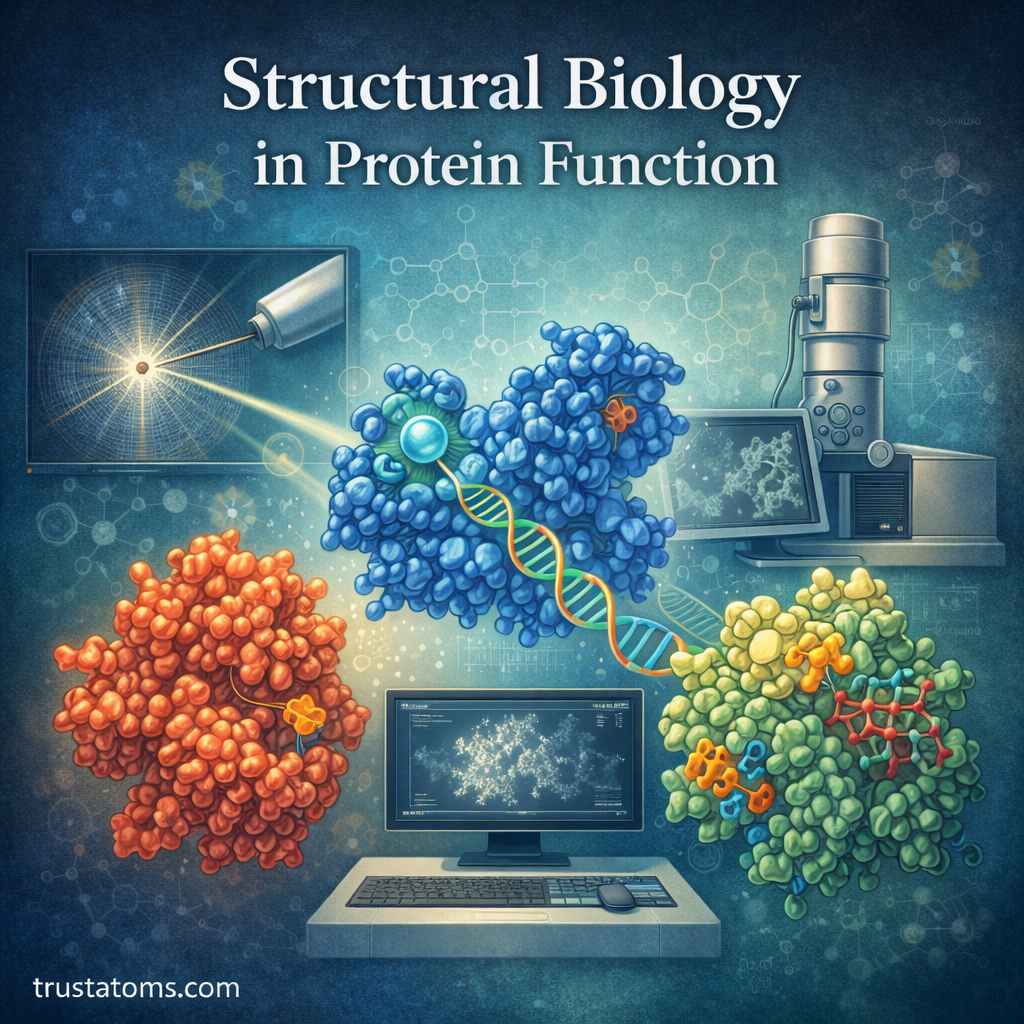
Structural biology is the field of science dedicated to studying the shapes and spatial arrangements of biological molecules, particularly proteins. By examining molecular structures in detail, scientists can understand how proteins interact with other molecules and how these interactions control biological processes.
This article explores the principles of structural biology, the relationship between protein structure and function, and the technologies scientists use to study these molecular structures.
What Is Structural Biology?
Structural biology focuses on determining the three-dimensional structures of biological molecules such as proteins, nucleic acids, and large molecular complexes.
Unlike basic biochemical studies that analyze chemical composition, structural biology investigates how atoms are arranged in space and how those arrangements influence biological activity.
Scientists study structures at multiple levels, including:
- Individual atoms within a molecule
- The folding patterns of proteins
- Large molecular assemblies inside cells
These structural insights help explain how biological molecules perform their functions.
Why Protein Structure Matters
Proteins are made from chains of amino acids, but the sequence alone does not determine their behavior. The way a protein folds into its three-dimensional shape directly affects its biological role.
A protein’s structure determines:
- Which molecules it can bind to
- How efficiently it catalyzes chemical reactions
- How it interacts with other proteins
- Whether it functions properly in a cell
Even small changes in structure can dramatically alter protein activity.
For example, a single mutation in a gene may change the shape of a protein and cause disease by disrupting its normal function.
Levels of Protein Structure
Proteins are organized into several structural levels, each contributing to the molecule’s final shape.
Primary Structure
The primary structure is the linear sequence of amino acids in a protein.
This sequence is encoded by a gene and determines how the protein will eventually fold. Even a single change in the amino acid sequence can influence the final structure.
Secondary Structure
Secondary structure refers to local folding patterns within the protein chain.
Common secondary structures include:
- Alpha helices
- Beta sheets
- Loops and turns
These structures are stabilized by hydrogen bonds between amino acids.
Tertiary Structure
Tertiary structure describes the overall three-dimensional shape of a single protein molecule.
This structure forms through interactions such as:
- Hydrogen bonding
- Hydrophobic interactions
- Ionic bonds
- Disulfide bridges
The tertiary structure creates the protein’s functional regions, including binding sites and catalytic centers.
Quaternary Structure
Some proteins consist of multiple polypeptide chains working together.
Quaternary structure describes how these subunits assemble into a functional complex.
Examples include:
- Hemoglobin, which carries oxygen in blood
- Multi-enzyme complexes involved in metabolism
How Structure Determines Protein Function
A protein’s shape determines how it interacts with other molecules. This principle is often described as structure determines function.
Key ways structure influences function include:
Active Sites in Enzymes
Enzymes contain specialized regions called active sites where chemical reactions occur.
The precise shape of the active site allows enzymes to:
- Bind specific substrates
- Stabilize reaction intermediates
- Speed up biochemical reactions
Even slight changes in the active site structure can affect enzyme efficiency.
Molecular Recognition
Proteins often recognize other molecules through structural compatibility.
Examples include:
- Antibodies binding to antigens
- Hormones binding to receptors
- DNA-binding proteins interacting with genetic sequences
These interactions depend on complementary shapes between molecules.
Protein Stability
A stable protein structure ensures that proteins maintain their function under varying conditions.
Structural features such as folding patterns and molecular interactions help proteins remain stable despite changes in temperature, pH, or cellular environment.
Techniques Used in Structural Biology

Scientists use several experimental techniques to determine protein structures.
X-ray Crystallography
X-ray crystallography has been one of the most widely used structural biology methods.
The process involves:
- Crystallizing the protein.
- Exposing the crystal to X-ray beams.
- Analyzing diffraction patterns produced by the crystal.
- Reconstructing the atomic structure using computational analysis.
This method provides highly detailed structural information at atomic resolution.
Nuclear Magnetic Resonance (NMR) Spectroscopy
NMR spectroscopy analyzes protein structures in solution rather than crystals.
This technique measures magnetic signals from atomic nuclei to determine:
- Molecular structure
- Atomic interactions
- Protein dynamics
NMR is especially useful for studying smaller proteins.
Cryo-Electron Microscopy (Cryo-EM)
Cryo-electron microscopy is a newer technique that allows scientists to study large molecular structures without crystallization.
The process involves:
- Rapidly freezing biological samples
- Imaging molecules with electron beams
- Reconstructing structures using computational algorithms
Cryo-EM has revolutionized structural biology by enabling visualization of complex protein assemblies.
Applications of Structural Biology
Understanding protein structure has major implications across many scientific fields.
Drug Discovery
Many modern medicines are designed using structural biology insights.
Scientists can study protein structures to:
- Identify drug-binding sites
- Design molecules that interact with specific proteins
- Improve drug selectivity and effectiveness
Structure-based drug design has become a key approach in pharmaceutical research.
Disease Research
Structural biology helps explain how genetic mutations lead to disease.
Researchers can observe how mutations alter protein structure and disrupt biological processes.
This is important for studying:
- Genetic disorders
- Cancer-related proteins
- Neurodegenerative diseases
Biotechnology and Protein Engineering
Scientists can modify proteins to improve or change their function.
Applications include:
- Designing industrial enzymes
- Creating therapeutic antibodies
- Developing bioengineered proteins
Understanding protein structure allows researchers to make precise modifications.
Challenges in Structural Biology
Despite advances in technology, determining molecular structures remains complex.
Difficulty Crystallizing Proteins
Many proteins are difficult to crystallize, which limits the use of X-ray crystallography.
Membrane proteins in particular can be challenging to study because they are embedded in cell membranes.
Dynamic Molecular Behavior
Proteins are not rigid objects. They constantly move and change shape.
Capturing these dynamic motions remains a challenge for structural studies.
Large Molecular Complexes
Some biological systems involve massive molecular assemblies with many interacting components.
Studying these complexes requires advanced imaging techniques and computational modeling.
Future Directions in Structural Biology
Structural biology continues to evolve with new technologies and computational tools.
Important developments include:
- Artificial intelligence for protein structure prediction
- High-resolution cryo-electron microscopy
- Integrated structural and computational modeling
- Large-scale structural databases
One of the most exciting recent developments is AI-driven protein structure prediction, which can model protein structures from amino acid sequences with remarkable accuracy.
These advances are transforming how scientists study biological molecules.
Final Thoughts
Structural biology provides critical insight into how proteins function at the molecular level. By revealing the three-dimensional structures of biological molecules, scientists can understand how proteins interact, catalyze reactions, and regulate cellular processes.
From drug discovery to biotechnology and disease research, structural biology continues to shape modern life sciences. As imaging technologies and computational tools improve, researchers will gain even deeper understanding of the molecular structures that drive life.