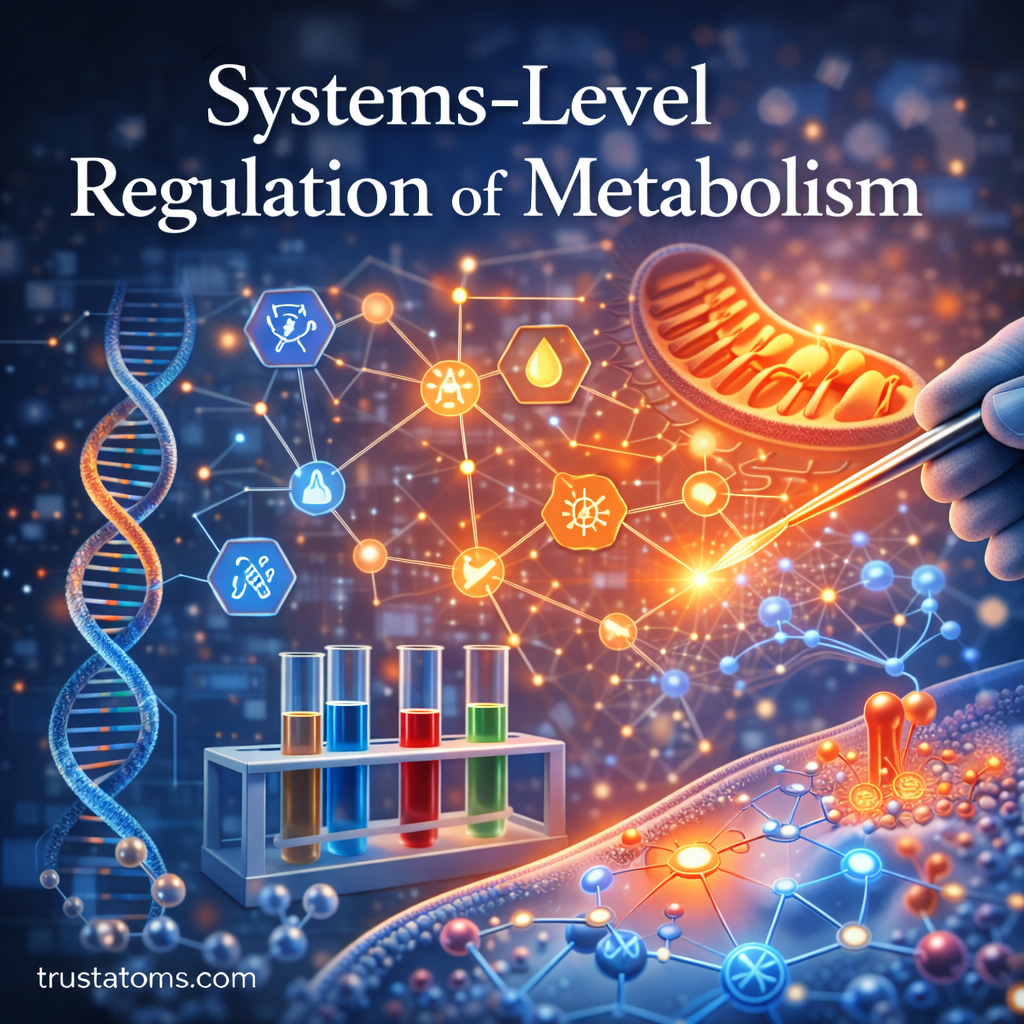
Metabolism is the collection of chemical reactions that allow living organisms to grow, produce energy, and maintain cellular function. These reactions are not isolated processes; they operate as interconnected networks regulated across the entire cell and organism.
Scientists study metabolism at the systems level to understand how metabolic pathways interact, respond to environmental changes, and maintain biological balance. Systems-level regulation examines how genes, enzymes, signaling pathways, and environmental signals coordinate metabolic activity across complex biological networks.
This approach helps researchers better understand diseases, energy balance, and the mechanisms that allow organisms to adapt to changing conditions.
What Is Systems-Level Regulation in Metabolism?
Systems-level regulation refers to the coordinated control of metabolic pathways across multiple layers of biological organization.
Rather than focusing on individual enzymes or reactions, systems biology examines how entire networks of metabolic processes interact and regulate one another.
Key components involved in metabolic regulation include:
- Enzymes that catalyze chemical reactions
- Genes controlling enzyme production
- Signaling pathways that regulate metabolic activity
- Hormones coordinating metabolism across tissues
- Environmental factors such as nutrient availability
These components work together to maintain metabolic homeostasis, ensuring that cells have the energy and molecules they need to function.
The Structure of Metabolic Networks
Metabolism is organized into interconnected pathways that transform molecules into energy and essential cellular components.
Major metabolic pathways include:
- Glycolysis
- The citric acid cycle
- Oxidative phosphorylation
- Lipid metabolism
- Amino acid metabolism
These pathways form metabolic networks, where the output of one reaction becomes the input for another.
Because these networks are tightly connected, changes in one pathway can affect many others throughout the system.
Key Layers of Metabolic Regulation

Metabolic control occurs at multiple biological levels. Systems-level regulation integrates these layers to ensure proper cellular function.
Enzyme Regulation
Enzymes control the speed of metabolic reactions.
Cells regulate enzyme activity through mechanisms such as:
- Allosteric regulation by metabolites
- Feedback inhibition from pathway products
- Covalent modification of enzymes
- Changes in enzyme concentration
These mechanisms allow cells to quickly adjust metabolic rates based on immediate needs.
Gene Expression Control
Cells can regulate metabolism by controlling the production of metabolic enzymes.
Gene regulation influences metabolism by:
- Increasing or decreasing enzyme synthesis
- Activating specific metabolic pathways
- Responding to environmental signals such as nutrient availability
For example, cells may activate genes involved in glucose metabolism when energy demand increases.
Hormonal Regulation
In multicellular organisms, hormones coordinate metabolism across different tissues.
Important metabolic hormones include:
- Insulin
- Glucagon
- Cortisol
- Adrenaline
These hormones regulate processes such as:
- Blood glucose levels
- Energy storage
- Fat metabolism
- Stress responses
Hormonal signaling allows the body to maintain overall metabolic balance.
Cellular Signaling Networks
Cells use signaling pathways to coordinate metabolic activity with environmental conditions.
Examples of signals affecting metabolism include:
- Nutrient availability
- Oxygen levels
- Cellular stress
- Energy demand
Signaling pathways connect metabolic regulation to other cellular processes such as growth and cell division.
Systems Biology Approaches to Metabolism
Studying metabolism at the systems level requires integrating large amounts of biological data. Scientists use computational and experimental methods to model metabolic networks.
Common approaches include:
Metabolic Network Modeling
Researchers create computational models representing metabolic pathways as networks of reactions.
These models help scientists:
- Predict metabolic responses
- Simulate nutrient changes
- Identify key metabolic regulators
Network models provide insight into how metabolism behaves under different biological conditions.
Flux Balance Analysis
Flux balance analysis is a computational method used to study the flow of metabolites through metabolic pathways.
This technique allows scientists to:
- Estimate metabolic reaction rates
- Identify bottlenecks in metabolic pathways
- Predict how genetic changes affect metabolism
Flux analysis is widely used in microbiology and metabolic engineering.
Multi-Omics Integration
Modern systems biology integrates data from multiple biological layers.
These datasets include:
- Genomics (DNA sequences)
- Transcriptomics (gene expression)
- Proteomics (protein levels)
- Metabolomics (metabolite concentrations)
Combining these data types helps researchers build a more complete picture of metabolic regulation.
Why Systems-Level Metabolism Matters
Studying metabolism at the systems level provides important insights into many biological processes.
Understanding Metabolic Diseases
Many diseases involve disruptions in metabolic networks.
Examples include:
- Diabetes
- Obesity
- Cancer metabolism
- Mitochondrial disorders
Systems biology helps scientists identify how metabolic pathways become dysregulated in these conditions.
Improving Drug Development
Many pharmaceuticals target metabolic enzymes or pathways.
Systems-level analysis can reveal:
- How drugs affect multiple metabolic pathways
- Potential side effects from metabolic disruptions
- New therapeutic targets
Understanding metabolic networks improves the design of more effective treatments.
Biotechnology and Metabolic Engineering
In biotechnology, scientists modify metabolic pathways to produce useful compounds.
Applications include:
- Biofuel production
- Pharmaceutical manufacturing
- Industrial enzyme production
- Nutrient-enhanced foods
Systems-level modeling helps optimize these engineered metabolic systems.
Environmental and Ecological Research
Metabolic systems also influence ecological processes.
For example, microbial metabolism drives:
- Carbon cycling
- Nitrogen fixation
- Biogeochemical nutrient cycles
Studying metabolism across ecosystems helps scientists understand environmental sustainability.
Challenges in Systems-Level Metabolic Research
Although systems biology provides powerful insights, studying metabolic regulation at large scales presents several challenges.
Complexity of Biological Networks
Metabolic systems contain thousands of reactions and regulatory interactions.
Capturing the full complexity of these networks requires extensive experimental data and sophisticated computational models.
Data Integration Difficulties
Combining genomic, proteomic, and metabolic data can be technically challenging due to differences in measurement techniques and data formats.
Developing standardized approaches for integrating these datasets remains an active area of research.
Dynamic Nature of Metabolism
Metabolism is constantly changing in response to environmental conditions.
Models must account for time-dependent changes in:
- Nutrient availability
- Cellular energy levels
- Hormonal signals
Capturing these dynamic behaviors remains a major challenge for systems biology.
The Future of Systems-Level Metabolism Research
Technological advances are rapidly improving the study of metabolic systems.
Emerging innovations include:
- Artificial intelligence for metabolic modeling
- High-throughput metabolomics technologies
- Single-cell metabolic analysis
- Improved computational simulations of metabolic networks
These tools will allow researchers to study metabolism with greater accuracy and detail.
As biological data continues to expand, systems-level approaches will play an increasingly important role in understanding how metabolism supports life.
Final Thoughts
Metabolism is not just a collection of individual chemical reactions—it is a complex, interconnected system regulated across multiple biological layers. Systems-level regulation of metabolism helps scientists understand how genes, enzymes, signaling pathways, and environmental signals work together to maintain cellular balance.
By studying metabolic networks as integrated systems, researchers can gain deeper insights into disease, biotechnology, and biological adaptation. As systems biology technologies continue to evolve, our understanding of metabolism will become increasingly sophisticated, revealing the intricate networks that sustain life.