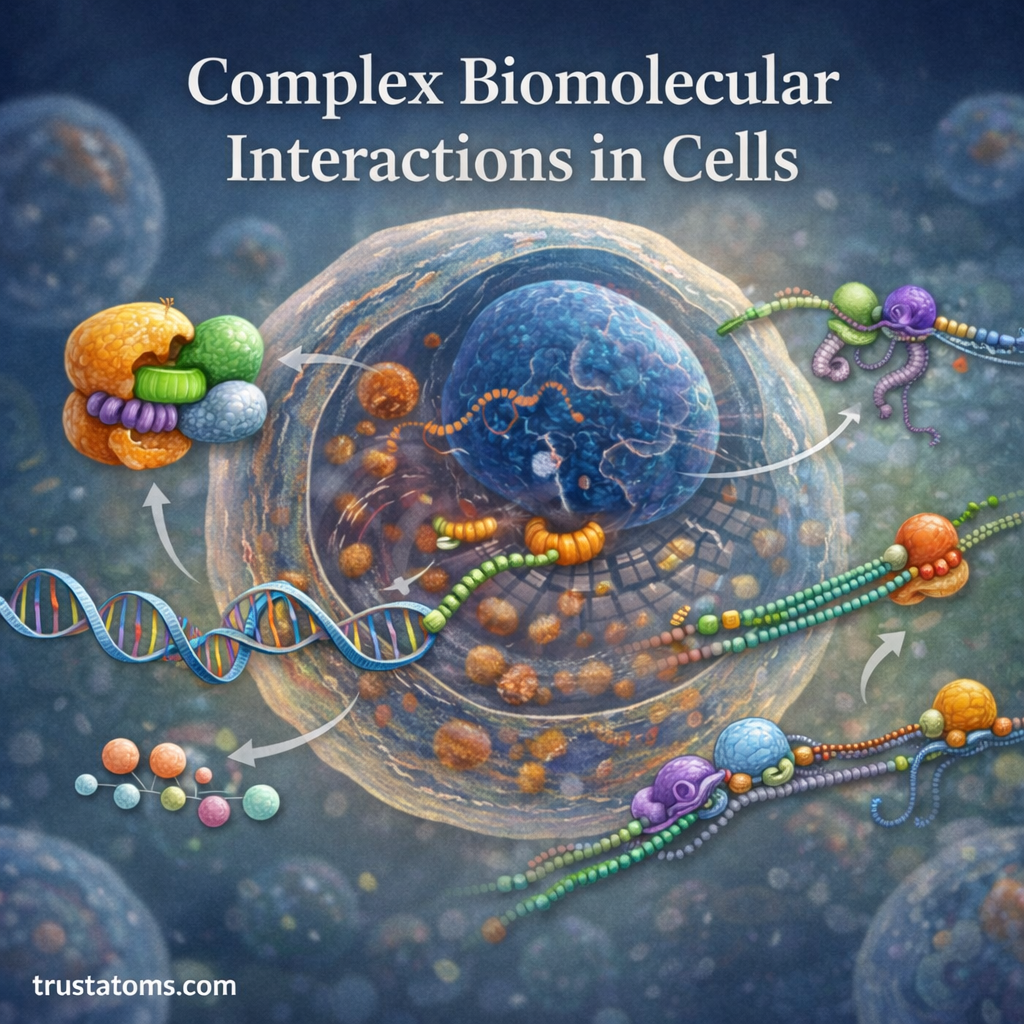
Cells function through an extraordinary web of molecular interactions. Rather than acting independently, biological molecules such as proteins, DNA, RNA, lipids, and small metabolites constantly interact with one another to maintain life.
These complex biomolecular interactions allow cells to process information, regulate metabolism, respond to environmental signals, and coordinate thousands of biochemical reactions simultaneously. Understanding these interactions is essential for explaining how cells grow, divide, repair damage, and adapt to changing conditions.
Modern biology increasingly views the cell as a dynamic molecular network, where interactions between biomolecules determine cellular behavior.
What Are Biomolecular Interactions?
Biomolecular interactions refer to physical and chemical associations between biological molecules inside cells. These interactions allow molecules to bind, communicate, and influence each other’s activity.
Some interactions are temporary and reversible, while others form stable molecular complexes that persist for longer periods.
Examples include interactions between:
- Proteins and other proteins
- Proteins and DNA
- Proteins and RNA
- Enzymes and metabolic substrates
- Lipids and membrane proteins
These molecular connections create functional systems that regulate nearly every cellular process.
Major Types of Biomolecules Involved
Several classes of biomolecules participate in cellular interactions. Each type plays a distinct role within biological networks.
Proteins
Proteins are the most versatile molecules in the cell. They perform a wide range of functions, including catalyzing chemical reactions, transporting molecules, and regulating gene expression.
Protein interactions include:
- Enzyme–substrate binding
- Structural complexes
- Signal transduction networks
- Protein folding and chaperone interactions
Many proteins only function properly when they interact with other proteins.
Nucleic Acids (DNA and RNA)
DNA and RNA store and transmit genetic information, but they also participate in many regulatory interactions.
Important nucleic acid interactions include:
- DNA binding with transcription factors
- RNA interactions with ribosomes
- RNA binding with regulatory proteins
- RNA–RNA regulatory interactions
These interactions help control how genetic information is expressed inside cells.
Lipids
Lipids are important components of cellular membranes and also participate in signaling pathways.
Their interactions often involve:
- Membrane protein anchoring
- Cellular signaling molecules
- Membrane structure and fluidity
- Transport systems embedded in membranes
Membrane-based interactions are particularly important in communication between cells and their environments.
Small Molecules and Metabolites
Cells contain thousands of small molecules involved in metabolism.
These molecules interact with enzymes and regulatory proteins to support processes such as:
- Energy production
- Nutrient metabolism
- Biosynthesis of macromolecules
- Cellular signaling pathways
Even small molecules can dramatically influence cellular activity.
Forces That Drive Molecular Interactions
Biomolecular interactions are governed by several fundamental chemical forces.
These forces allow molecules to bind to one another with varying strengths and durations.
Hydrogen Bonds
Hydrogen bonds occur when a hydrogen atom is shared between two electronegative atoms.
They are essential for:
- DNA base pairing
- Protein folding
- RNA structural stability
Although individually weak, large numbers of hydrogen bonds can stabilize complex structures.
Ionic Interactions
Ionic interactions occur between positively and negatively charged molecules.
These interactions help stabilize:
- Protein structures
- Enzyme–substrate binding
- Protein–DNA interactions
Ionic attractions are especially important in the crowded environment of the cell.
Hydrophobic Interactions
Hydrophobic interactions occur when nonpolar molecules cluster together to avoid contact with water.
These forces are crucial for:
- Protein folding
- Membrane formation
- Lipid bilayer stability
Hydrophobic interactions help create the basic architecture of cellular structures.
Van der Waals Forces
Van der Waals forces are weak attractions between nearby atoms.
Although individually small, they contribute to the precise alignment of interacting molecules.
These forces often help fine-tune the stability of biomolecular complexes.
Protein–Protein Interaction Networks
One of the most important types of biomolecular interaction is protein–protein interaction.
Proteins rarely work alone. Instead, they assemble into networks that coordinate cellular functions.
Examples include:
- Enzyme complexes in metabolic pathways
- Cytoskeletal protein assemblies
- Signal transduction cascades
- DNA replication machinery
In many cases, a single protein may interact with dozens or even hundreds of other proteins.
These networks allow cells to carry out highly coordinated processes.
Enzyme–Substrate Interactions
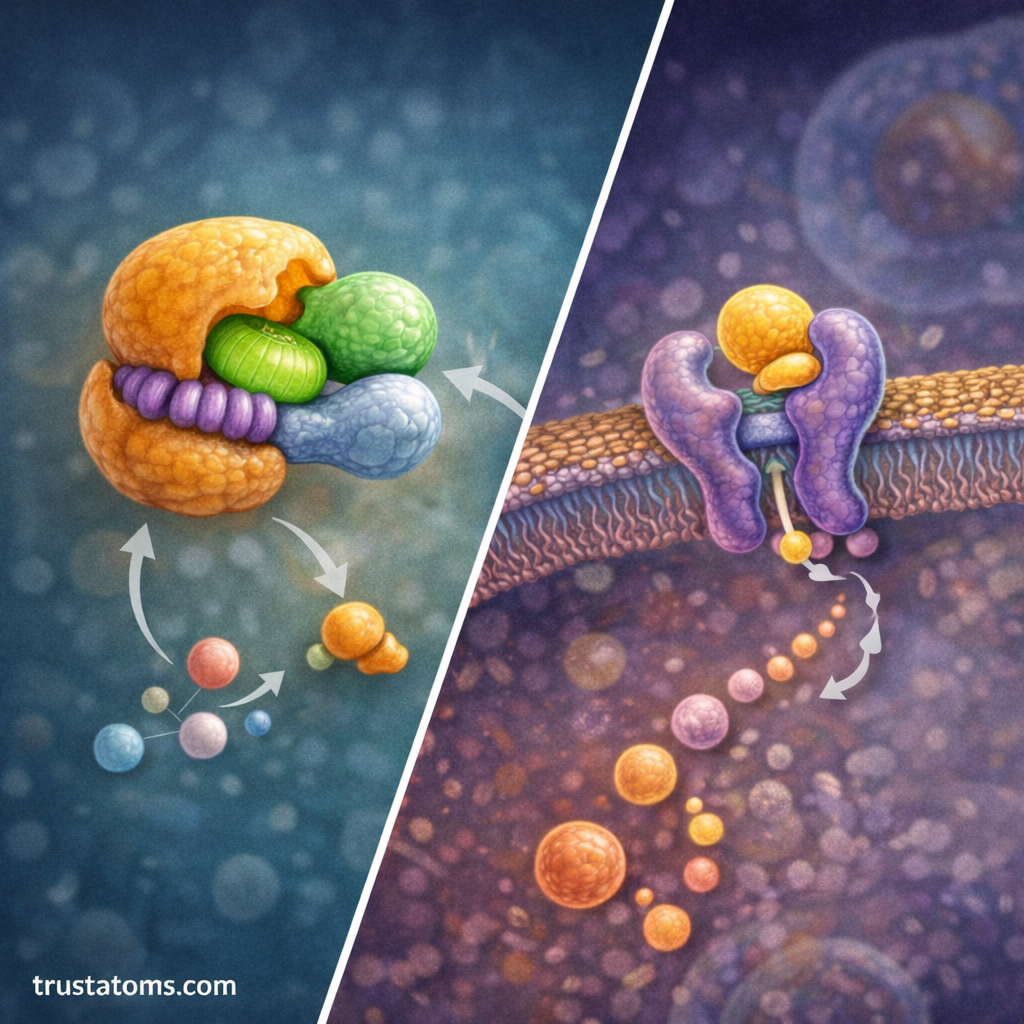
Enzymes are specialized proteins that catalyze biochemical reactions.
Each enzyme binds specific molecules called substrates at an active site.
This interaction allows enzymes to:
- Position substrates correctly
- Lower the energy required for reactions
- Speed up biochemical processes
Without enzyme–substrate interactions, most cellular reactions would occur too slowly to sustain life.
Molecular Complexes in Cells
Cells frequently organize biomolecules into large molecular machines.
These complexes perform complex tasks with remarkable precision.
Examples include:
Ribosomes
Ribosomes are molecular machines that translate genetic information into proteins.
They consist of:
- Ribosomal RNA
- Multiple protein subunits
Together, they coordinate the interaction between messenger RNA and transfer RNA to build proteins.
DNA Replication Complexes
When cells divide, DNA replication requires a coordinated system of proteins that interact with DNA.
Key components include:
- DNA polymerase enzymes
- Helicase proteins
- Primase enzymes
- DNA ligase
These proteins interact in a highly organized complex to ensure accurate genome duplication.
The Cytoskeleton
The cytoskeleton is a network of protein filaments that maintain cell structure and movement.
It involves interactions between:
- Actin filaments
- Microtubules
- Motor proteins such as kinesin and dynein
These components work together to transport molecules and organize cellular architecture.
Signaling Pathways and Cellular Communication
Cells must constantly communicate with their environment.
Biomolecular interactions form signaling pathways that transmit information from the outside of the cell to its interior.
A typical signaling pathway includes:
- A signaling molecule (ligand)
- A receptor protein on the cell surface
- Intracellular signaling proteins
- Activation of target genes or enzymes
These interactions allow cells to respond to hormones, nutrients, stress signals, and environmental changes.
Systems Biology and Interaction Networks
Because cellular interactions are so complex, scientists increasingly study them using systems biology approaches.
Instead of examining single molecules, researchers analyze entire interaction networks.
Techniques used include:
- Proteomics
- RNA sequencing
- Structural biology
- Computational modeling
- Network mapping
These methods allow scientists to understand how thousands of biomolecular interactions operate simultaneously within living cells.
Biomolecular Interactions and Disease
Disruptions in biomolecular interactions can lead to disease.
Many disorders arise when molecular interactions fail or become abnormal.
Examples include:
- Cancer caused by faulty signaling pathways
- Neurodegenerative diseases linked to protein misfolding
- Metabolic disorders caused by defective enzymes
- Genetic diseases resulting from DNA-protein interaction errors
Understanding these interactions helps researchers develop targeted treatments and therapies.
Why Studying Biomolecular Interactions Matters
Investigating biomolecular interactions provides insight into the fundamental mechanisms of life.
This knowledge helps scientists:
- Develop new medicines
- Design targeted therapies
- Understand genetic diseases
- Engineer biotechnology applications
- Improve diagnostic tools
The deeper researchers explore cellular interactions, the clearer it becomes that life depends on coordinated molecular networks rather than isolated molecules.
Conclusion
Complex biomolecular interactions are the foundation of cellular life. Through countless interactions among proteins, nucleic acids, lipids, and small molecules, cells coordinate metabolism, gene regulation, structural organization, and communication.
These molecular systems operate through precise chemical forces and dynamic interaction networks. As research advances, scientists continue to uncover how these interactions shape cellular behavior, influence health, and drive biological evolution.
Understanding biomolecular interactions not only reveals how cells function but also opens the door to new innovations in medicine, biotechnology, and molecular biology.