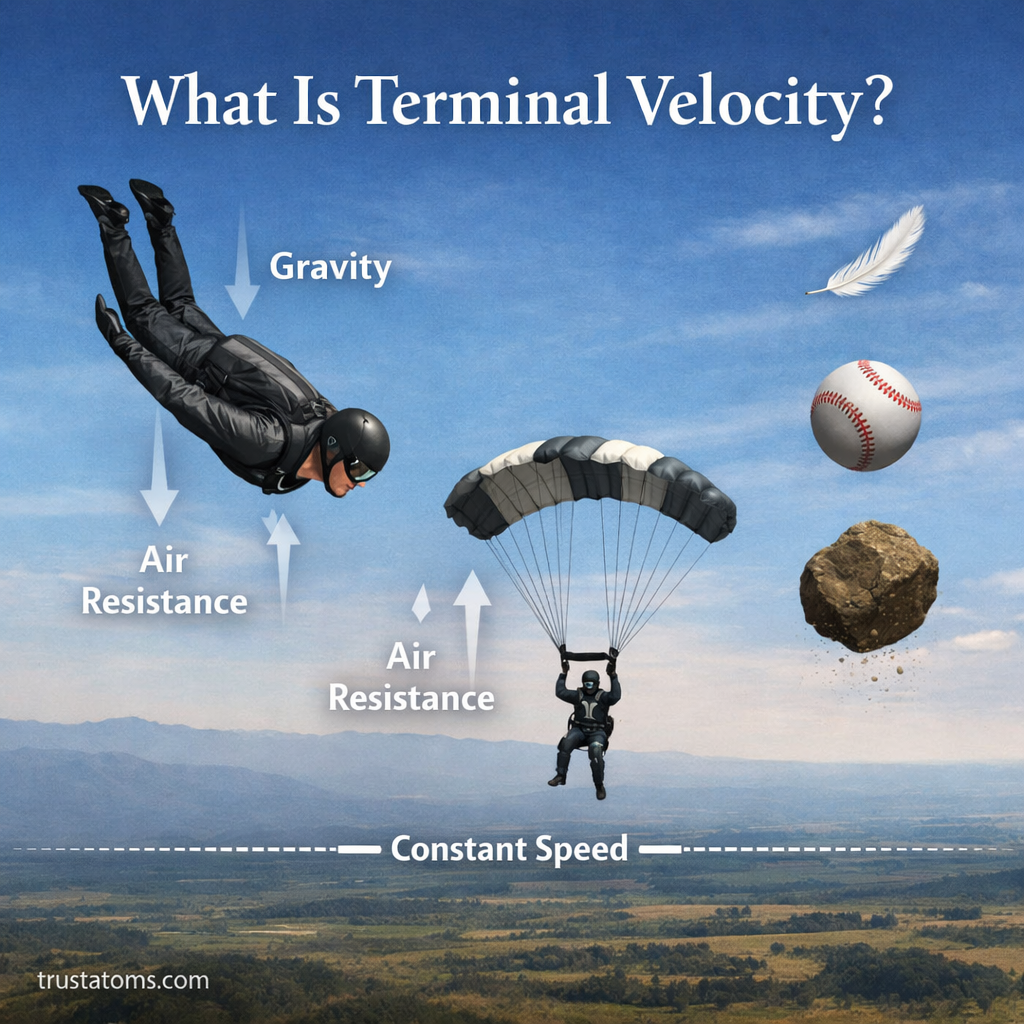
Terminal velocity is the maximum speed an object reaches while falling through a fluid, usually air, when the downward pull of gravity is balanced by the upward force of drag (air resistance). Once this balance occurs, the object stops accelerating and continues falling at a constant speed.
Understanding terminal velocity helps explain everyday phenomena such as why raindrops fall at limited speeds, how parachutes work, and why different objects fall at different rates in the atmosphere.
How Falling Objects Accelerate
When an object first begins to fall, gravity pulls it downward, causing the object to accelerate. Near Earth’s surface, gravity accelerates objects at approximately 9.8 meters per second squared (9.8 m/s²).
During the first moments of a fall:
- Gravity pulls the object downward.
- The object begins to accelerate.
- Air resistance starts to increase as speed increases.
At low speeds, air resistance is small, so the object accelerates quickly. As the object speeds up, air resistance grows stronger and begins pushing upward against the motion.
The Balance Between Gravity and Drag
Terminal velocity occurs when two forces become equal:
- Gravity (downward force)
- Drag or air resistance (upward force)
When these forces balance:
- Net force becomes zero
- Acceleration stops
- Velocity becomes constant
At this point, the object continues falling at a steady speed called terminal velocity.
What Determines Terminal Velocity?

Terminal velocity varies depending on several factors related to both the object and the environment.
1. Mass of the Object
Heavier objects generally reach higher terminal velocities because gravity exerts a stronger force on them.
However, mass alone does not determine terminal velocity. Shape and air resistance also play important roles.
2. Surface Area
Objects with larger surface areas experience more air resistance.
Examples include:
- A parachute
- A feather
- A sheet of paper
These objects encounter strong drag forces that reduce their terminal velocity.
3. Shape and Aerodynamics
Streamlined shapes reduce drag.
Examples:
- Skydivers in a head-down position fall faster.
- Flat objects or spread-out bodies create more drag and fall slower.
4. Air Density
Terminal velocity also depends on the density of the fluid the object moves through.
Higher air density creates stronger drag forces. This means objects reach lower terminal velocities in dense air compared to thin air.
Example: Skydivers and Terminal Velocity
Skydiving provides one of the most well-known examples of terminal velocity.
When a skydiver jumps from an aircraft:
- They accelerate downward due to gravity.
- Air resistance increases as their speed increases.
- After several seconds, forces balance and they reach terminal velocity.
Typical terminal velocities for skydivers:
- Belly-to-earth position: about 120 mph (193 km/h)
- Head-down position: up to 200 mph (322 km/h)
When the parachute opens, surface area increases dramatically, creating enormous drag and reducing terminal velocity to a safe landing speed.
Terminal Velocity of Common Objects
Different objects reach very different terminal velocities because of variations in mass, shape, and surface area.
Examples include:
- Raindrops: about 20–30 km/h
- Human skydiver: about 193 km/h
- Baseball: roughly 150 km/h
- Feather: extremely slow due to high air resistance
These differences explain why light or flat objects appear to float downward while dense objects fall more quickly.
Why Terminal Velocity Matters
Terminal velocity plays an important role in many scientific and engineering applications.
Physics and Engineering
Scientists use terminal velocity concepts when studying motion, drag forces, and fluid dynamics.
Applications include:
- Aircraft design
- Rocket reentry physics
- Vehicle aerodynamics
Safety Equipment
Understanding terminal velocity allows engineers to design safety systems such as:
- Parachutes
- Skydiving equipment
- Protective gear for extreme sports
Meteorology
Meteorologists study the terminal velocities of precipitation particles such as raindrops, snowflakes, and hailstones to better understand weather patterns and storm dynamics.
Terminal Velocity in Space vs Earth
Terminal velocity only occurs when a fluid creates resistance, such as air or water.
In outer space, where there is essentially no atmosphere:
- There is no air resistance
- Objects continue accelerating under gravity
- Terminal velocity does not occur
This is why astronauts experience very different motion dynamics in space compared with objects falling through Earth’s atmosphere.
Key Takeaways
Terminal velocity is a fundamental concept in physics that describes the maximum speed reached by an object falling through a fluid.
Important points to remember:
- Terminal velocity occurs when gravity and drag forces balance.
- At terminal velocity, acceleration stops and speed becomes constant.
- Factors affecting terminal velocity include mass, surface area, shape, and air density.
- The concept explains phenomena ranging from skydiving and rainfall to aerodynamics and engineering design.
Understanding terminal velocity helps scientists and engineers predict how objects move through air and other fluids, making it a key principle in both physics education and real-world applications.