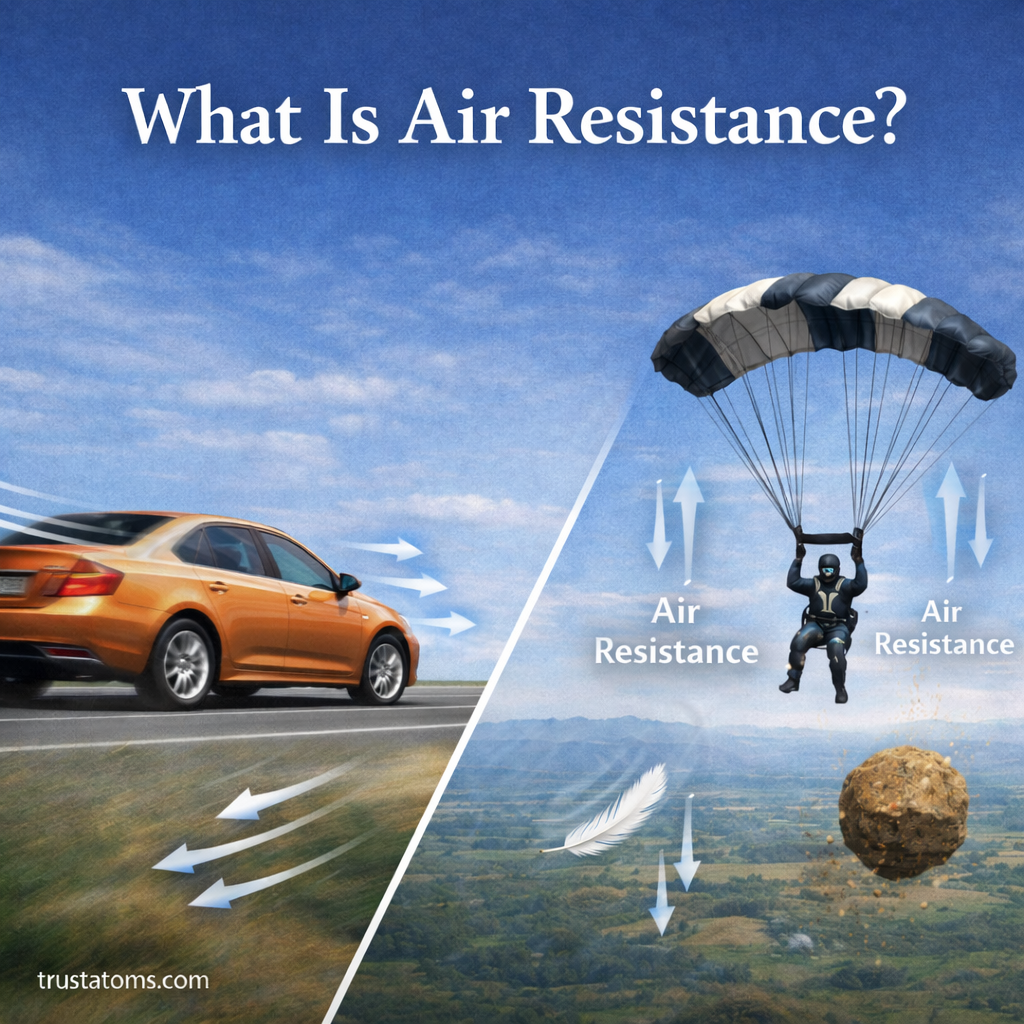
Air resistance is the force that opposes the motion of objects moving through air. It acts in the opposite direction of movement and slows objects down as they travel through the atmosphere.
In physics, air resistance is a type of drag force, which occurs whenever an object moves through a fluid. Although we often think of fluids as liquids like water, air is also a fluid, meaning it can flow and exert forces on moving objects.
Air resistance plays a major role in everyday situations—from falling leaves and parachutes to cars driving on highways and airplanes flying through the sky.
How Air Resistance Works
When an object moves through air, it must push air molecules out of the way. As this happens, the air pushes back against the object.
This interaction creates a force that resists motion.
The faster an object moves, the more air molecules it collides with, and the stronger the resistance becomes.
In simple terms:
- Moving object pushes through air
- Air molecules push back
- This pushback slows the object down
Because of this effect, air resistance increases with speed.
Air Resistance and Speed
One important feature of air resistance is that it increases as speed increases.
At low speeds, air resistance is relatively small. But as an object moves faster, the force grows significantly.
This is why:
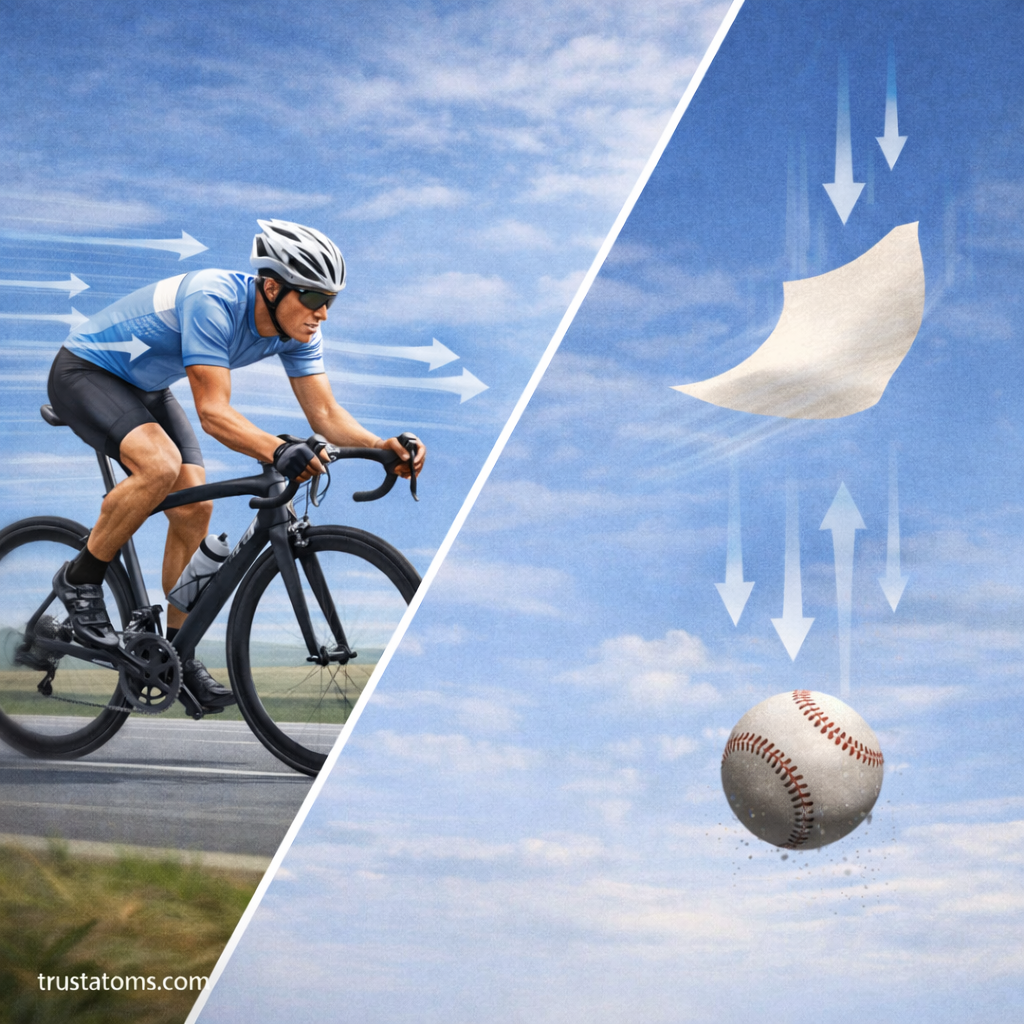
- Cyclists feel more wind pressure when riding faster
- Cars require more energy to travel at higher speeds
- Skydivers eventually stop accelerating during a fall
At very high speeds, air resistance becomes one of the most important forces affecting motion.
Factors That Affect Air Resistance
Several characteristics determine how much air resistance an object experiences.
1. Speed of the Object
Speed is one of the biggest factors.
- Faster objects encounter more air molecules per second.
- This increases the opposing force.
For example, a runner feels more wind resistance when sprinting compared to jogging.
2. Surface Area
Objects with larger surface areas encounter more air resistance.
Examples include:
- A parachute
- A large umbrella
- A flat sheet of paper
These shapes push more air aside, increasing the drag force.
3. Shape of the Object
Aerodynamic shapes reduce air resistance by allowing air to flow smoothly around them.
Examples:
- Airplanes
- Racing bicycles
- Sports cars
In contrast, blunt or irregular shapes create turbulence and experience greater resistance.
4. Air Density
Air resistance also depends on how dense the air is.
Denser air contains more molecules, which increases drag.
Air density can change depending on:
- Altitude
- Temperature
- Weather conditions
For example, airplanes experience less air resistance at higher altitudes where the air is thinner.
Everyday Examples of Air Resistance
Air resistance influences many common experiences.
Parachuting
When a parachute opens, it increases the skydiver’s surface area dramatically. This creates strong air resistance that slows the descent and allows for a safe landing.
Driving a Car
Cars experience air resistance as they move forward. At highway speeds, a large portion of a vehicle’s fuel consumption goes toward overcoming drag.
Falling Objects
Air resistance affects how fast objects fall.
For example:
- A feather falls slowly because air resistance is large compared to its weight.
- A rock falls quickly because its weight overpowers the drag force.
Sports
Athletes often try to reduce air resistance to improve performance.
Examples include:
- Cyclists wearing aerodynamic helmets
- Swimmers wearing smooth racing suits
- Skiers crouching to reduce drag
Air Resistance and Terminal Velocity
Air resistance is the key reason objects reach terminal velocity.
As an object falls:
- Gravity pulls it downward.
- Air resistance pushes upward.
- The faster it falls, the stronger the air resistance becomes.
Eventually, the upward drag force equals the downward force of gravity.
At that point:
- Acceleration stops
- The object continues falling at a constant speed
This constant speed is called terminal velocity.
Why Air Resistance Matters
Air resistance is an essential concept in physics and engineering.
Understanding it helps scientists and engineers design systems that move efficiently through air.
Important applications include:
- Aircraft and drone design
- Automobile aerodynamics
- Rocket launches
- Sports performance equipment
Reducing air resistance often improves efficiency, saves energy, and increases speed.
Key Takeaways
Air resistance is the force that opposes motion when objects move through air.
Important points include:
- It is a type of drag force.
- It increases as an object’s speed increases.
- Surface area, shape, and air density all affect the strength of air resistance.
- It plays a key role in phenomena such as falling objects, vehicle efficiency, and parachuting.
- Air resistance is responsible for the formation of terminal velocity during free fall.
By understanding air resistance, scientists can better predict motion and design technologies that interact efficiently with the atmosphere.