Collisions are a fundamental part of physics and occur whenever two objects come into contact and exert forces on each other. From bouncing balls to car crashes and atomic particle interactions, collisions help scientists understand how energy and motion behave.
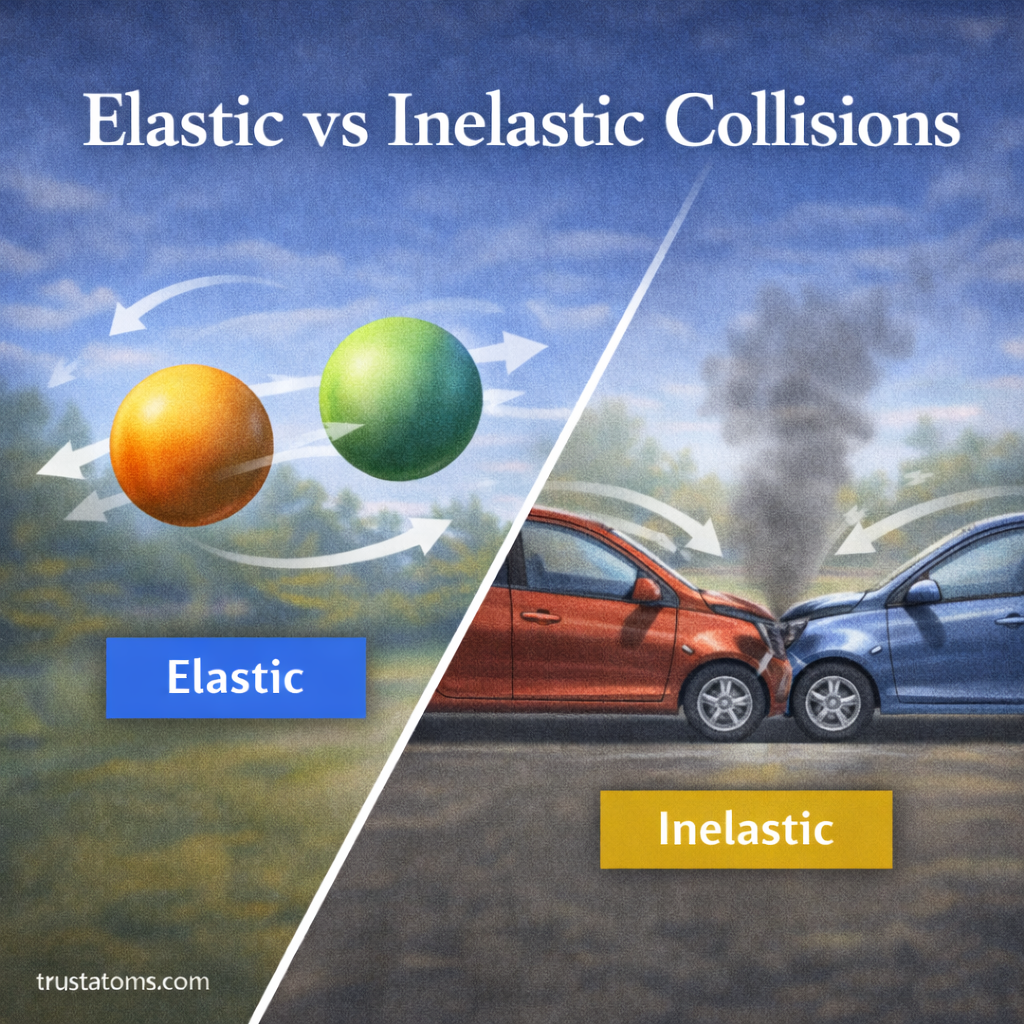
Two major types of collisions studied in physics are elastic collisions and inelastic collisions. The key difference between them lies in how kinetic energy behaves during the interaction.
Understanding the distinction between elastic and inelastic collisions helps explain many everyday phenomena and plays an important role in fields such as engineering, transportation safety, and particle physics.
What Is a Collision in Physics?
In physics, a collision occurs when two objects interact through forces for a short period of time.
During a collision:
- Objects exert forces on each other
- Their velocities change
- Energy may transfer between them
One principle always holds true in collisions within an isolated system: momentum is conserved. This means the total momentum before the collision equals the total momentum after the collision.
However, kinetic energy behaves differently depending on the type of collision.
What Is an Elastic Collision?
An elastic collision is a collision in which both momentum and kinetic energy are conserved.
This means that:
- The total momentum before and after the collision remains the same.
- The total kinetic energy of the system also remains unchanged.
In elastic collisions, objects typically bounce off each other without permanent deformation or energy loss to heat or sound.
Characteristics of Elastic Collisions
Elastic collisions usually involve the following features:
- Objects rebound after impact
- Kinetic energy is preserved
- No lasting deformation occurs
- Energy is not converted into heat or sound
Examples of Elastic Collisions
Elastic collisions can occur in many situations, especially at small scales.
Examples include:
- Collisions between molecules in gases
- Billiard balls striking each other
- Certain types of rubber balls bouncing off a hard surface
- Atomic and subatomic particle interactions
In ideal physics models, billiard ball collisions are often treated as nearly elastic because the balls bounce cleanly and retain most of their kinetic energy.
What Is an Inelastic Collision?
An inelastic collision occurs when momentum is conserved but kinetic energy is not fully conserved.
In these collisions, some kinetic energy is converted into other forms of energy, such as:
- Heat
- Sound
- Deformation
- Internal energy
As a result, the objects may not bounce apart as strongly or may even stick together after the collision.
Characteristics of Inelastic Collisions
Inelastic collisions often involve:
- Energy loss from kinetic energy
- Deformation of objects
- Generation of heat or sound
- Reduced rebound after impact
Examples of Inelastic Collisions
Many everyday collisions are inelastic.
Examples include:
- Car crashes
- A lump of clay hitting the ground
- A dropped egg splattering on the floor
- A baseball hitting a glove
In these cases, energy is absorbed by the objects or surrounding environment.
Perfectly Inelastic Collisions
A special type of inelastic collision is called a perfectly inelastic collision.
In this scenario:
- The objects stick together after impact.
- They move as a single combined object.
Even though kinetic energy is lost, momentum is still conserved.
Examples include:
- Two train cars coupling together
- Two lumps of clay sticking together
- Objects colliding and moving together afterward
Perfectly inelastic collisions represent the maximum loss of kinetic energy in a collision.
Key Differences Between Elastic and Inelastic Collisions
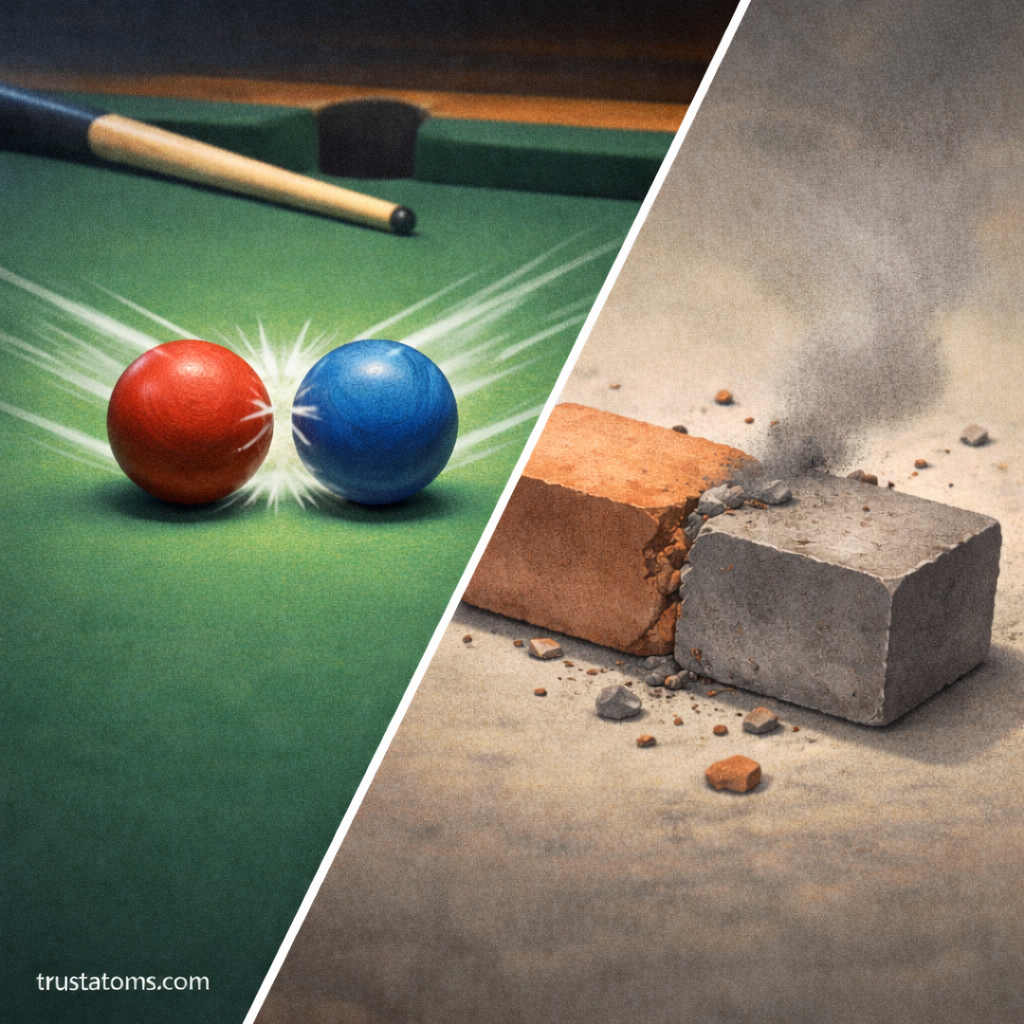
Elastic and inelastic collisions differ mainly in how energy behaves during the interaction.
Elastic collisions:
- Momentum is conserved
- Kinetic energy is conserved
- Objects typically bounce apart
- Minimal energy conversion occurs
Inelastic collisions:
- Momentum is conserved
- Kinetic energy decreases
- Energy converts to heat, sound, or deformation
- Objects may stick together or deform
These differences are crucial for predicting motion and understanding real-world impacts.
Why Collisions Matter in Physics
Studying collisions helps scientists and engineers analyze motion and energy transfer in many systems.
Important applications include:
- Vehicle safety and crash testing
- Sports physics (bouncing balls, impacts)
- Aerospace engineering
- Particle accelerators
- Robotics and machinery design
By understanding how collisions behave, engineers can design safer vehicles, improve protective equipment, and develop better technology.
Collisions in the Real World
In everyday life, most collisions are partially inelastic. This means some kinetic energy is lost, but the objects do not necessarily stick together completely.
For example:
- A basketball hitting the floor loses some energy but still bounces.
- A tennis ball slows down slightly after each bounce.
- A car bumper absorbs impact energy during a crash.
These energy losses help reduce damage or dissipate forces.
Key Takeaways
Elastic and inelastic collisions describe how energy behaves when objects collide.
Important points to remember:
- Momentum is conserved in all collisions within an isolated system.
- Elastic collisions conserve both momentum and kinetic energy.
- Inelastic collisions conserve momentum but lose some kinetic energy.
- Perfectly inelastic collisions cause objects to stick together.
- Most real-world collisions fall somewhere between elastic and perfectly inelastic.
Understanding these concepts helps explain motion, impact forces, and energy transfer throughout the physical world.