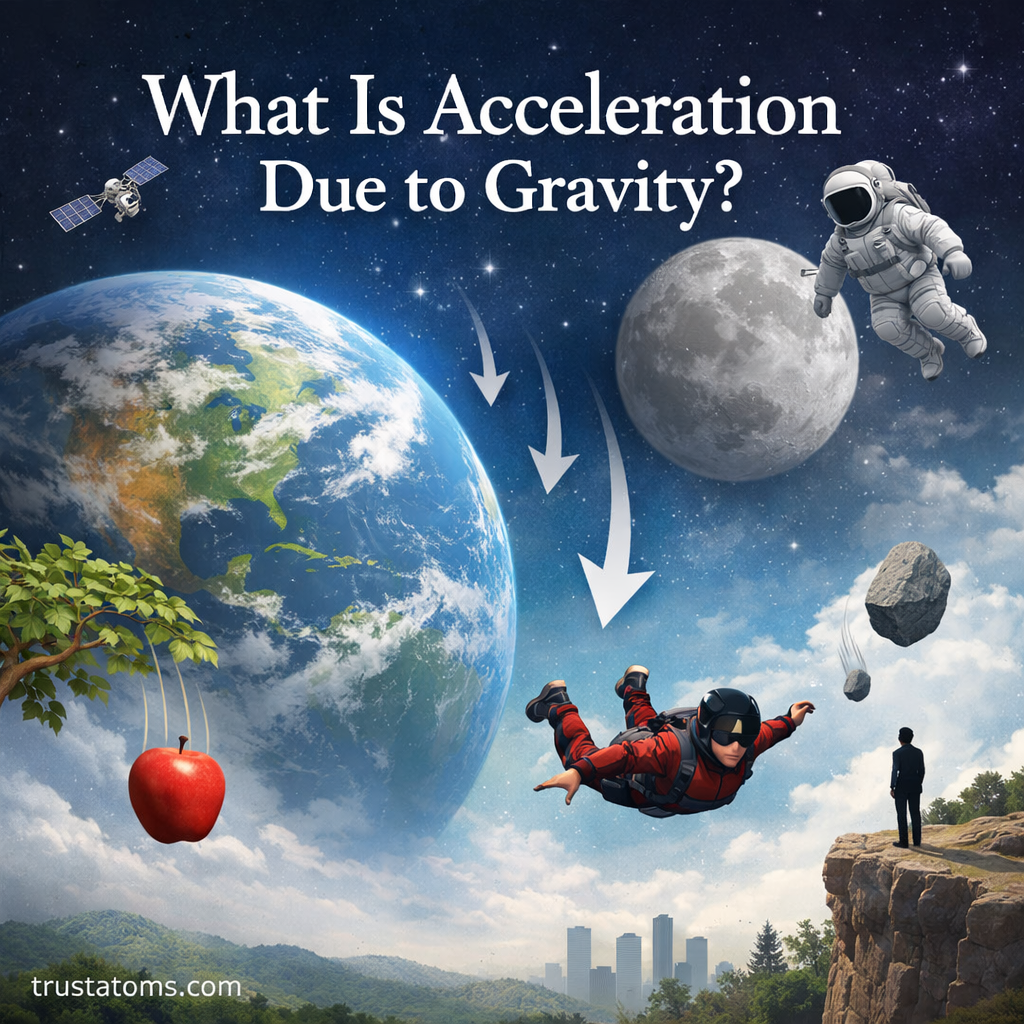
Acceleration due to gravity is one of the most fundamental concepts in physics. It describes how objects accelerate when they fall toward a massive body, such as Earth. Whether you drop a ball, jump into the air, or watch rain fall, the motion you see is controlled by gravity.
Understanding acceleration due to gravity helps explain everything from everyday motion on Earth to the movement of planets, satellites, and spacecraft.
Understanding Acceleration
Before discussing gravity specifically, it helps to understand acceleration in general.
Acceleration refers to the rate at which velocity changes over time. This change can involve:
- Speeding up
- Slowing down
- Changing direction
Acceleration is measured in meters per second squared (m/s²).
For example:
- A car that increases speed from 0 to 20 m/s in 4 seconds is accelerating.
- A turning car is also accelerating because its direction changes.
When gravity causes this change in velocity, we call it acceleration due to gravity.
What Is Acceleration Due to Gravity?
Acceleration due to gravity is the acceleration experienced by an object when it is falling under the influence of gravity alone.
On Earth, this value is approximately:
9.8 meters per second squared (9.8 m/s²)
This means that every second an object falls, its speed increases by about 9.8 meters per second.
For example:
- After 1 second of falling → speed ≈ 9.8 m/s
- After 2 seconds → speed ≈ 19.6 m/s
- After 3 seconds → speed ≈ 29.4 m/s
This constant acceleration is usually represented by the symbol:
g
So when physicists refer to g, they mean the acceleration caused by gravity.
Why Gravity Causes Acceleration
Gravity is a force that pulls objects with mass toward each other. On Earth, the planet’s massive size creates a strong gravitational pull that attracts objects toward its center.
According to Newton’s laws of motion:
- A force acting on an object produces acceleration.
- The greater the force, the greater the acceleration (for a given mass).
Since gravity constantly pulls objects downward, it continuously increases their speed as they fall.
This is why dropped objects accelerate until they hit the ground or encounter air resistance.
The Formula for Acceleration Due to Gravity
The acceleration caused by gravity can be calculated using Newton’s law of universal gravitation:g=R2GM
Where:
- G = gravitational constant
- M = mass of the planet
- R = distance from the planet’s center
This equation shows that gravity depends on two main factors:
- Mass of the object creating gravity
- Distance from its center
Because Earth is very massive and relatively compact, its gravitational acceleration is strong enough to hold the atmosphere and keep objects firmly on the surface.
Why the Value of g Is About 9.8 m/s² on Earth
Earth’s mass and radius determine the value of its gravitational acceleration.
Key factors include:
- Earth’s mass: 5.97 × 10²⁴ kg
- Earth’s average radius: 6,371 km
When these values are inserted into the gravitational formula, the result is approximately:
9.8 m/s²
However, this value is an average. In reality, the acceleration due to gravity varies slightly across Earth.
Small differences occur because of:
- Earth’s rotation
- Changes in altitude
- Variations in geological density
For example:
- Near the poles → gravity is slightly stronger
- Near the equator → gravity is slightly weaker
Do All Objects Fall at the Same Rate?
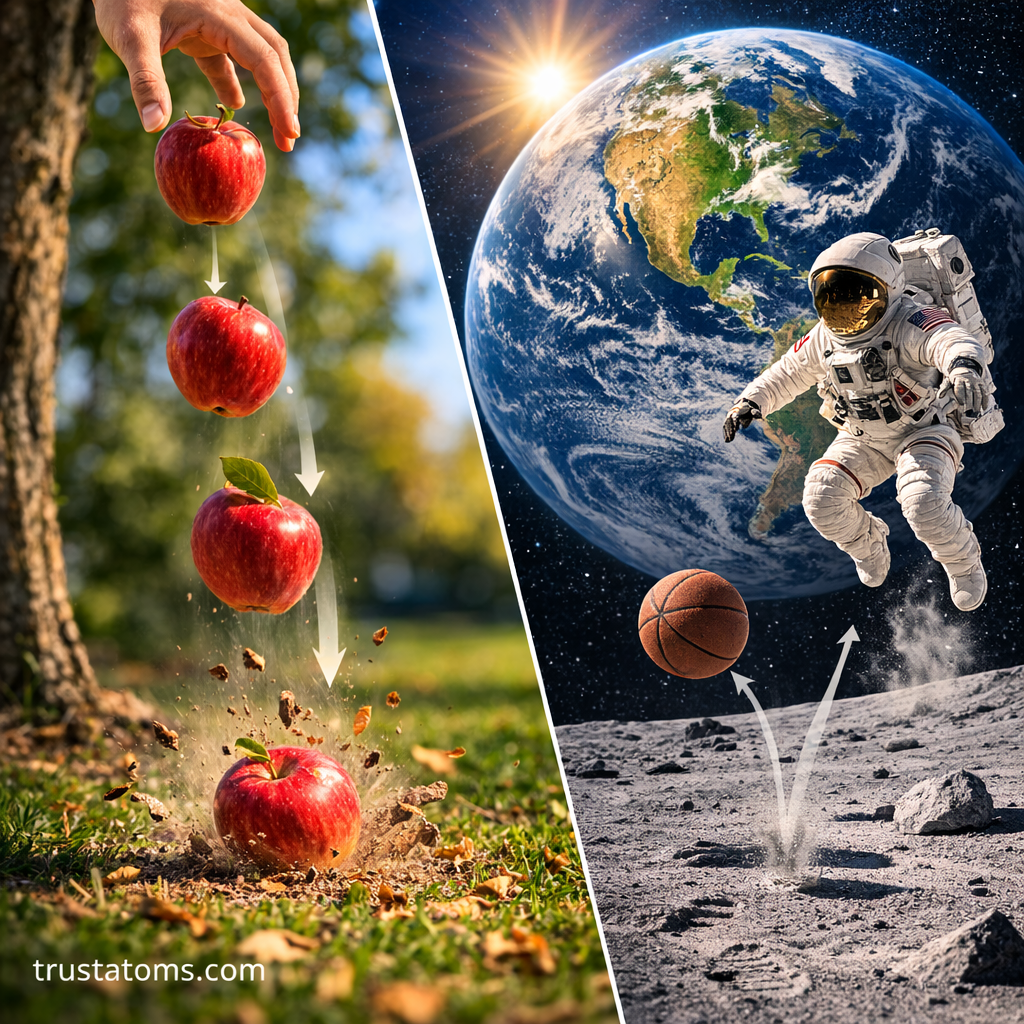
One of the most surprising results of gravity experiments is that all objects fall with the same acceleration in a vacuum, regardless of their mass.
This idea was famously demonstrated in experiments often associated with Galileo Galilei.
In the absence of air resistance:
- A hammer and a feather fall at the same rate.
- A bowling ball and a tennis ball accelerate equally.
This happens because gravity accelerates objects independently of their mass.
A famous demonstration occurred during the Apollo 15 mission, when astronaut David Scott dropped a hammer and a feather on the Moon. Without air resistance, both hit the ground simultaneously.
The Role of Air Resistance
In everyday life, objects do not always fall at the same speed because of air resistance.
Air resistance is a force that opposes motion through the atmosphere.
Factors that affect air resistance include:
- Shape of the object
- Surface area
- Speed of the object
- Air density
For example:
- A feather falls slowly because air resistance is large compared to its weight.
- A rock falls quickly because its weight overwhelms air resistance.
Eventually, some falling objects reach terminal velocity, where gravity and air resistance balance out and acceleration stops.
Acceleration Due to Gravity on Other Planets
Gravity is not the same everywhere in the universe. The acceleration due to gravity depends on the mass and size of the celestial body.
Examples include:
| Planet | Approximate Gravity |
|---|---|
| Mercury | 3.7 m/s² |
| Mars | 3.7 m/s² |
| Moon | 1.62 m/s² |
| Jupiter | 24.8 m/s² |
| Earth | 9.8 m/s² |
Because the Moon’s gravity is weaker, astronauts can jump much higher there than on Earth.
On Jupiter, however, gravity is much stronger, meaning objects would accelerate downward far more quickly.
Real-World Examples of Gravity in Action
Acceleration due to gravity affects many real-world situations.
Falling Objects
Examples include:
- Dropping a book
- Rain falling from clouds
- A skydiver jumping from a plane
Each object accelerates downward due to gravity.
Sports
Athletes constantly interact with gravitational acceleration:
- Basketball shots follow curved trajectories.
- Long jumps depend on gravity pulling the athlete back down.
- Baseball pitches arc toward the ground.
Space Exploration
Gravity determines how spacecraft move.
Examples include:
- Rocket launches overcoming Earth’s gravitational pull
- Satellites orbiting the planet
- Space probes using gravitational assists
Understanding gravitational acceleration is essential for planning safe and efficient space missions.
Free Fall and Gravitational Motion
When an object moves only under the influence of gravity, it is said to be in free fall.
Examples include:
- A dropped object
- A skydiver before the parachute opens
- Objects orbiting Earth
Even astronauts aboard the International Space Station are technically in free fall. They appear weightless because they are constantly falling toward Earth while moving sideways fast enough to remain in orbit.
Why Acceleration Due to Gravity Matters in Physics
Acceleration due to gravity plays a central role in many areas of physics.
It helps scientists understand:
- Motion and mechanics
- Planetary orbits
- Tides in Earth’s oceans
- The structure of stars and galaxies
The concept also connects classical physics to modern fields like astrophysics and cosmology.
Scientific study of gravity has advanced from Newton’s laws to Einstein’s theory of general relativity, which describes gravity as the curvature of spacetime caused by mass.
Gravity and the Structure of Matter
Gravity also plays a role in shaping large-scale structures in the universe and influences how matter organizes in systems ranging from planets to galaxies. Scientific studies of biological and cellular structures also occur within gravitational environments, affecting how organisms evolve and function in complex systems.
Final Thoughts
Acceleration due to gravity describes how quickly objects speed up as they fall toward a massive body. On Earth, this acceleration averages 9.8 m/s², meaning falling objects gain speed rapidly with each passing second.
Although gravity feels constant in everyday life, it varies across the universe depending on planetary size and mass. From falling apples to orbiting satellites, gravitational acceleration governs motion on both small and cosmic scales.
Understanding this concept provides a foundation for physics, engineering, space exploration, and our broader understanding of how the universe works.