In physics, describing motion accurately requires understanding two closely related concepts: distance and displacement. Although these terms may seem similar in everyday conversation, they have distinct meanings in scientific measurements.
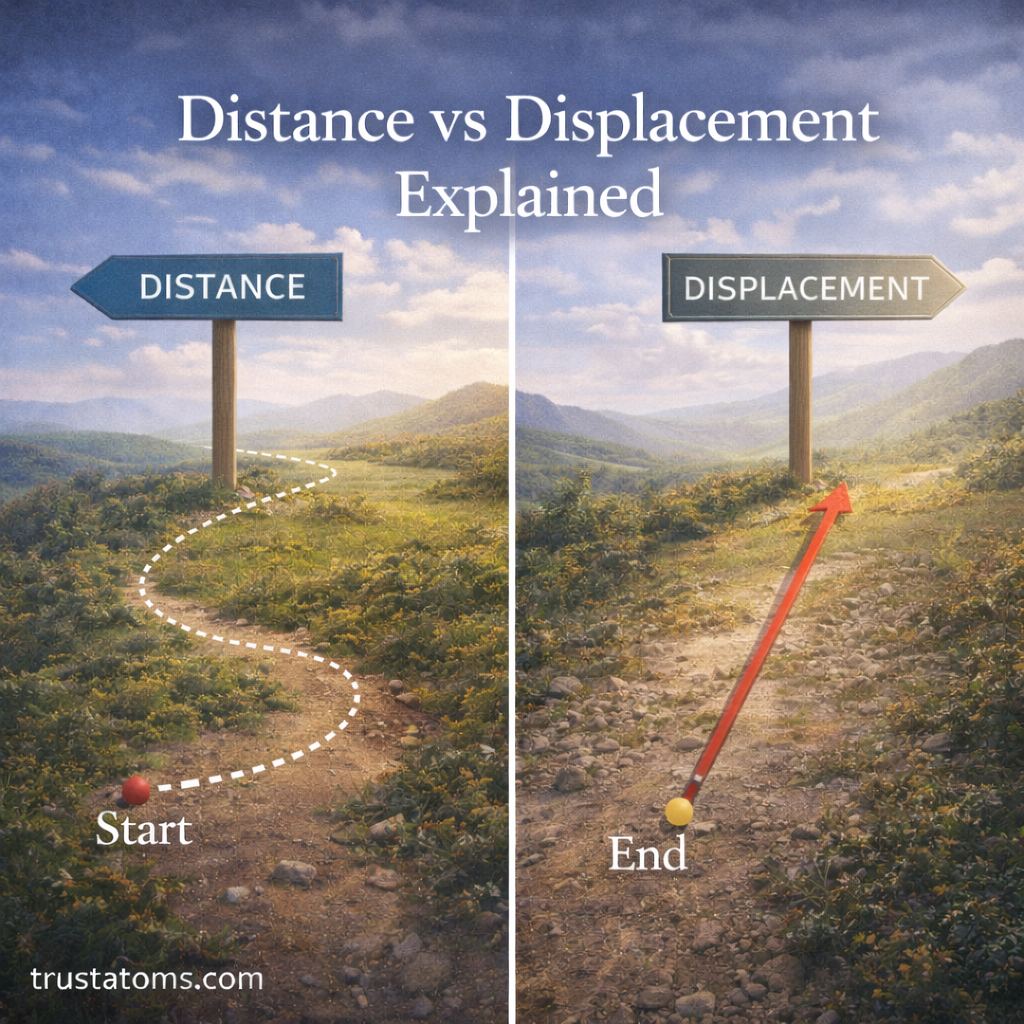
Distance refers to how far an object travels, while displacement describes how far an object moves from its starting point in a specific direction.
Understanding the difference between these two concepts is essential for studying motion, velocity, and many other topics in physics.
What Is Distance?
Distance is the total length of the path traveled by an object, regardless of direction.
Distance is a scalar quantity, which means it only has magnitude and no direction.
Key Characteristics of Distance
Distance has several important properties:
- It measures the entire path traveled
- It is always positive
- It does not include direction
- It is measured in units such as meters (m) or kilometers (km)
Example of Distance
Imagine walking around a circular track that is 400 meters long.
If you complete one full lap, your distance traveled is:
400 meters
If you walk two laps, your distance becomes:
800 meters
Distance simply adds up the length of the path you traveled.
What Is Displacement?
Displacement describes the shortest straight-line distance from the starting point to the final position of an object, including the direction.
Displacement is a vector quantity, meaning it has both magnitude and direction.
Key Characteristics of Displacement
Displacement differs from distance in several ways:
- It measures the change in position
- It includes direction
- It represents the shortest path between two points
- It can be positive, negative, or zero
Displacement is usually expressed using direction such as:
- North
- South
- East
- West
- Upward or downward
Distance vs Displacement: The Key Difference
Although both terms describe motion, the major difference lies in how they measure movement.
| Feature | Distance | Displacement |
|---|---|---|
| Type | Scalar | Vector |
| Includes direction | No | Yes |
| Path considered | Total path traveled | Shortest path |
| Possible value | Always positive | Positive, negative, or zero |
In many situations, distance and displacement may have the same value, but they often differ depending on the path taken.
Example: Walking in a Straight Line
Consider a person walking 10 meters east.
Distance traveled:
10 meters
Displacement:
10 meters east
Because the person moved in a straight line, distance and displacement are the same.
Example: Walking Back and Forth
Now imagine the person walks:
- 10 meters east
- Then 10 meters west back to the starting point
Distance traveled:
10 m + 10 m = 20 meters
Displacement:
0 meters
The person ended exactly where they started, so their displacement is zero even though they traveled 20 meters.
Example: Motion Around a Circular Track
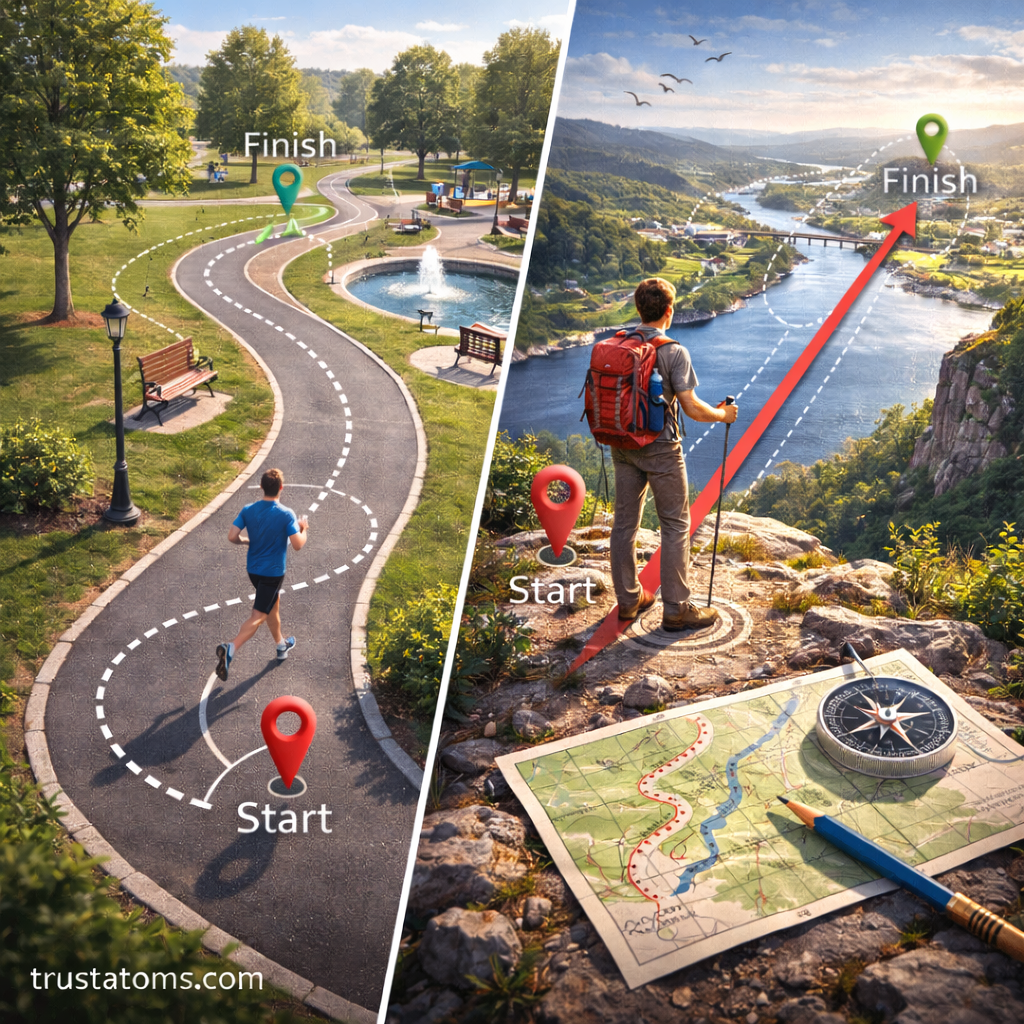
A runner completes one full lap around a circular track.
Distance traveled:
400 meters
Displacement:
0 meters
Even though the runner covered a long path, the starting and ending positions are the same.
Why Distance and Displacement Matter in Physics
Distance and displacement are foundational concepts in physics because they are used to define other motion-related quantities.
For example:
- Speed uses distance
- Velocity uses displacement
Speed
Speed measures how fast something moves based on distance traveled over time.
Example:
Speed = distance ÷ time
Velocity
Velocity measures how fast something moves in a specific direction.
Example:
Velocity = displacement ÷ time
Because velocity includes direction, it depends on displacement rather than distance.
Visualizing Distance and Displacement
Understanding these concepts is easier when imagining paths and positions.
Distance
Distance follows the actual route taken.
Examples include:
- Driving along curved roads
- Walking through a winding hiking trail
- Running around a sports track
Displacement
Displacement connects the starting point and final position directly.
Examples include:
- The straight-line distance between two cities
- A drone flying directly from point A to point B
- A person walking across a field in a straight line
Real-Life Examples
Distance and displacement appear in many everyday situations.
Navigation and Travel
When driving, your GPS might show:
- Total distance of a trip
- Straight-line distance between cities
The first is distance, while the second represents displacement.
Sports and Fitness
Athletes often track:
- Distance run during a workout
- Position changes during gameplay
These measurements help analyze performance and movement.
Physics Experiments
Scientists studying motion must distinguish between:
- Total path length (distance)
- Change in position (displacement)
This distinction allows accurate calculations of velocity and acceleration.
When Distance and Displacement Are Equal
Distance and displacement are equal only when an object moves:
- In a straight line
- In one direction
- Without turning back
Examples include:
- A car driving straight down a road
- A runner sprinting forward on a straight track
- A ball rolling across a flat surface
If the path curves or the object reverses direction, distance will always be greater than displacement.
Common Misunderstandings
Students often confuse distance and displacement because they both involve measuring movement.
Common misconceptions include:
- Assuming they are always equal
- Ignoring the importance of direction
- Forgetting that displacement can be zero
Remember:
Distance measures how much ground was covered, while displacement measures how far the position changed.
Final Thoughts
Distance and displacement are two important ways of describing motion in physics.
Distance measures the total length of the path traveled, while displacement measures the straight-line change in position from start to finish.
Although they may sometimes have the same value, they represent different aspects of motion. Understanding this distinction is essential for studying speed, velocity, and many other concepts in physics.