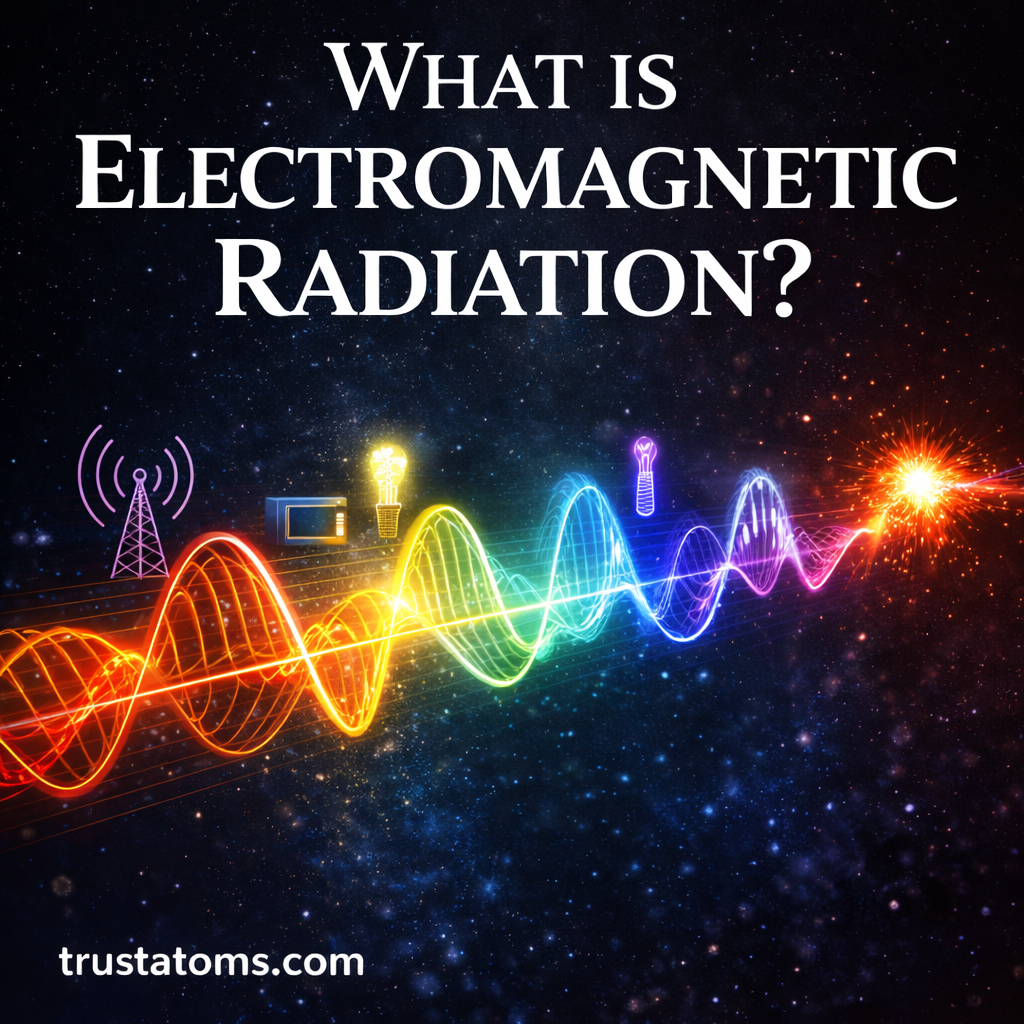
Electromagnetic radiation is a fundamental form of energy that travels through space as waves made of electric and magnetic fields. It surrounds us constantly and plays a major role in both natural phenomena and modern technology.
Sunlight, radio signals, X-rays, and microwaves are all examples of electromagnetic radiation. Although these forms of energy behave differently in everyday use, they are all part of the same physical system known as the electromagnetic spectrum.
Understanding electromagnetic radiation helps explain how light travels, how wireless communication works, and how scientists observe the universe.
What Is Electromagnetic Radiation?
Electromagnetic radiation is energy that moves through space in the form of electromagnetic waves.
These waves are made of two linked components:
- An electric field
- A magnetic field
The fields oscillate perpendicular to each other and move forward through space together, carrying energy.
Unlike sound waves or ocean waves, electromagnetic waves do not require a medium such as air or water to travel. This means they can move through the vacuum of space.
For example:
- Sunlight travels from the Sun to Earth across empty space.
- Radio waves travel through the atmosphere to deliver signals.
- X-rays pass through the body to create medical images.
How Electromagnetic Radiation Works
Electromagnetic radiation moves in waves that transport energy through space.
Each electromagnetic wave has several important properties:
- Wavelength – the distance between peaks of a wave
- Frequency – how many wave cycles pass a point per second
- Energy – the amount of energy carried by the wave
These properties are connected. In general:
- Higher frequency waves carry more energy
- Shorter wavelengths correspond to higher frequencies
This relationship is why different types of electromagnetic radiation have different uses and effects.
For example:
- Radio waves have long wavelengths and low energy.
- X-rays have very short wavelengths and much higher energy.
The Electromagnetic Spectrum
All types of electromagnetic radiation form a continuous range called the electromagnetic spectrum.
The spectrum is organized from the lowest-energy waves to the highest-energy waves.
Main Types of Electromagnetic Radiation
- Radio waves
- Microwaves
- Infrared radiation
- Visible light
- Ultraviolet radiation
- X-rays
- Gamma rays
Each category differs in wavelength, frequency, and energy.
Radio Waves
Radio waves have the longest wavelengths and lowest energy in the electromagnetic spectrum.
They are commonly used for communication technologies such as:
- Radio broadcasting
- Television signals
- Wi-Fi networks
- GPS communication
Because radio waves carry relatively low energy, they are generally safe for everyday use.
Microwaves
Microwaves have shorter wavelengths than radio waves and slightly higher energy.
Common uses include:
- Microwave ovens
- Radar systems
- Satellite communications
- Wireless internet signals
Microwaves interact strongly with water molecules, which is why they are effective for heating food.
Infrared Radiation
Infrared radiation is often associated with heat.
Objects that emit heat—such as warm bodies, fires, and machinery—release infrared radiation.
Infrared technology is used in:
- Thermal imaging cameras
- Night vision devices
- Remote controls
- Heat sensors
Although humans cannot see infrared radiation, many animals can detect it.
Visible Light
Visible light is the small portion of the electromagnetic spectrum that the human eye can detect.
It includes all the colors we see, from red to violet.
Visible light allows us to:
- See objects
- Observe the natural world
- Study distant stars and galaxies
Sunlight contains the full range of visible light wavelengths.
Ultraviolet Radiation
Ultraviolet (UV) radiation has higher energy than visible light.
It is produced naturally by the Sun and can affect living organisms.
Moderate exposure helps the body produce vitamin D, but excessive exposure can cause:
- Sunburn
- Skin damage
- Increased risk of skin cancer
UV radiation is also used in technologies such as sterilization and forensic detection.
X-Rays
X-rays are high-energy electromagnetic waves that can pass through many materials.
Because of this ability, they are widely used in medicine for imaging bones and internal structures.
Other applications include:
- Airport security scanners
- Industrial inspection
- Scientific research
However, high doses of X-rays can damage biological tissues, so medical imaging carefully controls exposure levels.
Gamma Rays
Gamma rays have the highest energy and shortest wavelengths in the electromagnetic spectrum.
They are produced by extremely energetic processes such as:
- Nuclear reactions
- Radioactive decay
- Exploding stars
- Black hole activity
Gamma rays are powerful enough to penetrate many materials and can be harmful to living cells.
In controlled settings, gamma radiation is used in:
- Cancer treatment (radiation therapy)
- Sterilizing medical equipment
- Scientific research
How Electromagnetic Radiation Is Produced
Electromagnetic radiation is produced when charged particles accelerate or change motion.
This often occurs when electrons move within atoms or electrical systems.
Common sources of electromagnetic radiation include:
- The Sun and other stars
- Lightning
- Radio transmitters
- Electronic devices
- Nuclear reactions
When charged particles move or shift energy levels, they release energy in the form of electromagnetic waves.
How Electromagnetic Radiation Travels
Electromagnetic radiation travels at the speed of light, approximately:
300,000 kilometers per second
(186,000 miles per second)
Because electromagnetic waves can move through empty space, they allow energy and information to travel across vast cosmic distances.
For example:
- Sunlight reaches Earth in about 8 minutes
- Light from distant stars may travel millions of years before reaching telescopes on Earth
Everyday Uses of Electromagnetic Radiation
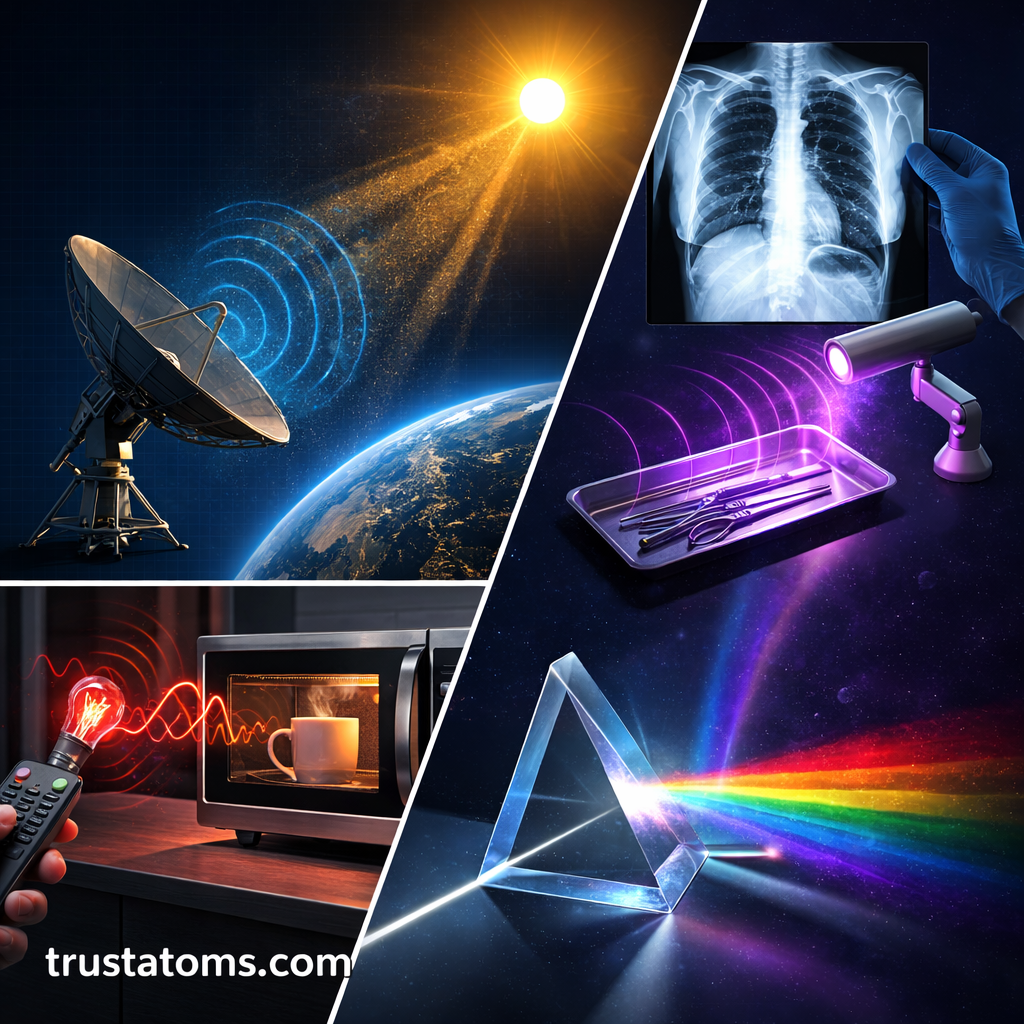
Electromagnetic radiation is essential to modern life and technology.
Some everyday applications include:
Communication
Wireless technologies rely on electromagnetic waves to transmit information.
Examples include:
- Radio broadcasts
- Television signals
- Cell phone networks
- Wi-Fi communication
- Satellite transmissions
Medicine
Medical science uses several forms of electromagnetic radiation.
Examples include:
- X-ray imaging
- Radiation therapy for cancer
- MRI and diagnostic scanning support technologies
- Ultraviolet sterilization
Astronomy
Astronomers study electromagnetic radiation to understand the universe.
By observing different wavelengths of radiation, scientists can learn about:
- Stars
- Galaxies
- Black holes
- Planetary systems
- Cosmic background radiation
Telescopes are designed to detect different parts of the electromagnetic spectrum.
Household Technology
Many common devices rely on electromagnetic radiation.
Examples include:
- Microwave ovens
- Remote controls
- Wireless routers
- Bluetooth devices
- Infrared sensors
These technologies use different parts of the spectrum to perform specific functions.
Why Electromagnetic Radiation Matters
Electromagnetic radiation is one of the most important ways energy moves through the universe.
It enables:
- Light from stars to reach distant planets
- Wireless communication across the globe
- Medical imaging and treatments
- Scientific observations of space
Without electromagnetic radiation, many natural processes and modern technologies would not exist.
Final Thoughts
Electromagnetic radiation is energy that travels through space as oscillating electric and magnetic fields. Although invisible in most forms, it surrounds us constantly and powers many aspects of modern science and technology.
From radio waves carrying signals across continents to gamma rays produced in distant galaxies, electromagnetic radiation connects everyday life to the broader workings of the universe. By studying this form of energy, scientists continue to uncover new insights about both our planet and the cosmos.