Introduction
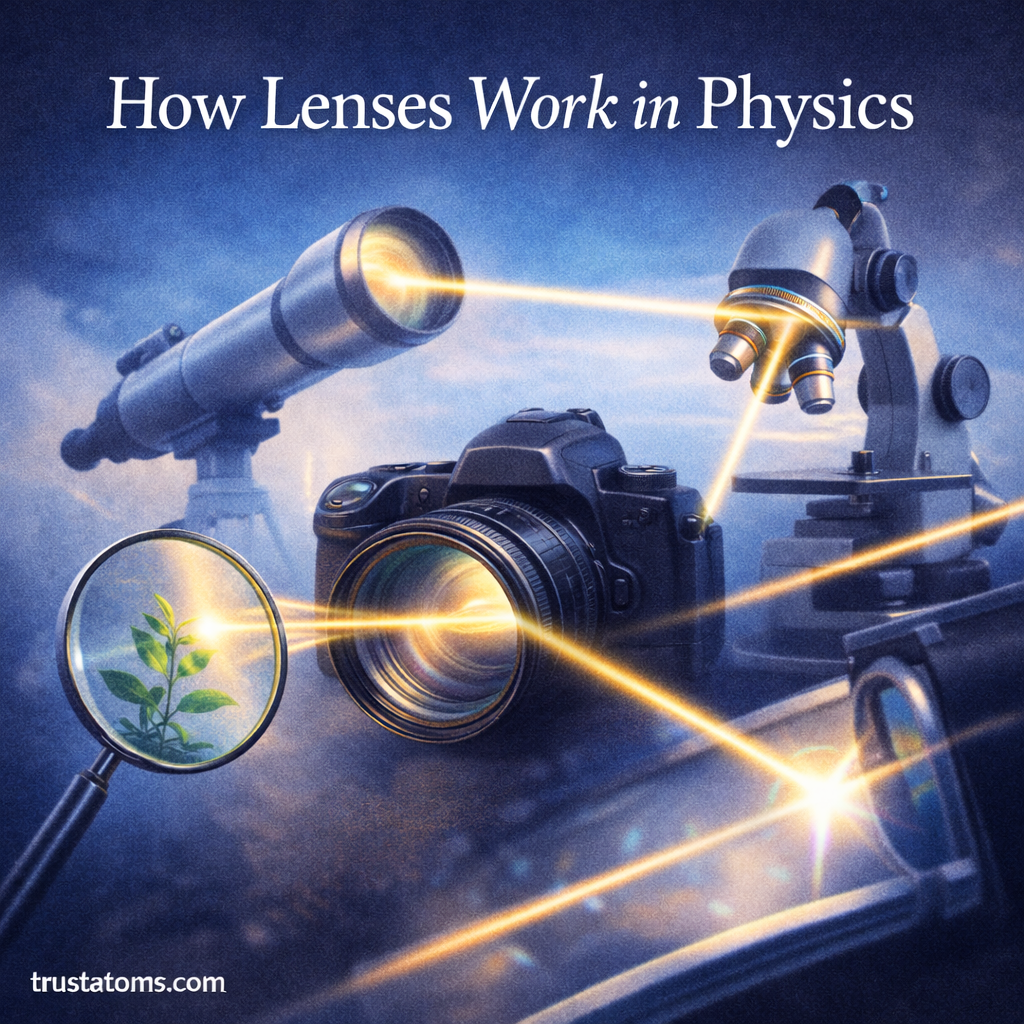
Lenses are optical devices that bend light to form images. They are used in many everyday technologies, including eyeglasses, cameras, microscopes, telescopes, and projectors.
In physics, lenses work by refracting light, which means bending light rays as they pass from one medium to another. By carefully shaping transparent materials such as glass or plastic, lenses can focus light to create magnified, reduced, or corrected images.
Understanding how lenses work helps explain how we see clearly, how cameras capture images, and how scientists observe extremely small or distant objects.
What Is a Lens?
A lens is a transparent optical component designed to bend light in a controlled way.
Most lenses are made from:
- Glass
- Plastic
- Optical polymers
The curved surfaces of a lens cause light rays to change direction as they pass through the material.
Depending on the shape of the lens, the light rays can either:
- Converge (come together)
- Diverge (spread apart)
These two behaviors form the basis of how lenses create images.
How Refraction Allows Lenses to Work
The main physical principle behind lenses is refraction.
Refraction occurs when light moves between materials with different optical densities. When light passes from air into glass or plastic, its speed changes, causing the light rays to bend.
Inside a lens, this bending happens twice:
- When light enters the lens
- When light exits the lens
The curved shape of the lens ensures the bending happens in a predictable way, allowing the lens to focus or spread light rays.
Types of Lenses
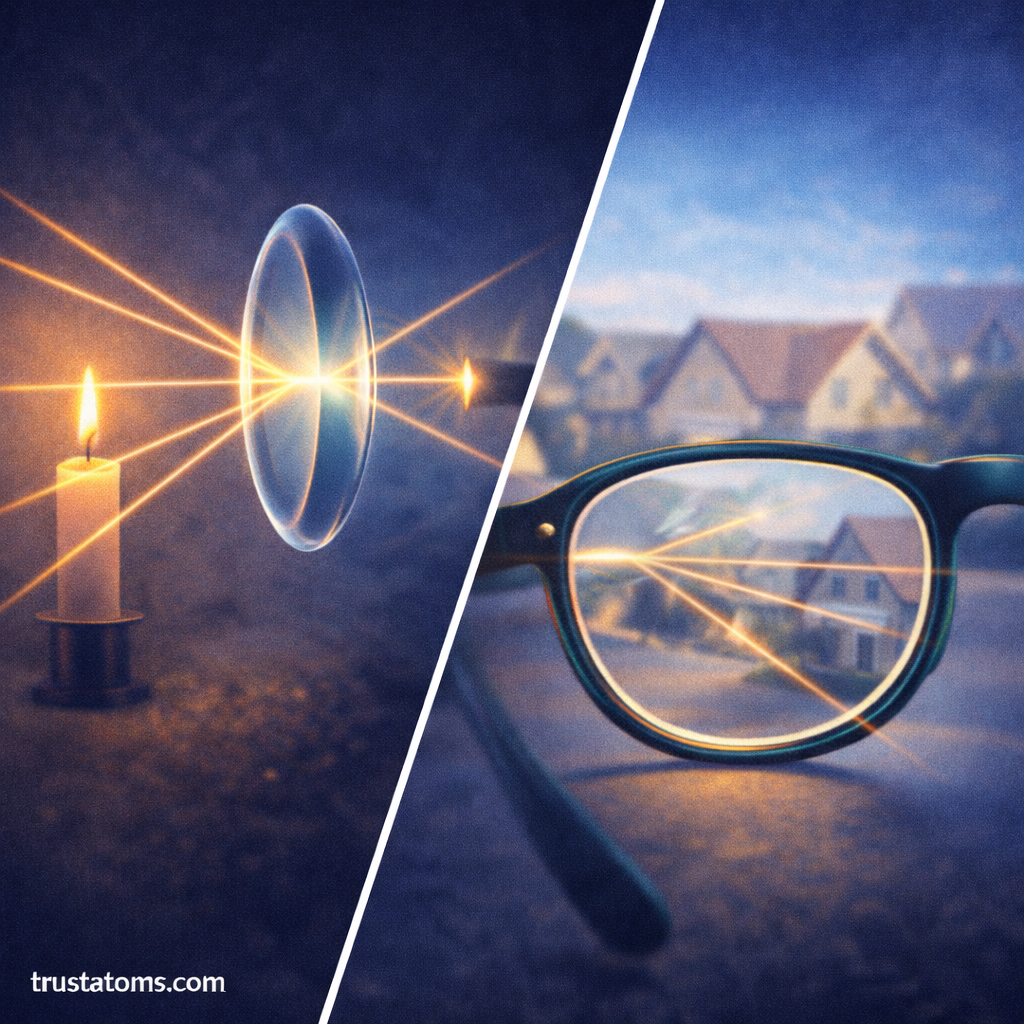
There are two main types of lenses in physics: converging lenses and diverging lenses.
Converging Lenses (Convex Lenses)
Converging lenses are thicker in the center than at the edges. These lenses bend light rays inward so they meet at a point called the focus.
Characteristics of converging lenses:
- Bring parallel light rays together
- Form real or virtual images
- Used for magnification
Common uses include:
- Magnifying glasses
- Cameras
- Microscopes
- Telescopes
- Reading glasses for farsightedness
Diverging Lenses (Concave Lenses)
Diverging lenses are thinner in the center and thicker at the edges. These lenses spread light rays outward.
Instead of meeting at a real point, the rays appear to come from a focal point behind the lens.
Characteristics of diverging lenses:
- Spread light rays apart
- Always produce virtual images
- Reduce image size
Common uses include:
- Eyeglasses for nearsightedness
- Door viewers (peepholes)
- Some optical instruments
Key Parts of a Lens
To understand how lenses form images, it helps to know several important parts of a lens system.
Optical Center
The optical center is the point near the middle of the lens where light rays pass straight through without bending significantly.
Principal Axis
The principal axis is an imaginary horizontal line passing through the center of the lens.
Focal Point
The focal point is where light rays converge after passing through a converging lens.
For diverging lenses, rays appear to originate from this point.
Focal Length
The focal length is the distance between the center of the lens and the focal point.
This value determines how strongly a lens bends light.
How Lenses Form Images
Lenses create images by bending light rays in a specific pattern.
The process generally works as follows:
- Light rays leave an object.
- The rays travel toward the lens.
- The lens refracts the rays.
- The rays converge or diverge.
- An image forms either on a surface or in the viewer’s eye.
Depending on the lens type and object position, images can be:
- Real or virtual
- Upright or inverted
- Larger or smaller than the object
Real Images vs Virtual Images
Real Images
Real images form when light rays actually meet after passing through a lens.
Properties of real images:
- Can be projected onto a screen
- Often inverted
- Formed by converging lenses
Examples include images formed in:
- Cameras
- Projectors
- Human eyes
Virtual Images
Virtual images form when light rays do not actually meet but appear to originate from a point.
Properties of virtual images:
- Cannot be projected onto a screen
- Usually upright
- Often seen through diverging lenses
Examples include:
- Mirrors
- Eyeglasses
- Magnifying lenses
Everyday Applications of Lenses
Lenses are used in many devices that rely on precise control of light.
Some important applications include:
Eyeglasses and Contact Lenses
Correct vision problems by adjusting how light focuses on the retina.
Cameras
Focus light from a scene onto a sensor or film to capture images.
Microscopes
Magnify extremely small objects such as cells and bacteria.
Telescopes
Collect and focus light from distant stars and galaxies.
Projectors
Enlarge images and project them onto screens.
Lenses in the Human Eye
The human eye contains a natural lens that helps focus light onto the retina.
When light enters the eye:
- It passes through the cornea.
- The lens bends the light rays.
- The light focuses on the retina.
- The brain interprets the image.
Muscles surrounding the lens adjust its shape, allowing the eye to focus on objects at different distances.
Why Lenses Matter in Physics
Lenses are essential tools for studying the world around us. They allow scientists to:
- Observe microscopic organisms
- Study distant astronomical objects
- Capture detailed images
- Develop advanced optical technologies
From medical imaging to scientific research, lenses remain one of the most important components in modern optical systems.
Final Thoughts
Lenses work by bending light through the process of refraction. Their curved shapes allow them to focus or spread light rays, forming images that can be magnified, reduced, or corrected.
By understanding how lenses function, physicists and engineers can design powerful optical devices used in medicine, astronomy, photography, and everyday vision correction.