Introduction
Lenses are essential tools in physics and everyday technology. From eyeglasses and cameras to microscopes and telescopes, lenses help control how light travels and forms images.
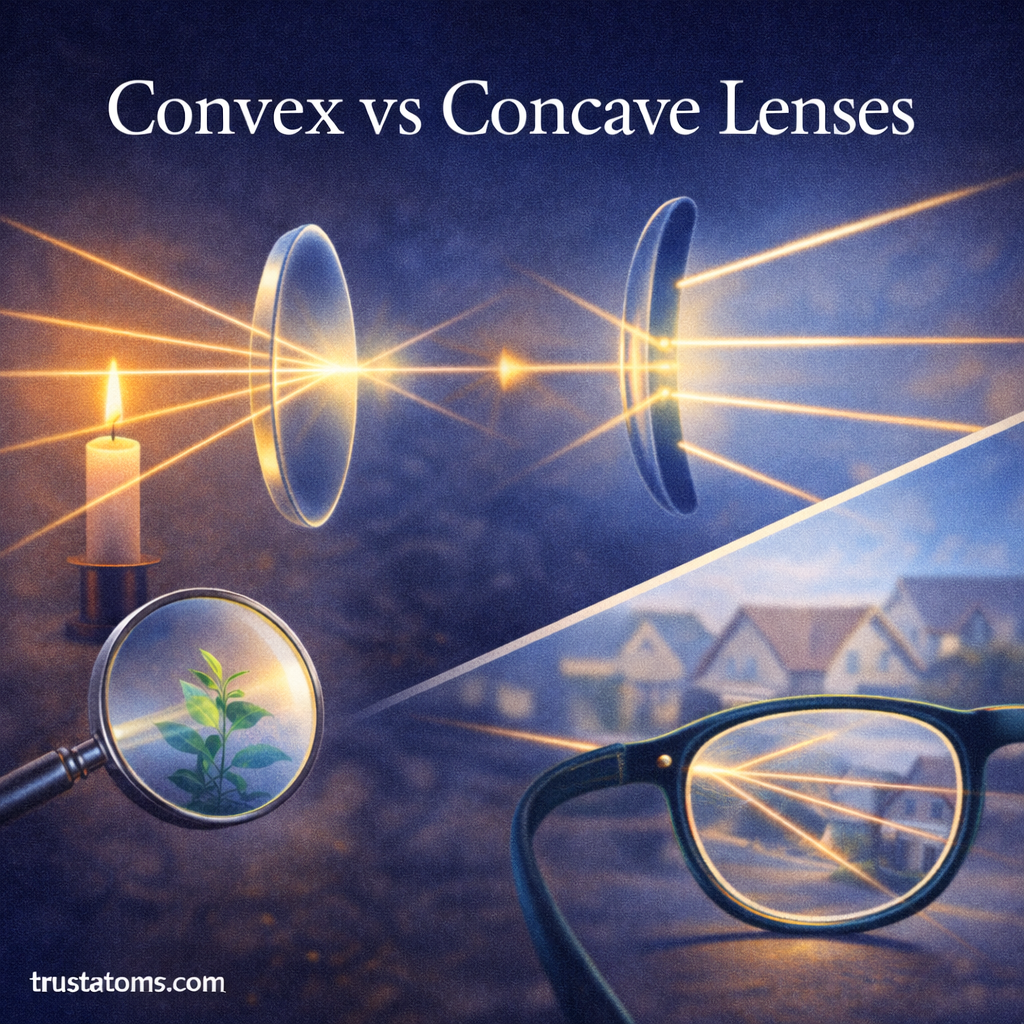
Two of the most common lens types are convex lenses and concave lenses. While both bend light through the process of refraction, they do so in different ways. Convex lenses bring light rays together, while concave lenses spread them apart.
Understanding the differences between convex and concave lenses helps explain how optical devices work and how vision problems can be corrected.
What Is a Lens?
A lens is a transparent optical component that bends light rays as they pass through it. Most lenses are made from materials such as:
- Glass
- Plastic
- Optical polymers
The curved surfaces of a lens cause light rays to change direction, allowing the lens to focus or spread light.
This bending of light occurs because light travels at different speeds in different materials, a phenomenon known as refraction.
What Is a Convex Lens?
A convex lens is a lens that is thicker in the center and thinner at the edges. Because of this shape, it bends light rays inward so they meet at a point.
This point is known as the focal point.
How Convex Lenses Work
When parallel light rays pass through a convex lens:
- The rays enter the curved surface of the lens.
- The lens refracts the light toward the center.
- The rays converge at a focal point on the opposite side.
Because of this behavior, convex lenses are also called converging lenses.
Images Formed by Convex Lenses
Convex lenses can produce two types of images depending on the object’s position.
Real images:
- Form when light rays actually meet
- Can be projected onto a screen
- Often appear inverted
Virtual images:
- Occur when light rays appear to originate from a point
- Cannot be projected onto a screen
- Usually appear upright
What Is a Concave Lens?
A concave lens is thinner in the center and thicker at the edges. This shape causes light rays to spread outward as they pass through the lens.
Because of this behavior, concave lenses are called diverging lenses.
How Concave Lenses Work
When parallel light rays pass through a concave lens:
- The rays enter the lens surface.
- The lens bends the light outward.
- The rays spread apart after leaving the lens.
Although the rays diverge, they appear to originate from a point behind the lens called the virtual focal point.
Images Formed by Concave Lenses
Concave lenses always produce virtual images.
These images are:
- Upright
- Smaller than the object
- Located on the same side of the lens as the object
Key Differences Between Convex and Concave Lenses
Convex and concave lenses behave differently because of their shapes and how they bend light.
Shape
Convex lens:
- Thick center
- Thin edges
Concave lens:
- Thin center
- Thick edges
Effect on Light
Convex lens:
- Converges light rays
- Brings rays together at a focal point
Concave lens:
- Diverges light rays
- Spreads rays outward
Image Formation
Convex lens:
- Can form real or virtual images
- Image size may be larger or smaller
Concave lens:
- Always forms virtual images
- Image is smaller than the object
Common Uses of Convex Lenses

Convex lenses are widely used in optical instruments because they focus light.
Examples include:
Magnifying Glasses
Magnifying glasses enlarge objects by producing a larger virtual image.
Cameras
Camera lenses focus light from a scene onto the camera sensor.
Microscopes
Microscopes use multiple convex lenses to magnify extremely small objects such as cells and microorganisms.
Telescopes
Convex lenses gather light from distant stars and planets.
Reading Glasses
Convex lenses help correct farsightedness (hyperopia) by bringing light rays into focus on the retina.
Common Uses of Concave Lenses
Concave lenses are useful when light needs to be spread outward.
Examples include:
Eyeglasses for Nearsightedness
Concave lenses correct nearsightedness (myopia) by spreading incoming light so it focuses properly on the retina.
Door Peepholes
Concave lenses allow people to see a wide viewing area through a small opening.
Laser Systems
Some optical devices use concave lenses to expand laser beams.
Convex and Concave Lenses in Vision
Human vision relies on a natural lens in the eye to focus light onto the retina.
However, when the eye does not focus light properly, corrective lenses are needed.
Vision corrections include:
Nearsightedness (myopia):
- Light focuses in front of the retina
- Corrected using concave lenses
Farsightedness (hyperopia):
- Light focuses behind the retina
- Corrected using convex lenses
By adjusting how light enters the eye, lenses restore clear vision.
Why Understanding Lenses Matters in Physics
Studying lenses helps scientists understand how light behaves and how images are formed.
This knowledge is important in many fields, including:
- Optics
- Astronomy
- Medical imaging
- Photography
- Vision science
Without lenses, many modern technologies used for observation, communication, and research would not exist.
Final Thoughts
Convex and concave lenses play essential roles in optics by controlling how light travels. Convex lenses focus light rays together, while concave lenses spread them apart.
These simple yet powerful tools allow us to magnify tiny organisms, observe distant galaxies, capture photographs, and correct vision problems. Understanding the differences between convex and concave lenses provides a strong foundation for learning how optical systems work.