Introduction
Specific heat capacity is a fundamental concept in physics that describes how much heat energy a substance needs to change its temperature. Different materials respond to heat differently—some warm up quickly, while others take much longer to heat.
Specific heat capacity explains this difference by measuring how much energy is required to raise the temperature of a substance by a certain amount.
This concept is important in physics, chemistry, environmental science, and engineering because it helps explain how heat moves through materials and how substances store thermal energy.
Understanding Heat and Temperature
Before exploring specific heat capacity, it helps to understand the difference between heat and temperature.
Heat refers to:
- Energy transferred between objects due to temperature differences.
Temperature refers to:
- A measure of how fast the particles in a substance are moving.
When heat energy is added to a material, its particles move faster, which increases the temperature.
However, not all materials require the same amount of heat to change temperature, which is where specific heat capacity becomes important.
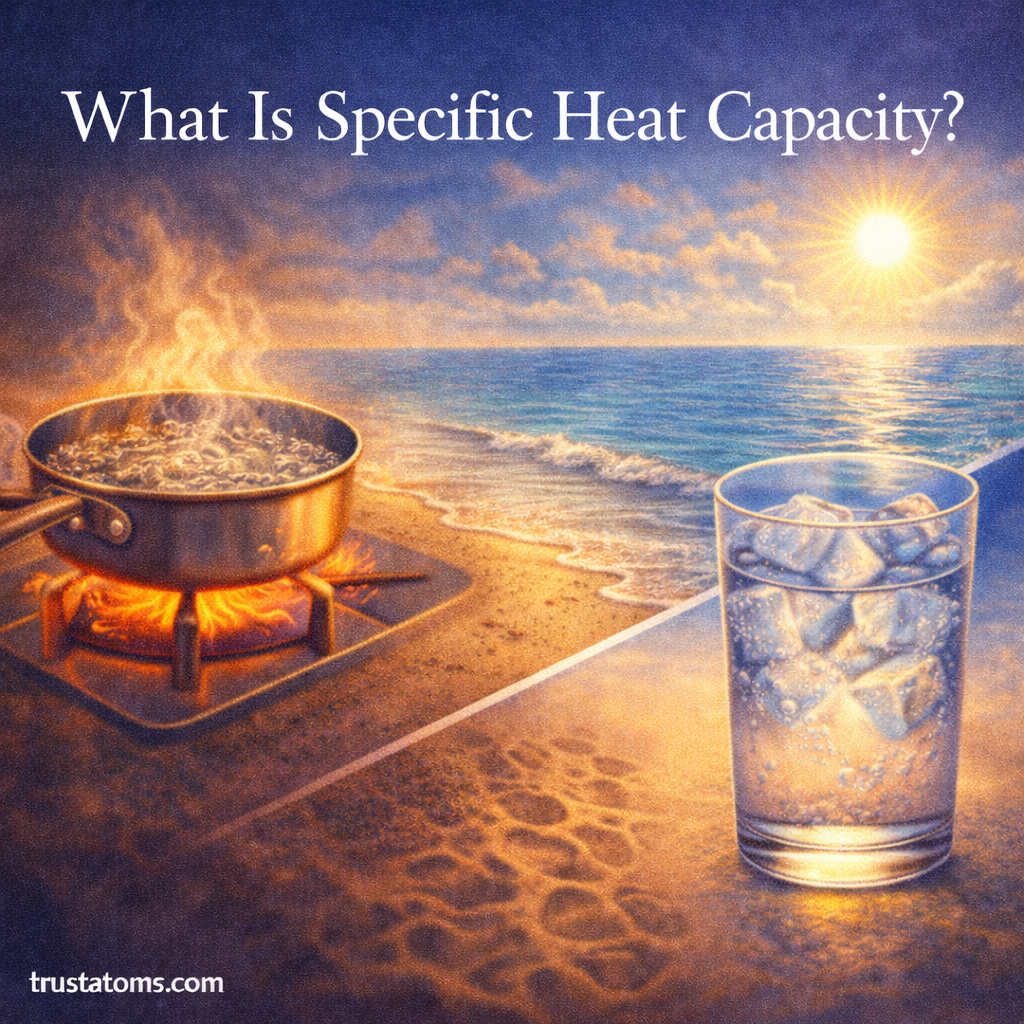
What Is Specific Heat Capacity?
Specific heat capacity is the amount of heat energy required to raise the temperature of a unit mass of a substance by one degree.
In simpler terms, it tells us how much heat a material can absorb before its temperature increases significantly.
Materials with:
High specific heat capacity
- Require a large amount of heat to change temperature.
Low specific heat capacity
- Heat up and cool down quickly.
This property is unique for each substance.
Why Different Materials Have Different Specific Heat Capacities
The specific heat capacity of a material depends on how its atoms and molecules store energy.
When heat is added to a substance, the energy may go into:
- Increasing particle motion
- Vibrational movement of atoms
- Rotational movement of molecules
- Interactions between particles
Materials whose particles can store energy in many ways usually have higher specific heat capacities.
Examples of Specific Heat Capacity

Different substances respond to heat at different rates because of their specific heat capacities.
Water
Water has one of the highest specific heat capacities of common substances.
This means:
- It absorbs a large amount of heat before its temperature rises.
- It cools down slowly.
Because of this property, water helps regulate temperatures on Earth.
Examples include:
- Oceans moderating climate
- Lakes warming slowly in spring
- Water used in cooling systems
Metals
Many metals have relatively low specific heat capacities.
This means they heat up quickly when exposed to energy.
For example:
- A metal spoon placed in hot soup quickly becomes hot.
- Metal cookware heats rapidly on a stove.
This property makes metals useful in applications where rapid heat transfer is needed.
Sand and Soil
Sand and soil also have relatively low specific heat capacities compared with water.
As a result:
- Land heats up quickly during the day.
- It cools rapidly at night.
This difference explains why coastal areas often experience milder temperatures than inland regions.
Real-World Applications of Specific Heat Capacity
Specific heat capacity plays a key role in many scientific and practical situations.
Climate and Weather
Large bodies of water absorb heat during the day and release it slowly at night.
This helps stabilize temperatures near oceans and lakes.
Cooking and Food Preparation
Materials used in cookware are chosen based on their heat properties.
For example:
- Cast iron stores heat well.
- Aluminum heats up quickly.
Understanding specific heat capacity helps chefs and manufacturers design better cooking equipment.
Engine Cooling Systems
Many engines use water or coolant fluids to prevent overheating.
These liquids absorb large amounts of heat from the engine before increasing in temperature.
Building Design
Engineers consider heat storage properties of materials when designing buildings.
Materials with high specific heat capacity can:
- Store heat during the day
- Release heat slowly at night
This helps improve energy efficiency in buildings.
Specific Heat Capacity and Energy Transfer
Specific heat capacity also helps explain how energy moves between objects.
When two materials at different temperatures come into contact:
- Heat flows from the warmer object to the cooler one.
- The temperature of both objects begins to change.
- The rate of temperature change depends on each material’s specific heat capacity.
A substance with high specific heat capacity will experience smaller temperature changes compared with one that has a lower value.
Why Specific Heat Capacity Matters in Physics
Specific heat capacity helps scientists understand how energy is stored and transferred in matter.
This concept is essential for studying:
- Thermodynamics
- Heat transfer
- Environmental systems
- Energy efficiency
- Engineering design
By understanding how different materials respond to heat, scientists can design technologies that better manage energy and temperature.
Final Thoughts
Specific heat capacity measures how much heat energy a substance requires to change its temperature. Materials with high specific heat capacity can absorb large amounts of energy with only small temperature changes, while materials with low specific heat capacity heat up quickly.
This property plays an important role in climate regulation, cooking, engineering, and many other everyday applications. Understanding specific heat capacity helps explain how heat moves through the world and how materials respond to temperature changes.