Introduction
Thermal conductivity is a property that describes how well a material can transfer heat. Some materials allow heat to move through them quickly, while others resist heat flow and act as insulators.
This concept is important in physics, engineering, and everyday life because it helps explain how heat moves between objects and through materials.
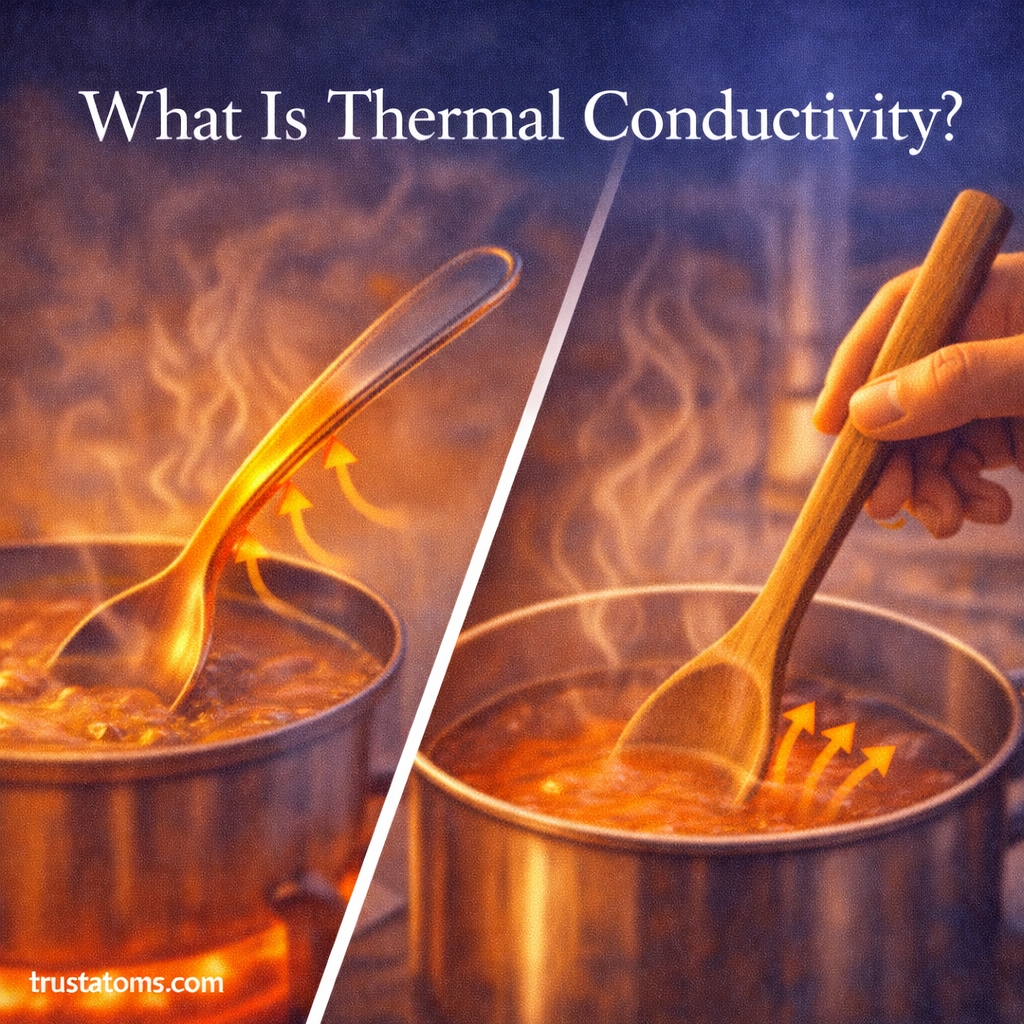
For example, a metal spoon placed in hot soup quickly becomes hot because metal has high thermal conductivity. In contrast, materials like wood or plastic transfer heat much more slowly.
Understanding thermal conductivity helps scientists and engineers design better buildings, cooking tools, electronic devices, and insulation systems.
What Is Heat Transfer?
Heat naturally flows from warmer objects to cooler objects. This process continues until both objects reach the same temperature.
Heat can transfer in three main ways:
- Conduction
- Convection
- Radiation
Thermal conductivity specifically relates to conduction, which is heat transfer through direct contact between particles in a material.
What Is Thermal Conductivity?
Thermal conductivity is the ability of a material to conduct heat through its structure.
In materials with high thermal conductivity:
- Heat moves quickly
- Energy transfers efficiently
In materials with low thermal conductivity:
- Heat moves slowly
- The material acts as insulation
This property depends on how easily energy moves between atoms and molecules inside the material.
How Heat Conduction Works
When one part of a material becomes hot, its particles gain energy and begin to vibrate more rapidly.
The process occurs step by step:
- Particles near the heat source gain energy.
- These particles collide with neighboring particles.
- Energy transfers from particle to particle.
- Heat spreads through the material.
In metals, this transfer happens very quickly because electrons can also carry heat energy.
Materials With High Thermal Conductivity

Materials that transfer heat efficiently are known as thermal conductors.
Examples include:
- Copper
- Aluminum
- Silver
- Iron
These materials are commonly used in applications where heat must move quickly.
Common Uses of Good Thermal Conductors
Cookware
- Metal pans transfer heat efficiently from a stove to food.
Heat exchangers
- Used in engines and industrial systems to transfer heat between fluids.
Electronics cooling
- Heat sinks made of metal remove excess heat from computer processors.
Materials With Low Thermal Conductivity
Materials that resist heat transfer are called thermal insulators.
Examples include:
- Wood
- Plastic
- Rubber
- Foam
- Air
These materials slow down heat movement and help maintain temperature differences.
Common Uses of Thermal Insulators
Building insulation
- Materials like fiberglass prevent heat loss from homes.
Clothing
- Winter clothing traps air to reduce heat loss.
Cooking utensils
- Plastic or wooden handles prevent heat from reaching your hands.
Thermal Conductivity in Everyday Life
Thermal conductivity explains many everyday experiences.
Metal Feels Colder Than Wood
Metal often feels colder than wood at room temperature.
This happens because metal transfers heat away from your skin quickly, while wood transfers heat more slowly.
Cooking on a Stove
Cooking pans are typically made of materials with high thermal conductivity so heat spreads evenly across the surface.
This helps food cook consistently.
Insulated Containers
Thermos bottles and insulated cups are designed to reduce heat transfer, keeping drinks hot or cold for longer periods.
Factors That Affect Thermal Conductivity
Several factors influence how easily heat moves through a material.
Material Structure
Dense materials with tightly packed particles often conduct heat better than loosely structured materials.
Temperature
Thermal conductivity can change with temperature, depending on the material.
Phase of Matter
Heat moves differently through solids, liquids, and gases.
General trends include:
- Solids usually conduct heat best.
- Liquids conduct heat moderately.
- Gases typically conduct heat poorly.
Thermal Conductivity in Engineering
Engineers must carefully consider thermal conductivity when designing machines, buildings, and technology.
Applications include:
- Cooling systems in electronics
- Energy-efficient building materials
- Industrial heating systems
- Thermal protection in spacecraft
Selecting the right materials ensures heat moves where it should—or stays where it should not.
Thermal Conductivity vs Thermal Insulation
Although related, thermal conductivity and insulation describe opposite behaviors.
Thermal conductivity
- Measures how easily heat moves through a material.
Thermal insulation
- Describes materials that slow down heat transfer.
Both concepts are essential when designing systems that manage heat.
Why Thermal Conductivity Matters in Physics
Thermal conductivity helps scientists understand how energy moves through matter.
This concept plays an important role in studying:
- Thermodynamics
- Energy efficiency
- Climate systems
- Material science
- Mechanical engineering
By understanding thermal conductivity, scientists can develop technologies that control heat more effectively.
Final Thoughts
Thermal conductivity describes how easily heat flows through a material. Some materials, such as metals, conduct heat quickly, while others, like wood or foam, slow heat transfer and act as insulators.
This property influences everything from cooking and home insulation to electronic cooling and industrial engineering. Understanding thermal conductivity helps explain how heat moves through the world and allows engineers to design safer and more efficient technologies.