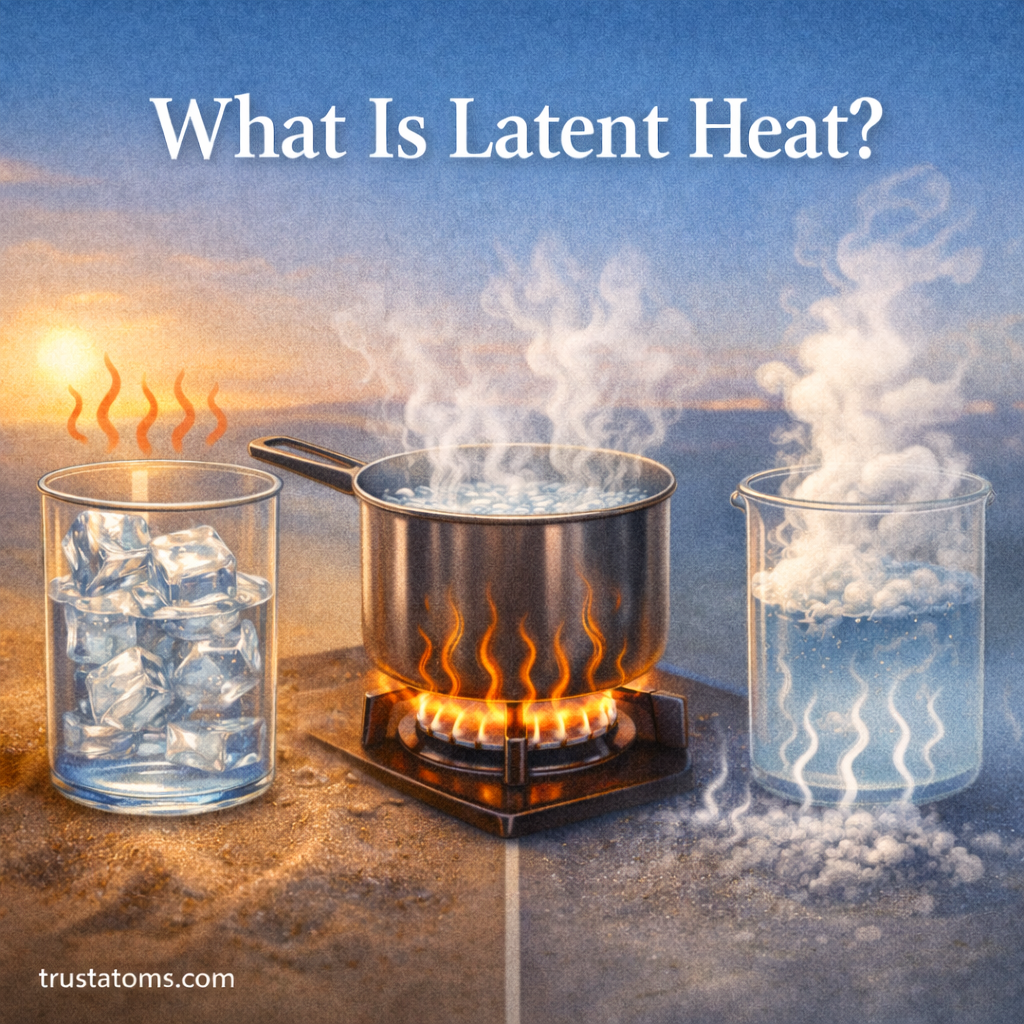
Latent heat is a concept in physics that describes the energy absorbed or released by a substance during a change of state without a change in temperature. When matter transitions between phases—such as solid to liquid or liquid to gas—it requires energy to rearrange its molecular structure.
Unlike normal heating, where temperature rises as heat is added, latent heat involves energy transfer while temperature stays constant. This hidden energy exchange plays a crucial role in natural processes, industrial systems, and everyday experiences.
Understanding Latent Heat
Latent heat refers to the heat energy required for a substance to change its physical state without changing its temperature.
For example:
- Ice melting into water
- Water boiling into steam
- Water vapor condensing into liquid
During these transitions, the temperature remains steady while energy is used to break or form intermolecular bonds.
This energy is called “latent,” meaning hidden, because it does not show up as a temperature increase on a thermometer.
The Latent Heat Formula
Physicists often calculate latent heat using a simple relationship between heat energy and mass.
Q = mL
Where:
- Q = Heat energy transferred (joules)
- m = Mass of the substance (kilograms)
- L = Specific latent heat (joules per kilogram)
This equation helps determine how much energy is required to change the phase of a given amount of material.
Types of Latent Heat
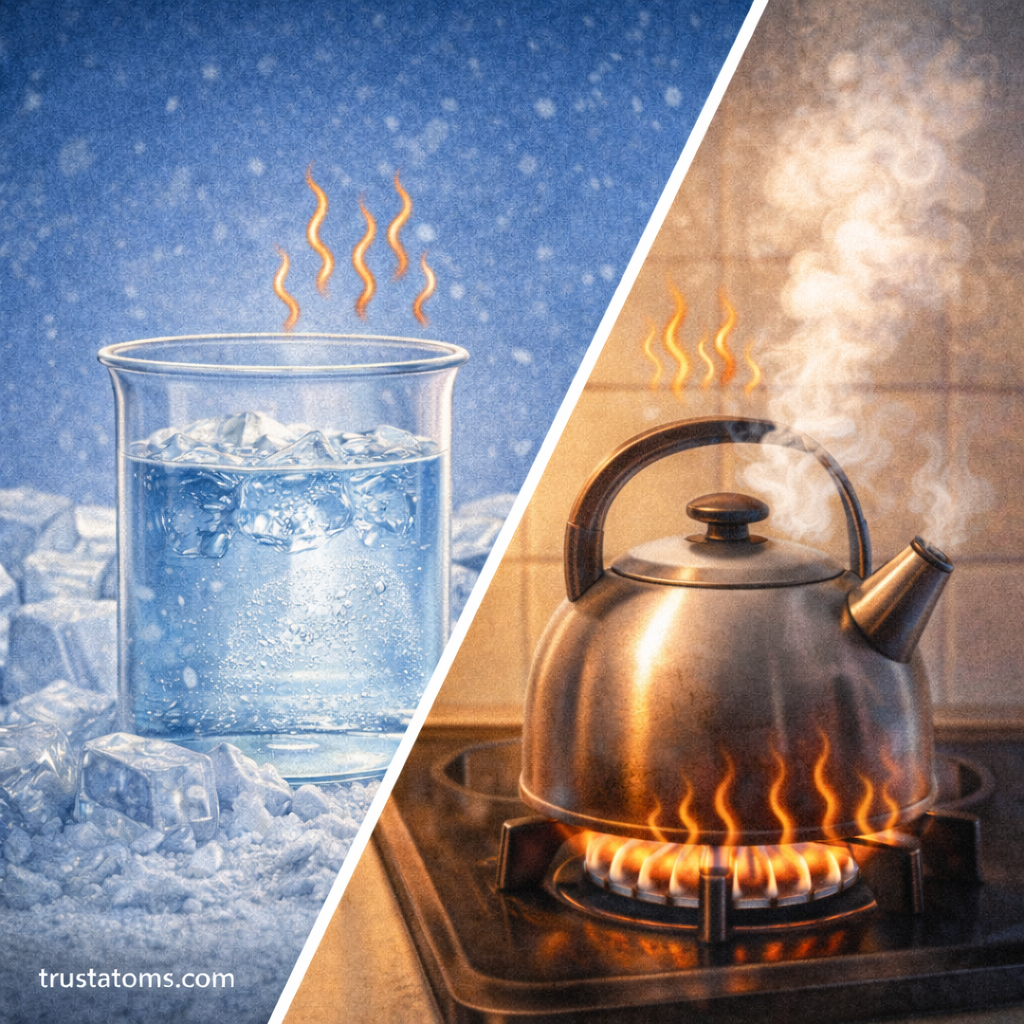
There are several forms of latent heat depending on the type of phase change occurring.
Latent Heat of Fusion
Latent heat of fusion refers to the energy required to change a solid into a liquid without changing temperature.
Examples include:
- Ice melting into water
- Solid metals melting in furnaces
For water, a significant amount of energy is required to break the bonds that hold ice crystals together.
Latent Heat of Vaporization
Latent heat of vaporization is the energy needed to change a liquid into a gas.
Examples include:
- Water boiling into steam
- Sweat evaporating from the skin
This process typically requires much more energy than melting because molecules must completely separate to form a gas.
Latent Heat of Condensation
This occurs when a gas changes back into a liquid. The process releases energy instead of absorbing it.
Examples include:
- Water vapor forming clouds
- Steam condensing on a mirror
Latent Heat of Sublimation
Sublimation happens when a solid turns directly into a gas without passing through the liquid phase.
Examples include:
- Dry ice turning into carbon dioxide gas
- Snow slowly disappearing in very cold, dry conditions
Why Latent Heat Matters
Latent heat influences many natural systems and technologies.
Weather and Climate
Latent heat plays a key role in the Earth’s atmosphere.
When water evaporates from oceans or lakes, energy is absorbed. When that vapor condenses into clouds, the stored energy is released into the atmosphere.
This energy transfer helps power:
- Storm systems
- Hurricanes
- Atmospheric circulation
Human Body Cooling
Sweating cools the body through evaporation. When sweat evaporates, it absorbs latent heat from the skin, lowering body temperature.
This process is critical for maintaining safe body temperatures during exercise or hot weather.
Industrial and Energy Systems
Latent heat is essential in technologies that involve heating and cooling.
Examples include:
- Refrigeration systems
- Steam power plants
- Air conditioning units
- Heat pumps
These systems rely on phase changes to efficiently move heat from one place to another.
Latent Heat vs Sensible Heat
Heat transfer can occur in two main ways: latent heat and sensible heat.
Latent Heat
- Energy used for phase changes
- Temperature remains constant
- Energy stored in molecular structure
Sensible Heat
- Energy that changes temperature
- No phase change occurs
- Easily measured by a thermometer
Both types of heat are important for understanding how energy moves through physical systems.
Real-World Examples of Latent Heat
Latent heat appears in many everyday situations.
- Ice melting in a drink
The ice absorbs energy while melting, keeping the drink cold. - Boiling water
Water stays at 100°C while heat continues converting it into steam. - Formation of clouds
Water vapor condenses and releases energy into the atmosphere. - Evaporation of sweat
Sweat removes heat from the body as it evaporates. - Dry ice sublimation
Solid carbon dioxide turns directly into gas without becoming liquid.
These examples highlight how latent heat affects both natural and human-made systems.
Latent Heat in Thermodynamics
In thermodynamics, latent heat is a key concept in understanding energy transfer during phase changes.
When a substance absorbs latent heat:
- Molecular bonds loosen or break
- Particles move farther apart
- The substance changes state
When latent heat is released:
- Molecules move closer together
- Bonds form
- Energy is transferred to the surrounding environment
This energy exchange is critical for describing processes in atmospheric science, engineering, and chemistry.
Final Thoughts
Latent heat is the hidden energy absorbed or released when a substance changes phase without a temperature change. It explains why melting ice, boiling water, and evaporating sweat involve significant energy transfer even when temperature remains constant.
This concept plays an essential role in physics, thermodynamics, weather systems, industrial technology, and everyday life. By understanding latent heat, scientists and engineers can better explain natural processes and design efficient heating and cooling systems.