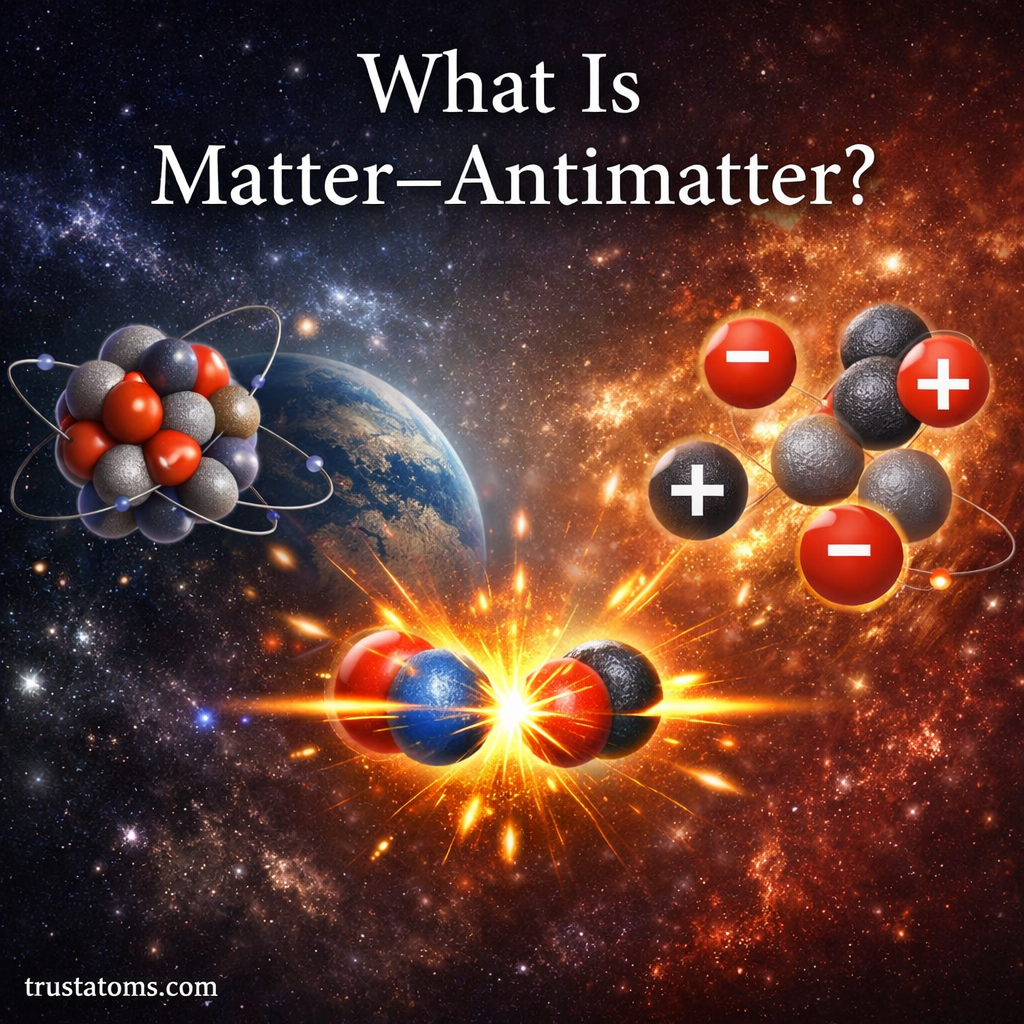
Matter and antimatter are two fundamental forms of particles in the universe. They are almost identical in mass but have opposite electrical charges and quantum properties. When matter and antimatter meet, they annihilate each other and release energy.
Understanding matter and antimatter helps scientists explore some of the deepest questions in physics, including how the universe formed and why it is made mostly of matter today.
What Is Matter?
Matter is anything that has mass and occupies space. Everything around us—from atoms and molecules to planets and galaxies—is made of matter.
At the smallest level, matter is built from subatomic particles, including:
- Protons (positively charged)
- Electrons (negatively charged)
- Neutrons (neutral)
These particles combine to form atoms, which then form molecules and larger structures.
Examples of everyday matter include:
- Air
- Water
- Metals
- Living organisms
- Stars and planets
Matter is the familiar substance that makes up the observable universe.
What Is Antimatter?
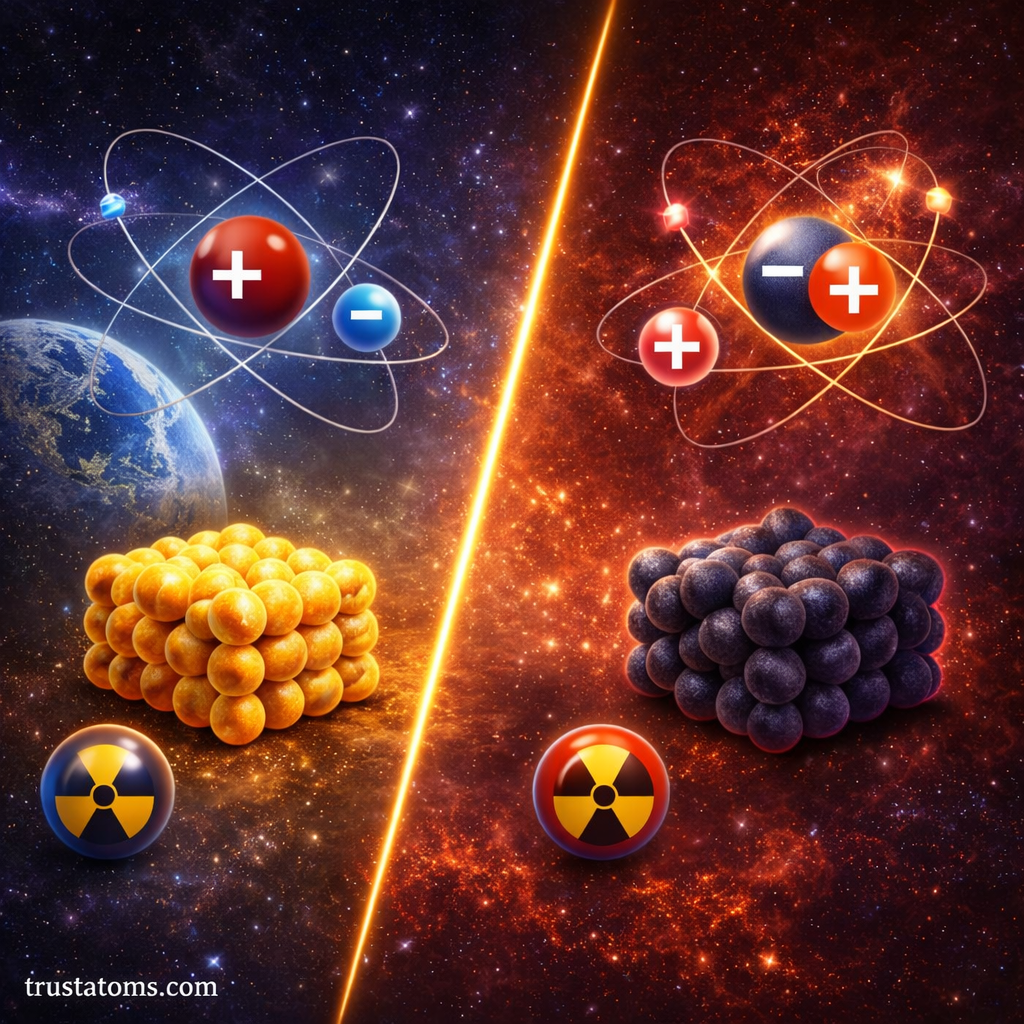
Antimatter is composed of particles that mirror ordinary matter but have opposite electric charge and certain reversed quantum properties.
For every type of matter particle, there exists a corresponding antimatter particle called an antiparticle.
Examples include:
- Electron → Positron (positive charge)
- Proton → Antiproton (negative charge)
- Neutron → Antineutron (same charge but different internal properties)
Antimatter behaves almost exactly like matter in terms of mass and motion. The key difference lies in the reversed charges and quantum numbers.
What Happens When Matter and Antimatter Meet?
When a particle of matter meets its antimatter counterpart, they undergo annihilation.
This means both particles disappear and their mass converts into energy.
The energy released often appears as:
- Gamma-ray photons
- Other particle pairs
This process follows the famous mass–energy equivalence principle from modern physics, where mass can transform into energy.
Because of this effect, even tiny amounts of matter and antimatter can release large amounts of energy.
How Antimatter Was Discovered
Antimatter was first predicted through theoretical physics before it was ever observed.
Key milestones include:
- 1928 – Prediction
- Physicist Paul Dirac developed equations describing electrons that implied the existence of opposite particles.
- 1932 – Discovery of the Positron
- Scientist Carl Anderson detected the positron in cosmic ray experiments.
- 1955 – Antiproton Discovery
- Scientists at particle accelerators confirmed the existence of antiprotons.
These discoveries confirmed that antimatter is a real and measurable part of nature.
Where Does Antimatter Exist?
Antimatter is extremely rare in the natural universe but can appear in several environments.
Natural Sources
Small amounts occur through:
- Cosmic ray collisions in Earth’s atmosphere
- Radioactive decay processes
- Certain high-energy astrophysical events
Artificial Production
Scientists also create antimatter in particle accelerators, such as those used in high-energy physics experiments.
Facilities like CERN produce antimatter particles to study:
- Fundamental forces
- Particle physics
- The structure of the universe
However, producing antimatter is extremely expensive and difficult.
Why Doesn’t Antimatter Destroy Everything?
A major mystery in physics is why the universe contains so much matter and so little antimatter.
According to current cosmological theories, the Big Bang should have produced equal amounts of matter and antimatter.
If that were the case, they would have annihilated each other, leaving mostly energy behind.
Yet the universe today is dominated by matter.
Scientists believe that very small asymmetries in the laws of physics may have favored matter slightly, allowing it to survive after the early annihilations.
This puzzle is known as the matter–antimatter asymmetry problem.
Real-World Uses of Antimatter
Although antimatter sounds exotic, it already has practical applications.
Medical Imaging (PET Scans)
Positrons are used in positron emission tomography (PET) scans.
These medical scans help doctors:
- Detect cancer
- Study brain activity
- Analyze organ function
The technique relies on positrons annihilating with electrons inside the body, producing detectable gamma rays.
Scientific Research
Antimatter helps scientists study:
- Particle interactions
- Fundamental symmetries of physics
- Conditions similar to those shortly after the Big Bang
Could Antimatter Be Used as Energy?
Antimatter has enormous theoretical energy potential because matter–antimatter annihilation converts 100% of mass into energy.
For comparison:
- Chemical fuels convert only a small fraction of mass into energy.
- Nuclear reactions convert slightly more.
In theory, antimatter could power:
- Future spacecraft
- Extremely high-energy propulsion systems
However, the main challenges are:
- Producing antimatter efficiently
- Storing it safely
- Preventing accidental annihilation
Currently, antimatter remains far too expensive for energy production.
Why Matter–Antimatter Research Matters
Studying antimatter allows scientists to explore some of the most fundamental questions about reality.
Research helps us understand:
- Why the universe exists in its current form
- The laws governing subatomic particles
- The early conditions after the Big Bang
- The structure of physical symmetries in nature
Experiments involving antimatter continue to push the boundaries of modern physics.
Final Thoughts
Matter and antimatter are mirror versions of each other at the particle level. While they share the same mass and many physical properties, their opposite charges cause them to annihilate when they meet.
Although antimatter is rare in the universe today, it plays an important role in physics research, medical imaging, and our understanding of how the universe formed.
By studying antimatter, scientists continue to uncover clues about the origins of matter itself and the deeper laws that govern the cosmos.