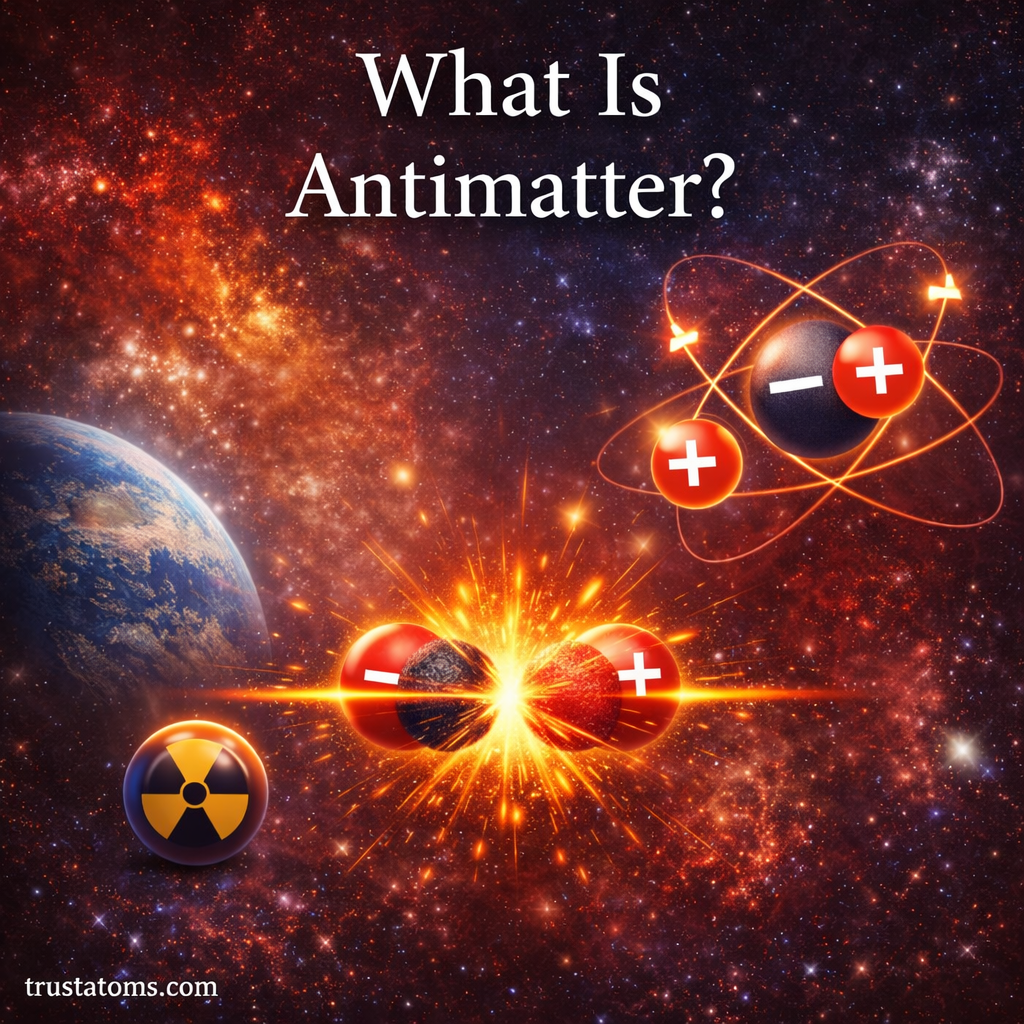
Antimatter is one of the most fascinating concepts in modern physics. It refers to particles that are nearly identical to ordinary matter but have opposite electric charge and certain reversed quantum properties.
When antimatter meets normal matter, the two annihilate each other and release energy. This phenomenon makes antimatter both scientifically important and incredibly powerful.
Although antimatter sounds like science fiction, it is very real and plays a key role in particle physics, medical imaging, and our understanding of how the universe formed.
Understanding Matter First
To understand antimatter, it helps to first understand matter.
Matter is anything that:
- Has mass
- Takes up space
Everything around us—air, water, planets, and living organisms—is made of matter.
At the smallest level, matter is composed of subatomic particles, including:
- Protons (positive charge)
- Electrons (negative charge)
- Neutrons (no charge)
These particles combine to form atoms, which then build molecules and the larger structures that make up the universe.
Antimatter is essentially the mirror counterpart of this familiar matter.
What Exactly Is Antimatter?
Antimatter consists of particles that have the same mass as normal matter particles but opposite charge and quantum properties.
Every particle of matter has a corresponding antiparticle.
Examples include:
- Electron → Positron (positive charge)
- Proton → Antiproton (negative charge)
- Neutron → Antineutron (neutral but different internal structure)
These antiparticles behave almost exactly like their matter counterparts in terms of:
- Mass
- Motion
- Physical interactions
The main difference is their reversed electrical charge and other quantum characteristics.
Matter vs Antimatter
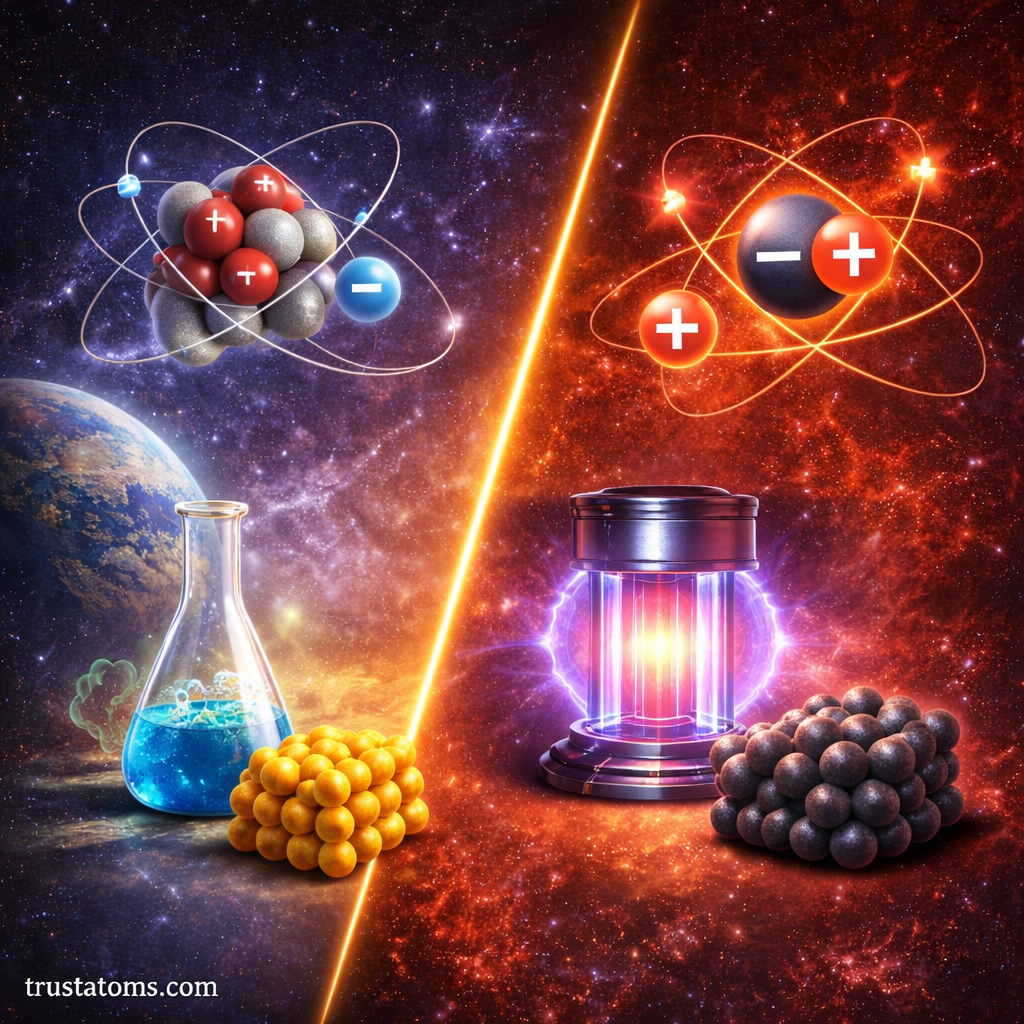
The relationship between matter and antimatter is symmetrical. Each particle has a mirror opposite.
Key Differences
Matter particles:
- Electrons carry negative charge
- Protons carry positive charge
Antimatter particles:
- Positrons carry positive charge
- Antiprotons carry negative charge
Despite these differences, both types of particles follow the same physical laws.
Key Similarities
Matter and antimatter share:
- Identical mass
- Identical spin
- Identical gravitational behavior
Because of these similarities, antimatter behaves very much like ordinary matter—until the two interact directly.
What Happens When Matter Meets Antimatter?
When a particle of matter meets its antimatter equivalent, they annihilate each other.
During annihilation:
- The particles collide.
- Their mass converts into energy.
- The energy is typically released as high-energy photons (gamma rays).
This process is one of the most efficient ways to convert mass into energy.
Even a tiny amount of matter and antimatter can release enormous energy.
The Discovery of Antimatter
Antimatter was first predicted through theoretical physics before it was ever observed experimentally.
Key Moments in Antimatter History
1928 — Paul Dirac’s Theory
- British physicist Paul Dirac developed equations describing electrons.
- His mathematical model predicted the existence of particles with opposite charge.
1932 — Discovery of the Positron
- Physicist Carl Anderson discovered the positron while studying cosmic rays.
- This confirmed the first antimatter particle.
1955 — Discovery of the Antiproton
- Scientists working at particle accelerators confirmed the existence of antiprotons.
These discoveries helped establish antimatter as a real and measurable part of nature.
Where Antimatter Exists
Antimatter is rare in the observable universe, but it does occur naturally in small amounts.
Natural Sources
Antimatter can appear in:
- Cosmic ray collisions in Earth’s atmosphere
- Radioactive decay
- High-energy astrophysical environments
However, these amounts are extremely small and disappear quickly due to annihilation.
Artificial Creation
Scientists can also produce antimatter in particle accelerators.
Large research facilities use high-energy collisions to create antiparticles. These experiments help scientists study:
- Particle physics
- Fundamental forces
- Early universe conditions
Producing antimatter is extremely expensive, which limits its practical use.
Why the Universe Is Mostly Matter
One of the biggest mysteries in physics is called the matter–antimatter asymmetry problem.
According to current theories, the Big Bang should have produced equal amounts of matter and antimatter.
If that were true, most particles should have annihilated each other shortly after the universe formed.
Yet today, the universe contains far more matter than antimatter.
Scientists believe that tiny differences in particle interactions may have favored matter slightly, allowing it to survive after the early annihilation phase.
Understanding this imbalance remains a major goal of modern physics research.
Practical Uses of Antimatter
Although antimatter is rare and difficult to produce, it already has some real-world applications.
Medical Imaging
One of the most important uses is in positron emission tomography (PET scans).
PET scans are used by doctors to:
- Detect cancer
- Study brain function
- Analyze organ activity
These scans rely on positrons interacting with electrons inside the body, producing detectable radiation signals.
Scientific Research
Antimatter helps scientists study:
- Particle symmetry
- The fundamental structure of matter
- The behavior of forces at very small scales
Experiments involving antimatter continue to push the boundaries of physics.
Could Antimatter Be Used as Energy?
Antimatter is often discussed as a potential energy source because annihilation converts all particle mass into energy.
Compared to other energy sources:
- Chemical reactions convert very little mass into energy.
- Nuclear reactions convert slightly more.
- Matter–antimatter annihilation converts nearly all of it.
In theory, antimatter could power:
- Advanced spacecraft propulsion
- Extremely high-energy power systems
However, several major challenges remain:
- Producing antimatter efficiently
- Storing it safely without contact with matter
- Managing the extreme energy release
Currently, antimatter remains far too expensive to use as a practical energy source.
Why Antimatter Matters to Science
Antimatter research helps scientists explore some of the most fundamental questions about the universe.
Studying antimatter allows physicists to investigate:
- The laws of particle physics
- The origins of the universe
- The symmetry between particles and forces
- Why matter dominates the cosmos
Ongoing experiments at particle physics laboratories continue to improve our understanding of these fundamental processes.
Final Thoughts
Antimatter is the mirror image of ordinary matter at the particle level. Although it shares the same mass and many physical properties, its opposite charge causes it to annihilate when it meets matter.
While antimatter is rare in the universe today, it plays an essential role in modern physics research and medical technology. By studying antimatter, scientists hope to unlock deeper insights into how the universe formed and why it exists in its current form.
The study of antimatter continues to reveal surprising truths about the fundamental nature of reality.