In chemistry, not every reaction produces as much product as expected. Even when the chemical equation is balanced correctly and the experiment is carefully designed, the amount of product formed can vary. This is where reaction yield becomes important.
Reaction yield measures how much product a chemical reaction actually produces compared to how much it was expected to produce. It helps chemists evaluate the efficiency of reactions in laboratories, industrial manufacturing, and scientific research.
Understanding reaction yield is essential for predicting reaction outcomes, improving chemical processes, and reducing waste.
Understanding Reaction Yield in Chemistry
Reaction yield refers to the amount of product formed during a chemical reaction. It is typically compared against the maximum possible amount predicted by stoichiometry.
Chemists use yield calculations to determine whether a reaction is performing efficiently or if improvements are needed.
There are three common yield terms used in chemistry:
- Theoretical yield
- Actual yield
- Percent yield
Each of these helps describe different aspects of reaction performance.
Theoretical Yield
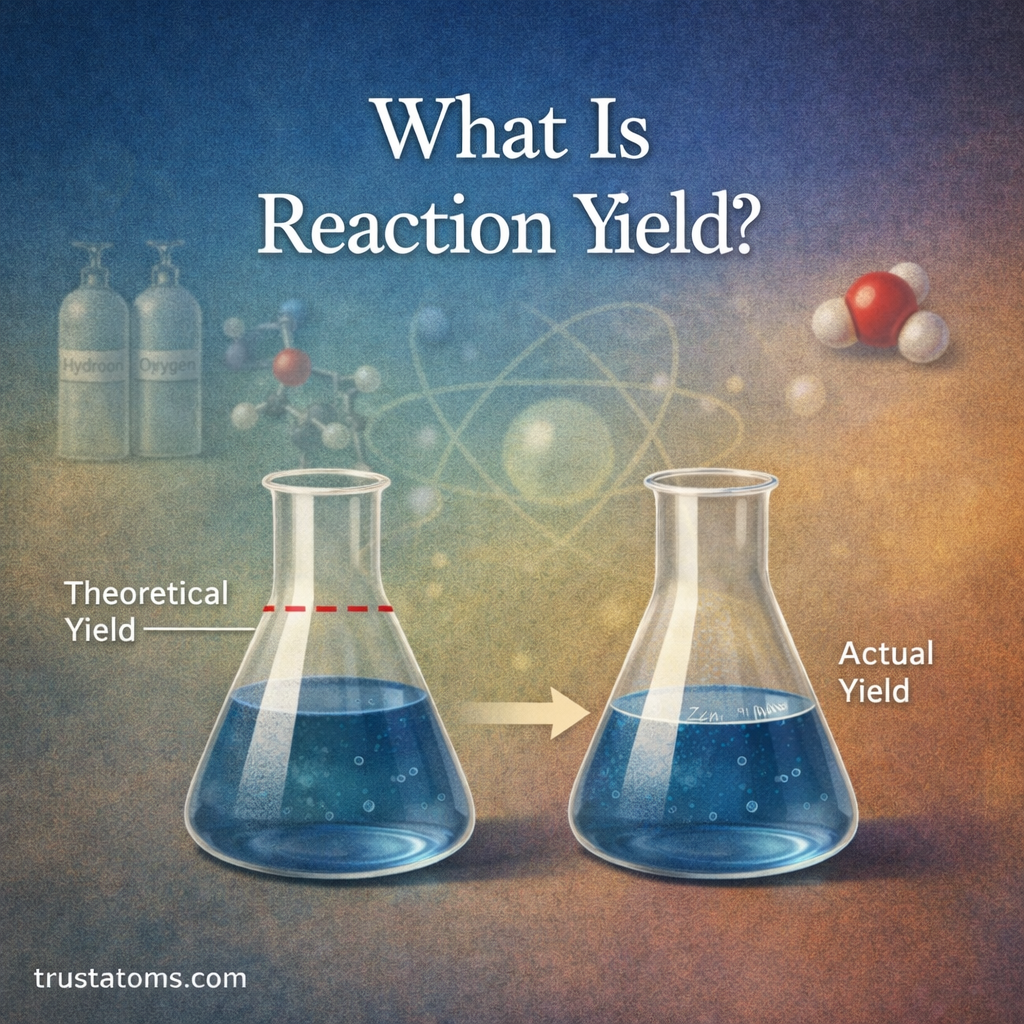
The theoretical yield is the maximum amount of product that could be produced if a reaction proceeds perfectly with no losses.
This value is calculated using:
- The balanced chemical equation
- The starting quantities of reactants
- Stoichiometric relationships between substances
Theoretical yield assumes that:
- All reactants react completely
- No side reactions occur
- No material is lost during the reaction
Because real-world reactions rarely behave perfectly, theoretical yield represents an ideal maximum.
Actual Yield
The actual yield is the amount of product that is actually obtained from a reaction when it is carried out in a laboratory or industrial setting.
Actual yield is measured experimentally after the reaction finishes.
Factors that can reduce the actual yield include:
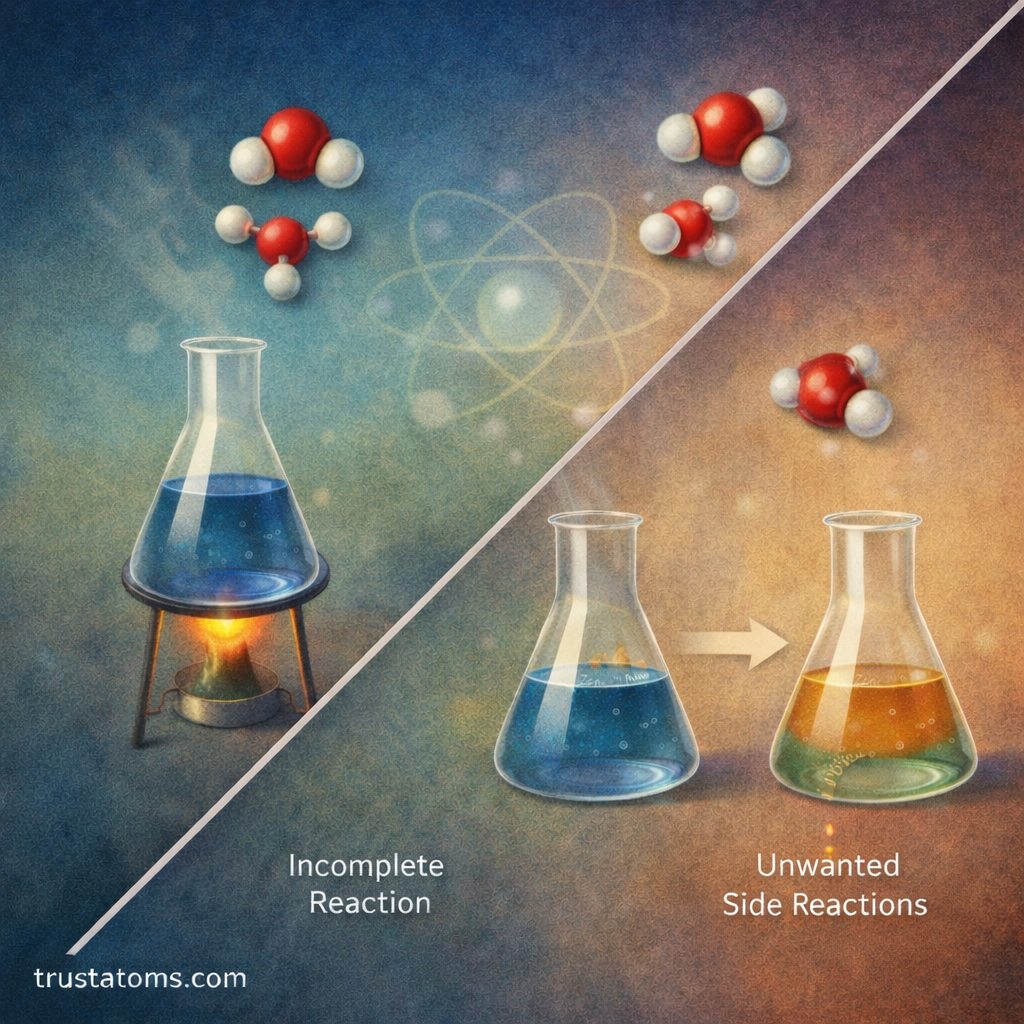
- Incomplete reactions
- Side reactions producing unwanted substances
- Loss of material during filtration or purification
- Measurement errors
- Equipment limitations
Since these factors occur frequently, the actual yield is usually lower than the theoretical yield.
Percent Yield
To evaluate how efficient a reaction is, chemists calculate percent yield.
Percent yield compares the actual product obtained to the theoretical maximum.
\text{Percent Yield} = \frac{\text{Actual Yield}}{\text{Theoretical Yield}} \times 100
This value tells chemists how closely the reaction approached the ideal outcome.
For example:
- 100% yield means the reaction produced the maximum possible product
- 80–90% yield is often considered very efficient in laboratory reactions
- Lower yields suggest inefficiencies or experimental losses
Example of Reaction Yield
Consider a reaction where hydrogen gas reacts with oxygen gas to produce water.
After balancing the equation, calculations may predict that the reaction should produce 10 grams of water.
If the experiment produces 8 grams of water, the yields are:
- Theoretical yield = 10 g
- Actual yield = 8 g
Using the percent yield formula:
Percent yield = (8 ÷ 10) × 100
Percent yield = 80%
This means the reaction achieved 80% of its theoretical maximum.
Why Reaction Yield Matters
Reaction yield plays an important role in both scientific research and industrial chemistry.
Chemists rely on yield calculations to:
- Evaluate reaction efficiency
- Improve chemical manufacturing processes
- Reduce material waste
- Optimize laboratory procedures
- Compare different reaction methods
In industries such as pharmaceuticals, plastics, and energy production, improving reaction yield can significantly reduce costs and increase productivity.
Factors That Affect Reaction Yield
Several variables can influence how much product a reaction produces.
Incomplete Reactions
Some reactions do not go to completion, leaving unreacted materials behind.
Side Reactions
Reactants may react in unexpected ways, forming different products and reducing the desired yield.
Product Loss During Processing
Chemists often need to separate, filter, or purify products. Some material can be lost during these steps.
Reaction Conditions
Temperature, pressure, catalysts, and concentration levels all influence reaction efficiency.
Optimizing these conditions can improve yield.
How Chemists Improve Reaction Yield
Chemists continuously refine reactions to achieve higher yields.
Common strategies include:
- Adjusting temperature and pressure conditions
- Using catalysts to speed up reactions
- Purifying reactants before the reaction begins
- Improving separation and purification methods
- Controlling reaction time carefully
Small improvements in yield can make a significant difference when reactions are scaled up for industrial production.
Reaction Yield in Real-World Applications
Reaction yield is used in many scientific and industrial fields, including:
- Pharmaceutical drug manufacturing
- Agricultural chemical production
- Fuel and energy research
- Food chemistry
- Materials science
In these industries, maximizing yield helps reduce raw material usage and environmental impact while increasing efficiency.
Final Thoughts
Reaction yield is a key concept in chemistry that measures how efficiently a chemical reaction produces its desired product. By comparing theoretical yield, actual yield, and percent yield, chemists can determine how well a reaction performs.
Understanding reaction yield allows scientists to improve reactions, reduce waste, and design more efficient chemical processes that support both research and industry.