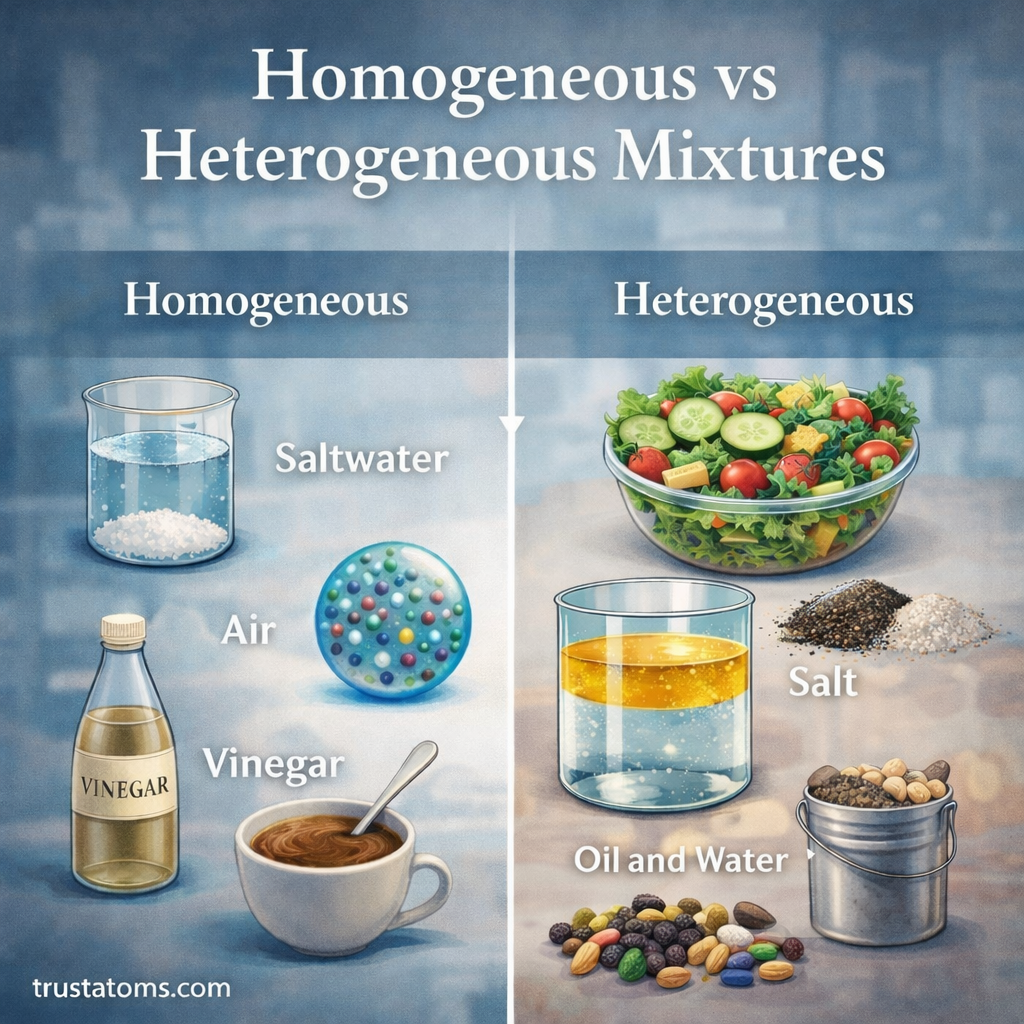
Mixtures are combinations of two or more substances that are physically combined rather than chemically bonded. While mixtures can vary widely in appearance and composition, they are commonly classified into two main categories: homogeneous mixtures and heterogeneous mixtures.
Understanding the difference between these two types of mixtures helps explain how substances interact, how materials are separated, and how many everyday products are formed.
This guide explores the characteristics, examples, and key differences between homogeneous and heterogeneous mixtures.
What Is a Mixture?
A mixture is a physical combination of substances where each component retains its own chemical properties. The substances are not chemically bonded, meaning they can usually be separated using physical methods.
Common characteristics of mixtures include:
- Two or more substances combined physically
- Components maintain their individual properties
- No chemical reaction required to form the mixture
- Composition may vary
- Components can often be separated by physical processes
Examples of mixtures include air, saltwater, soil, salad, and many beverages.
What Is a Homogeneous Mixture?
A homogeneous mixture has a uniform composition throughout the entire substance. The different components are evenly distributed, making it difficult or impossible to distinguish individual parts.
Homogeneous mixtures are often referred to as solutions.
Key Characteristics of Homogeneous Mixtures
Homogeneous mixtures share several defining features:
- Uniform appearance throughout the mixture
- Components are evenly distributed
- Individual substances are not visibly distinguishable
- The mixture exists in a single phase
Because the components are mixed so thoroughly, the mixture appears as a single substance.
Common Examples of Homogeneous Mixtures
Many everyday substances are homogeneous mixtures, including:
- Salt dissolved in water
- Sugar dissolved in tea
- Air (a mixture of gases)
- Vinegar
- Metal alloys such as brass or bronze
For example, when salt dissolves in water, the salt particles spread evenly throughout the liquid, creating a uniform mixture.
What Is a Heterogeneous Mixture?
A heterogeneous mixture has a non-uniform composition, meaning the different substances remain visibly distinct or unevenly distributed.
In heterogeneous mixtures, the components can usually be identified by sight or easily separated by physical means.
Key Characteristics of Heterogeneous Mixtures
Heterogeneous mixtures typically have the following traits:
- Non-uniform composition
- Multiple visible substances
- Uneven distribution of components
- Often contains more than one phase
Because the substances remain separate, the mixture may appear layered, clumped, or uneven.
Common Examples of Heterogeneous Mixtures
Many natural and everyday materials are heterogeneous mixtures.
Examples include:
- Salad
- Oil and water
- Sand mixed with gravel
- Chocolate chip cookies
- Soil
In a salad, for example, the ingredients such as lettuce, tomatoes, cucumbers, and dressing remain distinct and easily visible.
Key Differences Between Homogeneous and Heterogeneous Mixtures
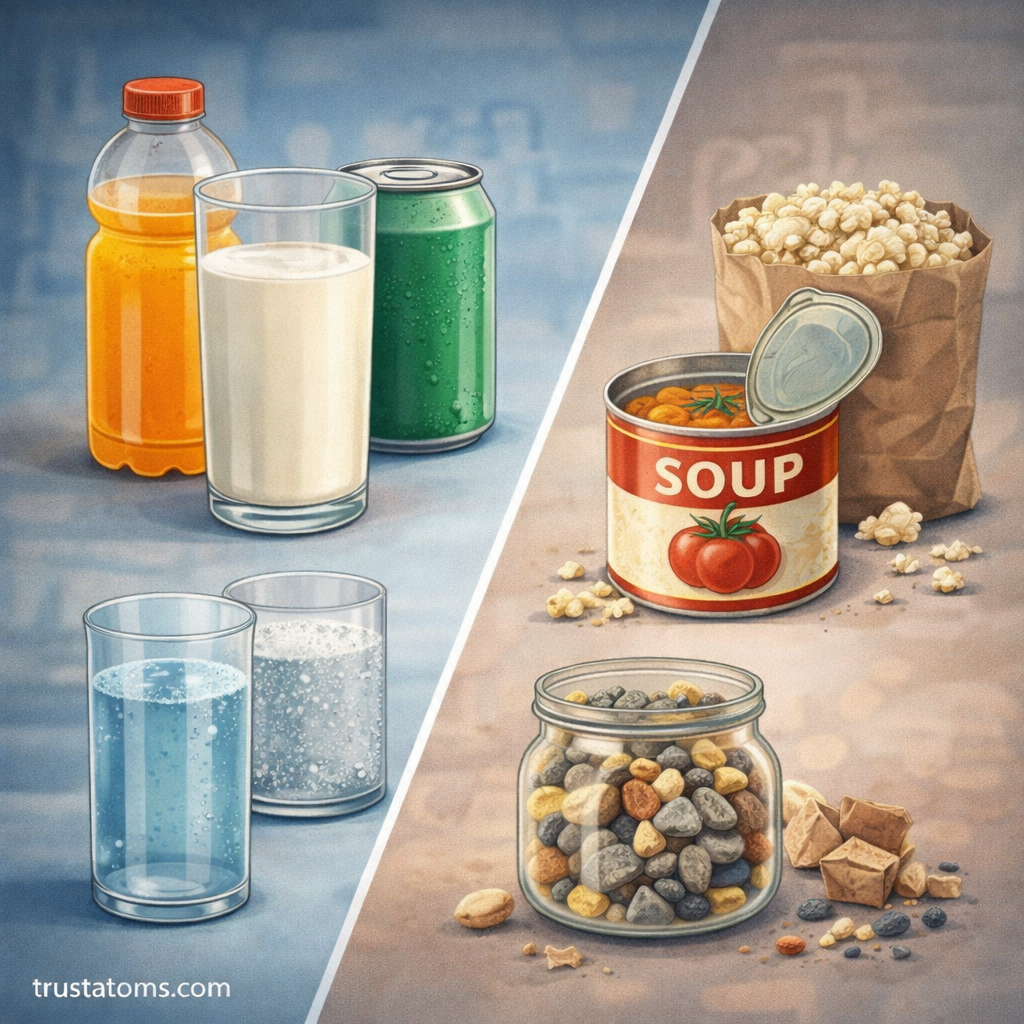
Although both types of mixtures involve substances that are physically combined, they differ mainly in how evenly the components are distributed.
Homogeneous Mixtures
Homogeneous mixtures have:
- Uniform composition
- A single visible phase
- Even distribution of components
- Components that cannot be easily distinguished
Example: Saltwater.
Heterogeneous Mixtures
Heterogeneous mixtures have:
- Non-uniform composition
- Multiple visible phases
- Uneven distribution of components
- Components that are easily distinguishable
Example: Oil and water.
Simple Ways to Identify Each Type of Mixture
Sometimes it can be difficult to determine whether a mixture is homogeneous or heterogeneous. Several simple observations can help identify the type.
Visual Inspection
Look at the mixture closely.
- If the mixture looks uniform throughout, it is likely homogeneous.
- If you can see different substances or layers, it is likely heterogeneous.
Settling or Separation
Allow the mixture to sit undisturbed.
- In heterogeneous mixtures, components may separate over time.
- Homogeneous mixtures generally remain evenly distributed.
Filtration
Filtering a mixture can sometimes reveal differences.
- Heterogeneous mixtures often contain particles that can be filtered out.
- Homogeneous mixtures typically cannot be separated by simple filtration.
Real-World Applications of Both Types of Mixtures
Homogeneous and heterogeneous mixtures are used in many fields, including chemistry, manufacturing, environmental science, and food production.
Homogeneous Mixtures in Industry
Industries rely on homogeneous mixtures for consistency and predictable performance.
Examples include:
- Pharmaceutical solutions
- Fuel mixtures
- Metal alloys used in construction
- Cleaning solutions
Uniform distribution ensures consistent chemical and physical properties.
Heterogeneous Mixtures in Nature and Manufacturing
Heterogeneous mixtures appear frequently in natural systems and industrial processes.
Examples include:
- Soil composition in agriculture
- Rock formations in geology
- Food products like cereal or salads
- Concrete mixtures used in construction
In many cases, the visible separation of components is important for the mixture’s function.
Why Understanding Mixture Types Matters
Distinguishing between homogeneous and heterogeneous mixtures helps scientists understand how materials behave and how they can be separated or processed.
This knowledge is essential in fields such as:
- Chemical engineering
- Environmental science
- Food science
- Medicine
- Materials science
By identifying the type of mixture, scientists can choose the most effective techniques for analysis, purification, and manufacturing.
Final Thoughts
Homogeneous and heterogeneous mixtures represent two fundamental ways substances combine without forming chemical bonds.
Homogeneous mixtures appear uniform and contain evenly distributed components, while heterogeneous mixtures display visible differences between their substances.
Recognizing the difference between these mixture types helps explain many natural phenomena and industrial processes, from the composition of air to the preparation of foods and construction materials.
Understanding these concepts provides a foundation for studying chemistry and the behavior of matter in everyday life.