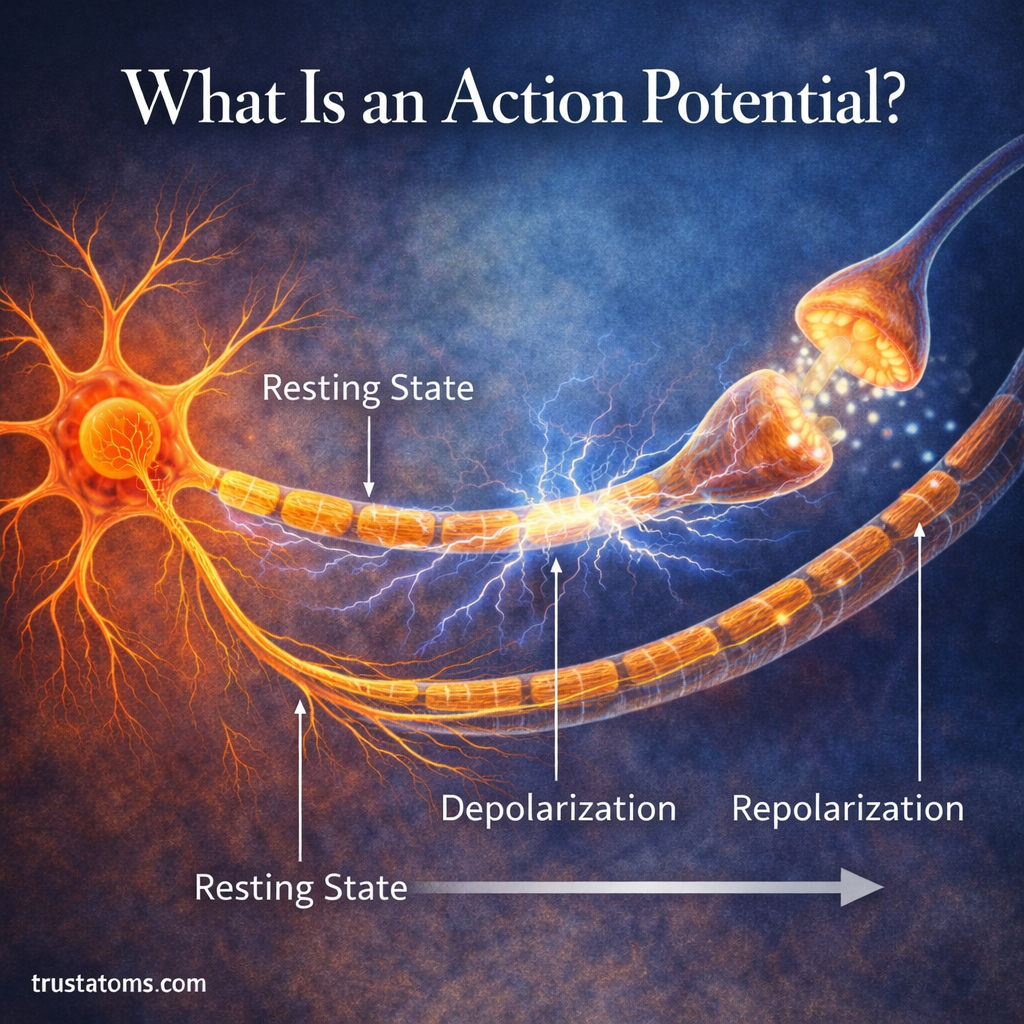
An action potential is a rapid electrical signal that travels along a neuron, allowing nerve cells to communicate with each other and with muscles or glands. It is the fundamental mechanism that enables the nervous system to transmit information throughout the body.
Every time you move a muscle, feel pain, or process a thought, action potentials are helping carry signals through networks of neurons. These electrical impulses move quickly along nerve fibers, ensuring that messages reach their destination in fractions of a second.
Without action potentials, neurons would not be able to send signals, and the nervous system would not function.
Why Action Potentials Are Important
The nervous system relies on electrical signaling to coordinate activities throughout the body. Action potentials are the events that make this communication possible.
They allow neurons to:
- Transmit signals over long distances
- Communicate with other neurons at synapses
- Activate muscles and glands
- Process sensory information
- Coordinate reflexes and movements
Because action potentials travel quickly and efficiently, they enable rapid responses to changes in the environment.
How Neurons Generate Electrical Signals
Neurons maintain a difference in electrical charge across their cell membranes. This difference is known as the resting membrane potential.
At rest, the inside of a neuron is slightly more negative than the outside. This occurs because of the distribution of charged particles, or ions, across the cell membrane.
Two important ions involved in this process are:
- Sodium (Na⁺)
- Potassium (K⁺)
Special proteins in the cell membrane regulate the movement of these ions in and out of the neuron.
This balance of ions sets the stage for an action potential.
The Stages of an Action Potential
An action potential occurs when the electrical balance of a neuron changes rapidly and then returns to its original state.
This process typically happens in several stages.
1. Resting State
Before an action potential occurs, the neuron is in a resting state.
During this stage:
- The inside of the cell is negatively charged compared to the outside
- Ion channels regulate the movement of sodium and potassium
- The neuron is ready to respond to incoming signals
This stable electrical condition is called the resting potential.
2. Depolarization
Depolarization begins when the neuron receives a signal strong enough to trigger an electrical response.
During depolarization:
- Sodium channels open in the cell membrane
- Sodium ions rapidly move into the neuron
- The inside of the cell becomes more positive
This sudden change in electrical charge creates the action potential.
3. Repolarization
After depolarization, the neuron must restore its original electrical balance.
During repolarization:
- Sodium channels close
- Potassium channels open
- Potassium ions move out of the neuron
This movement causes the inside of the cell to become negative again.
4. Hyperpolarization
In some cases, the neuron briefly becomes more negative than its resting state.
This phase is called hyperpolarization.
It occurs because potassium ions continue leaving the cell for a short period before the ion channels fully close.
The neuron then returns to its normal resting potential.
How Action Potentials Travel Along Neurons
Once an action potential begins, it moves along the neuron’s axon like a wave.
This happens because the change in electrical charge in one section of the membrane triggers the next section to open its ion channels.
The signal continues traveling until it reaches the axon terminals, where it can trigger the release of neurotransmitters.
These chemicals then carry the signal across the synapse to the next neuron or target cell.
The All-or-None Principle
Action potentials follow a rule known as the all-or-none principle.
This means:
- If the stimulus reaches the required threshold, the neuron fires an action potential
- If the stimulus is too weak, no action potential occurs
Once triggered, the action potential always travels with the same strength.
Stronger signals are represented not by larger action potentials but by more frequent firing of impulses.
Speed of Action Potentials
Action potentials travel at different speeds depending on the type of neuron and whether the axon is insulated by myelin.
Factors that influence signal speed include:
- Axon diameter – larger axons transmit signals faster
- Myelin sheath – insulated axons conduct signals more rapidly
- Distance between nodes – gaps in the myelin that help accelerate transmission
In myelinated neurons, signals can travel extremely fast through a process called saltatory conduction, where impulses jump between gaps in the myelin sheath.
Some nerve impulses travel at speeds of over 100 meters per second.
Action Potentials and Synaptic Communication
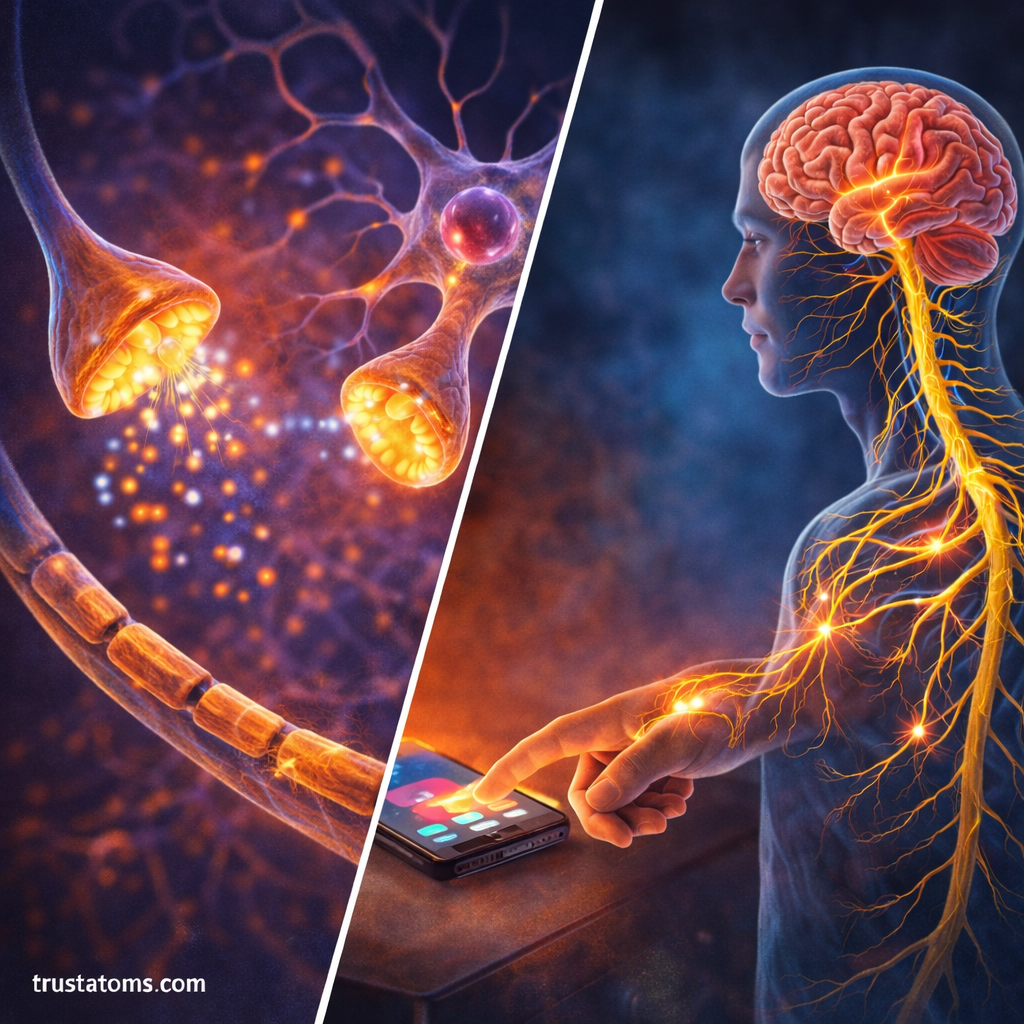
When an action potential reaches the end of a neuron, it triggers the release of neurotransmitters.
This process allows neurons to communicate with other cells.
The sequence usually follows these steps:
- The action potential reaches the axon terminal
- Neurotransmitters are released into the synapse
- These chemicals bind to receptors on the next cell
- The signal continues through the neural network
This communication allows the nervous system to coordinate complex activities throughout the body.
Why Action Potentials Matter in the Human Body
Action potentials are essential for nearly every function of the nervous system.
They help control:
- Muscle movement
- Sensory perception
- Reflex responses
- Heart rhythm regulation
- Cognitive processes like learning and memory
Without these electrical signals, the brain would not be able to send instructions to the body or interpret sensory input.
Final Thoughts
An action potential is the electrical signal that allows neurons to communicate across the nervous system. By rapidly changing the electrical charge of a neuron’s membrane, these impulses transmit information from one cell to another.
This process enables the brain, spinal cord, and nerves to coordinate everything from simple reflexes to complex thoughts. Understanding action potentials provides insight into how the nervous system processes information and maintains communication throughout the body.