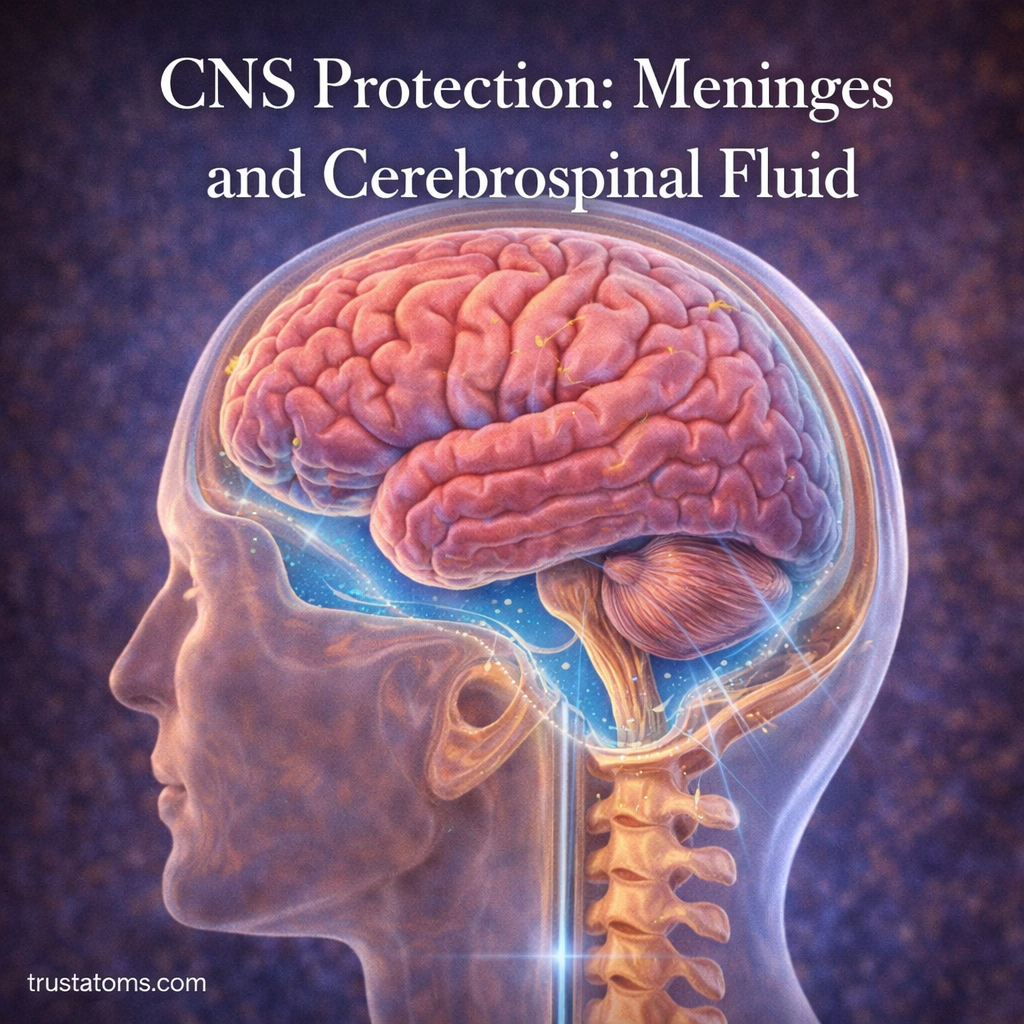
The central nervous system (CNS), which includes the brain and spinal cord, is one of the most vital and sensitive systems in the human body. Because of its importance, it requires multiple layers of protection to prevent damage from physical impact, infection, and environmental changes.
Two key protective components are the meninges and cerebrospinal fluid (CSF). Together, they create a supportive environment that cushions, stabilizes, and nourishes the brain and spinal cord.
Understanding how these structures work helps explain how the body protects its most critical control center.
Why the Central Nervous System Needs Protection
The brain and spinal cord control:
- Movement
- Sensory processing
- Thought and memory
- Breathing and heart rate
- Hormonal regulation
Because nervous tissue is delicate and has limited ability to repair itself, even minor damage can have serious consequences.
To reduce risk, the body uses several layers of protection:
- The skull and vertebral column (physical barriers)
- The meninges (protective membranes)
- Cerebrospinal fluid (shock absorption and support)
These systems work together to keep the CNS safe and functioning properly.
What Are the Meninges?
The meninges are three layers of connective tissue that surround and protect the brain and spinal cord.
They provide:
- Physical protection
- Structural support
- A framework for blood vessels
- Separation between different CNS regions
The three layers of the meninges are:
- Dura mater
- Arachnoid mater
- Pia mater
Each layer has a unique structure and function.
The Three Layers of the Meninges
Dura Mater
The dura mater is the outermost and toughest layer.
Key characteristics include:
- Thick and durable
- Provides strong protection against injury
- Anchors the brain within the skull
- Forms partitions that stabilize brain structures
In the skull, the dura mater has two layers that help create protective spaces for blood vessels.
Arachnoid Mater
The arachnoid mater is the middle layer.
It has a web-like structure and sits between the dura mater and pia mater.
Its main roles include:
- Acting as a cushion-like barrier
- Containing the subarachnoid space
- Supporting the circulation of cerebrospinal fluid
This layer helps create a protective fluid-filled environment around the CNS.
Pia Mater
The pia mater is the innermost and most delicate layer.
It closely adheres to the surface of the brain and spinal cord.
Its functions include:
- Following the contours of the brain
- Supporting blood vessels that supply nervous tissue
- Providing a thin protective covering
The pia mater plays a key role in nutrient delivery and tissue support.
The Subarachnoid Space
Between the arachnoid mater and pia mater lies the subarachnoid space.
This space is filled with cerebrospinal fluid and serves as a critical protective zone.
Functions of the subarachnoid space include:
- Allowing CSF to circulate around the brain and spinal cord
- Absorbing mechanical shock
- Providing a buffer against sudden movements
This fluid-filled space helps prevent direct impact on delicate neural tissue.
What Is Cerebrospinal Fluid (CSF)?
Cerebrospinal fluid is a clear, colorless liquid that surrounds the brain and spinal cord.
It is produced in structures within the brain called the ventricles, specifically by the choroid plexus.
CSF flows through:
- Brain ventricles
- The central canal of the spinal cord
- The subarachnoid space
It is continuously produced and reabsorbed to maintain a stable environment.
Functions of Cerebrospinal Fluid
Cerebrospinal fluid performs several essential functions.
Shock Absorption
CSF acts as a cushion, protecting the brain and spinal cord from sudden impacts or movements.
It helps reduce the force of:
- Falls
- Head movements
- External trauma
Buoyancy
CSF provides buoyancy, allowing the brain to “float” within the skull.
This reduces pressure on the base of the brain and prevents compression of delicate structures.
Nutrient Transport
CSF helps deliver nutrients to nervous tissue and remove waste products.
This supports:
- Cellular function
- Metabolic balance
- Overall brain health
Chemical Stability
CSF maintains a stable chemical environment for neurons.
It helps regulate:
- Ion balance
- pH levels
- Waste removal
This stability is essential for proper nerve signaling.
How CSF Circulates
Cerebrospinal fluid circulates through a continuous cycle.
The process includes:
- Production in the brain’s ventricles
- Flow through interconnected ventricular spaces
- Movement into the subarachnoid space
- Circulation around the brain and spinal cord
- Reabsorption into the bloodstream
This constant circulation ensures that the CNS remains protected and nourished.
Additional Protective Roles of the Meninges and CSF
Together, the meninges and cerebrospinal fluid provide multiple layers of defense.
These include:
- Acting as a barrier against infections
- Stabilizing the position of the brain and spinal cord
- Supporting blood vessels and nutrient delivery
- Reducing friction during movement
- Maintaining internal pressure within the skull
These systems ensure that the CNS can function efficiently under various conditions.
Conditions Affecting CNS Protection
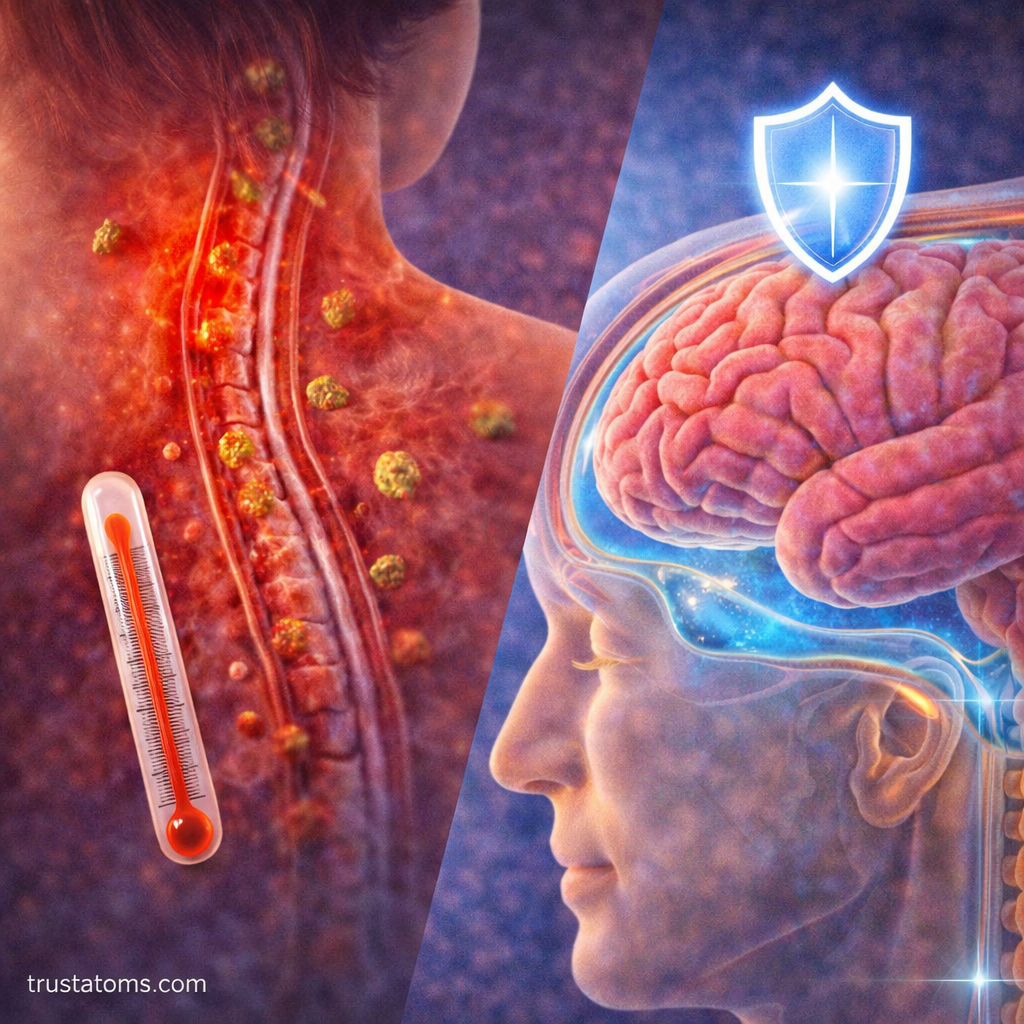
Damage or dysfunction in the meninges or CSF can lead to serious health issues.
Common conditions include:
Meningitis
Meningitis is inflammation of the meninges, often caused by infection.
Symptoms may include:
- Headache
- Fever
- Neck stiffness
- Sensitivity to light
This condition requires immediate medical attention.
Hydrocephalus
Hydrocephalus occurs when CSF accumulates in the brain.
This can lead to:
- Increased pressure inside the skull
- Brain tissue damage
- Cognitive and physical impairments
CSF Leaks
A cerebrospinal fluid leak can occur due to injury or structural defects.
This may cause:
- Headaches
- Fluid drainage from the nose or ears
- Increased risk of infection
Why CNS Protection Is Essential
The meninges and cerebrospinal fluid are critical for maintaining the safety and function of the central nervous system.
They allow the brain and spinal cord to:
- Withstand physical forces
- Maintain a stable internal environment
- Receive nutrients and remove waste
- Function without disruption
Without these protective systems, even minor impacts could lead to significant neurological damage.
Final Thoughts
The central nervous system relies on multiple layers of protection to function safely and efficiently. The meninges provide strong structural support, while cerebrospinal fluid offers cushioning, buoyancy, and chemical stability.
Together, these systems create a protective environment that shields the brain and spinal cord from harm while supporting essential biological processes. Understanding how the meninges and CSF work highlights the complexity and resilience of the human body’s most important control system.