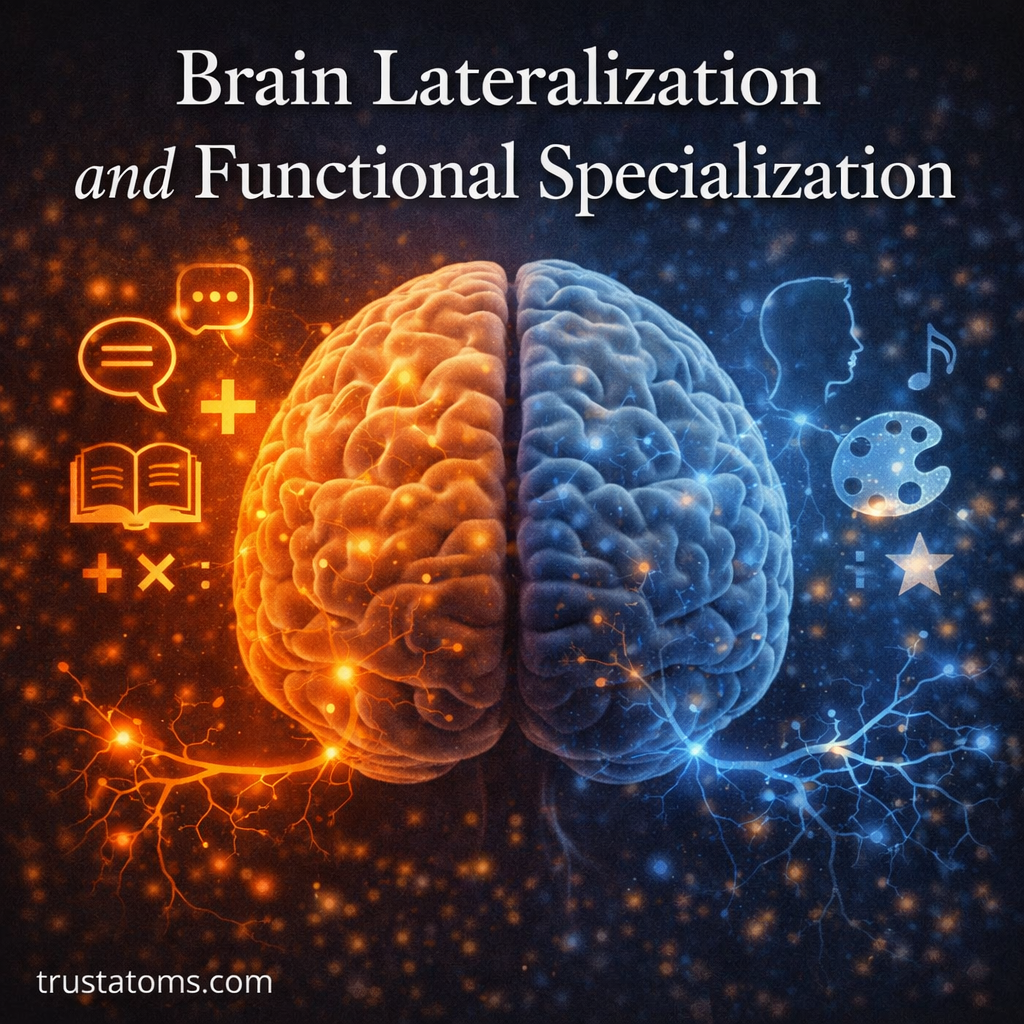
The human brain is often described as having two halves, but these halves are not identical in function. Brain lateralization refers to the idea that certain cognitive processes and functions are more dominant in one hemisphere than the other. Alongside this, functional specialization explains how specific brain regions are dedicated to particular tasks.
In this article, we’ll explore how the brain divides responsibilities, what each hemisphere is known for, and why this organization is essential for efficient thinking and behavior.
What Is Brain Lateralization?
Brain lateralization is the tendency for some neural functions to be more dominant in either the left or right hemisphere of the brain.
While both hemispheres work together, they often specialize in different types of processing.
Key idea:
- The brain is functionally divided, but not completely separated.
Each hemisphere communicates through a structure called the corpus callosum, which allows information to pass between them.
Left Hemisphere vs. Right Hemisphere
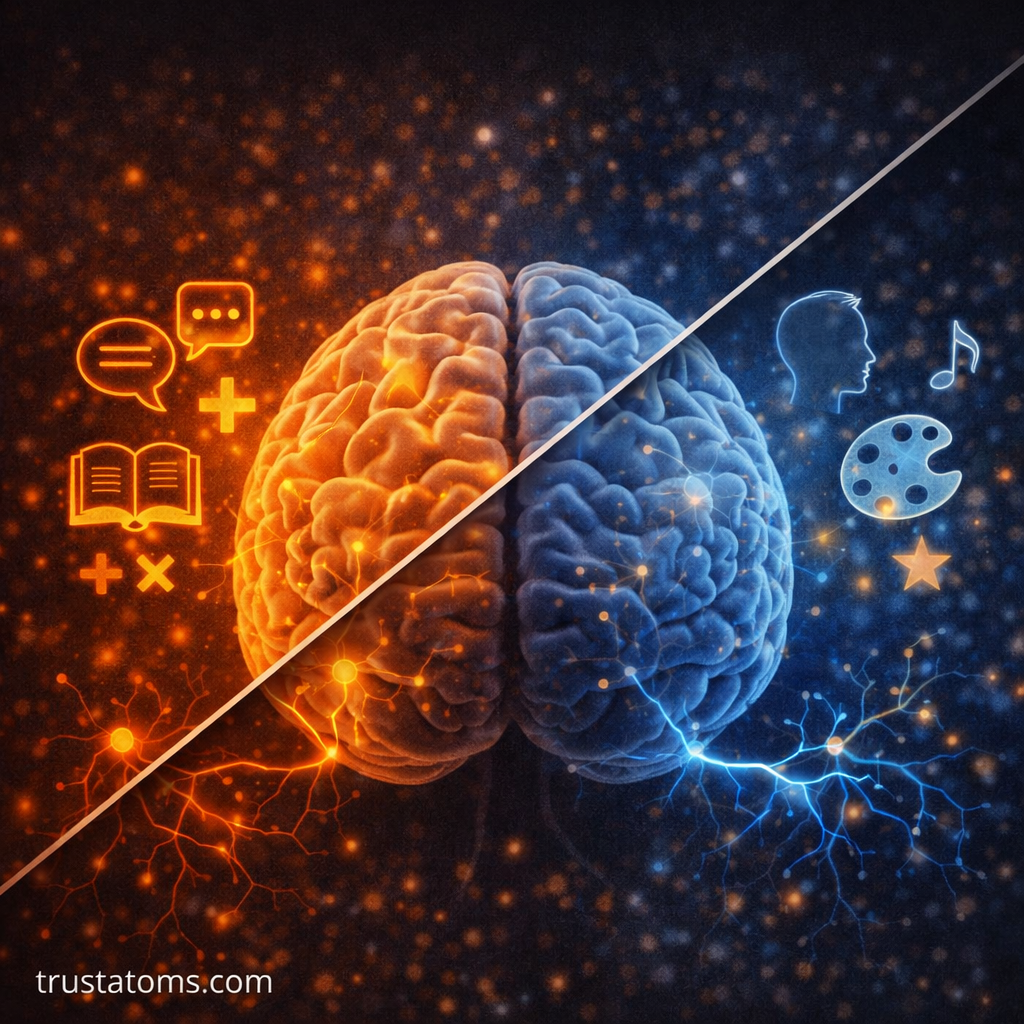
The two hemispheres are associated with different strengths, although these are general patterns rather than strict rules.
Left Hemisphere Functions
- Language processing (speech, reading, writing)
- Logical reasoning and analysis
- Mathematical calculations
- Sequential processing (step-by-step thinking)
Right Hemisphere Functions
- Spatial awareness and navigation
- Face recognition
- Emotional processing
- Creativity and holistic thinking
It’s important to note that most tasks involve both hemispheres working together.
What Is Functional Specialization?
Functional specialization refers to the idea that specific brain regions are responsible for particular tasks.
Instead of every part of the brain doing everything, different areas are optimized for specific functions.
Examples of Specialized Brain Regions:
- Broca’s area: Speech production
- Wernicke’s area: Language comprehension
- Occipital lobe: Visual processing
- Temporal lobe: Auditory processing and memory
- Parietal lobe: Sensory integration and spatial awareness
- Frontal lobe: Decision-making and motor control
This specialization allows the brain to process information more efficiently.
How Hemispheres Work Together
Although the brain is lateralized, the two hemispheres constantly communicate.
Role of the Corpus Callosum
- Connects left and right hemispheres
- Transfers information between them
- Ensures coordinated processing
For example:
- Reading involves language (left hemisphere) and visual recognition (right hemisphere)
- Music processing combines rhythm (left) and melody/emotion (right)
This collaboration is essential for complex tasks.
Why Lateralization Exists
Brain lateralization offers several advantages.
Benefits of Lateralization:
- Efficiency: Dividing tasks reduces redundancy
- Speed: Parallel processing improves response time
- Specialization: Regions can optimize for specific functions
By distributing tasks, the brain can handle more information simultaneously.
Variations in Lateralization
Not everyone’s brain is lateralized in exactly the same way.
Factors That Influence Lateralization:
- Genetics
- Development
- Experience and learning
- Handedness
For example:
- Most right-handed individuals have left-hemisphere language dominance
- Some left-handed individuals show more balanced or right-sided language processing
These variations highlight the brain’s flexibility.
Lateralization in Everyday Life
Brain lateralization affects many everyday activities.
Examples:
- Speaking and understanding language
- Navigating spaces or reading maps
- Recognizing faces and emotions
- Solving logical problems
Even simple tasks often rely on contributions from both hemispheres.
Split-Brain Research
Much of what we know about lateralization comes from split-brain studies.
What Is Split-Brain Surgery?
- A procedure that cuts the corpus callosum
- Used to treat severe epilepsy
Key Findings:
- Each hemisphere can function independently to some extent
- The left hemisphere is often dominant for language
- The right hemisphere excels in visual and spatial tasks
These studies provided strong evidence for functional specialization.
Functional Specialization Beyond Hemispheres
Specialization occurs not only between hemispheres but also within specific brain networks.
Examples:
- Visual cortex processes shapes, color, and motion
- Motor cortex controls voluntary movement
- Limbic system regulates emotions
This layered organization allows the brain to handle complex processes efficiently.
When Lateralization Is Disrupted
Damage to specific brain regions can affect specialized functions.
Examples:
- Aphasia: Language impairment due to left hemisphere damage
- Neglect syndrome: Ignoring one side of space, often due to right hemisphere damage
- Prosopagnosia: Difficulty recognizing faces
These conditions demonstrate how specialized brain regions contribute to normal function.
Common Myths About Brain Hemispheres
Myth 1: People Are “Left-Brained” or “Right-Brained”
- In reality, both hemispheres are involved in most tasks
Myth 2: Creativity Only Comes from the Right Brain
- Creativity involves multiple regions across both hemispheres
Myth 3: Logic Is Only in the Left Brain
- Logical thinking also involves broader networks
Understanding these myths helps clarify how the brain truly works.
Why Functional Specialization Matters
Functional specialization and lateralization are essential for:
- Efficient information processing
- Coordinated behavior
- Learning and memory
- Adaptability after injury
They allow the brain to divide and conquer complex tasks.
Final Thoughts
Brain lateralization and functional specialization reveal how the brain organizes its workload. By assigning different functions to specific regions and hemispheres, the brain achieves remarkable efficiency and flexibility.
Rather than operating as a single uniform system, the brain is a coordinated network of specialized parts working together. This balance between division and integration is what makes human cognition so powerful.