
Buoyancy is the upward force that a fluid exerts on an object placed in it.
This force is what allows boats to float, balloons to rise, and swimmers to stay above water.
Whenever an object is partially or completely submerged in a liquid or gas, buoyancy acts against gravity. Whether the object floats, sinks, or stays suspended depends on the balance between buoyant force and weight.
The Basic Idea of Buoyancy
When you place an object in water, it pushes some of the water out of the way.
This displaced water creates an upward force on the object. That upward force is called the buoyant force.
If the buoyant force is:
- Greater than the object’s weight → the object rises.
- Equal to the object’s weight → the object floats.
- Less than the object’s weight → the object sinks.
Buoyancy depends on both the object and the fluid it is placed in.
Archimedes’ Principle
The concept of buoyancy is explained by Archimedes’ Principle.
It states:
The buoyant force on an object equals the weight of the fluid displaced by the object.
In simple terms:
- The more fluid an object displaces, the greater the upward force.
- Denser fluids provide greater buoyant force.
This principle explains why large steel ships can float even though steel itself is denser than water.
Why Some Objects Float and Others Sink
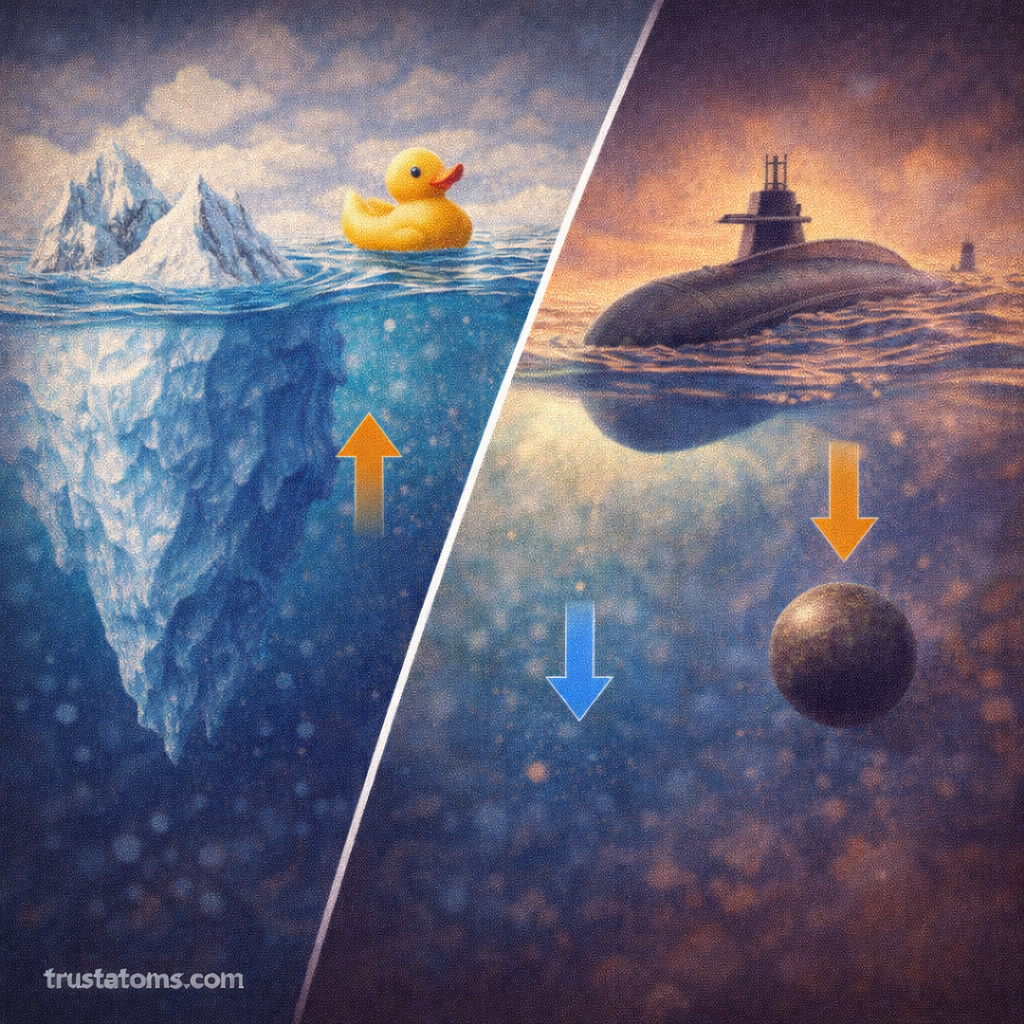
Floating and sinking depend on density.
An object floats if:
- Its average density is less than the density of the fluid.
An object sinks if:
- Its average density is greater than the fluid.
For example:
- Wood floats in water.
- A rock sinks.
- Ice floats because it is less dense than liquid water.
It is not just weight that matters — it is density relative to the surrounding fluid.
Buoyancy in Liquids
Buoyancy is most noticeable in liquids like water.
Examples include:
- Boats floating on lakes
- Submarines adjusting depth
- Icebergs drifting in oceans
Submarines control buoyancy by changing the amount of water in ballast tanks. By increasing or decreasing their average density, they can rise or sink.
Buoyancy in Gases
Buoyancy also occurs in gases.
Air is a fluid, so it can exert a buoyant force.
Examples include:
- Hot air balloons rising
- Helium balloons floating
- Warm air rising in the atmosphere
Hot air balloons rise because heated air inside the balloon becomes less dense than the surrounding air.
Factors That Affect Buoyancy
Several factors influence buoyant force.
1. Fluid Density
Denser fluids create greater buoyant force.
For example:
- It is easier to float in saltwater than in freshwater.
- Objects float more easily in mercury than in water.
2. Volume of Displaced Fluid
The larger the submerged volume of the object, the greater the buoyant force.
This is why large ships displace enormous amounts of water.
3. Gravity
Buoyant force depends on gravity.
On planets with weaker gravity, buoyant forces would also be weaker.
Neutral Buoyancy
Neutral buoyancy occurs when buoyant force equals weight.
The object neither sinks nor floats upward — it stays suspended.
Examples include:
- Fish adjusting swim bladders
- Scuba divers controlling depth
- Submarines hovering underwater
Neutral buoyancy is especially important in underwater operations.
Real-World Applications of Buoyancy
Buoyancy is essential in many fields.
Engineering
- Designing ships and floating structures
- Building oil platforms
- Creating flotation devices
Oceanography
- Studying ocean currents
- Understanding how water temperature affects movement
Aviation
- Designing hot air balloons
- Studying atmospheric circulation
Buoyancy connects physics with transportation, safety, and environmental science.
The Big Picture
Buoyancy is the upward force a fluid exerts on an object.
It:
- Opposes gravity
- Depends on displaced fluid
- Is explained by Archimedes’ Principle
- Determines whether objects float or sink
From icebergs to balloons to massive cargo ships, buoyancy shapes how objects move in fluids.
Understanding buoyancy reveals how density, gravity, and fluid motion work together in the physical world.