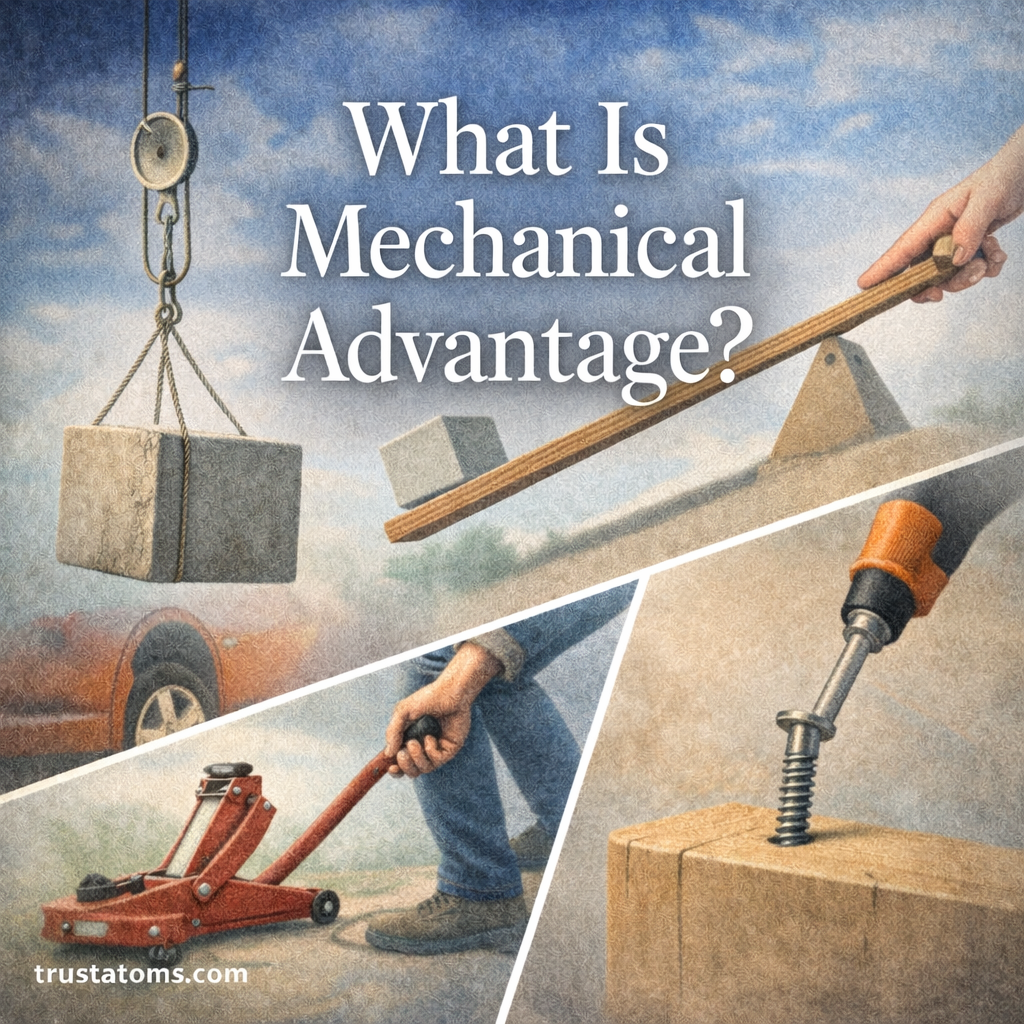
Mechanical advantage is a key concept in physics that explains how machines make work easier.
From simple tools like levers and pulleys to complex machines like cranes and hydraulic lifts, mechanical advantage helps us lift heavier objects, move loads more efficiently, and apply force more effectively.
In simple terms, mechanical advantage describes how much a machine multiplies your input force.
Let’s break it down clearly.
What Is Mechanical Advantage?
Mechanical advantage (MA) is the ratio of output force to input force in a machine.
It tells us how much a machine amplifies the force you apply.
Mechanical Advantage = Output Force ÷ Input Force
If a machine has a mechanical advantage greater than 1:
- It multiplies your force.
- You apply less effort than the load requires.
If mechanical advantage equals 1:
- The machine changes direction but not force.
If mechanical advantage is less than 1:
- The machine increases speed or distance instead of force.
Why Mechanical Advantage Matters
Mechanical advantage explains why simple machines are so powerful.
It allows humans to:
- Lift heavy objects with less effort
- Move large loads safely
- Apply force more precisely
- Increase efficiency in construction and engineering
Without mechanical advantage, tasks like building bridges, moving cargo, or operating machinery would require far more energy.
Types of Mechanical Advantage
There are two main ways to describe mechanical advantage.
1. Ideal Mechanical Advantage (IMA)
Ideal mechanical advantage assumes no friction or energy loss.
It is calculated using distances:
Ideal Mechanical Advantage = Input Distance ÷ Output Distance
This represents the maximum possible efficiency of a machine.
2. Actual Mechanical Advantage (AMA)
Actual mechanical advantage considers real-world factors like friction.
Actual Mechanical Advantage = Actual Output Force ÷ Actual Input Force
In reality, AMA is always less than IMA because some energy is lost.
Mechanical Advantage in Simple Machines
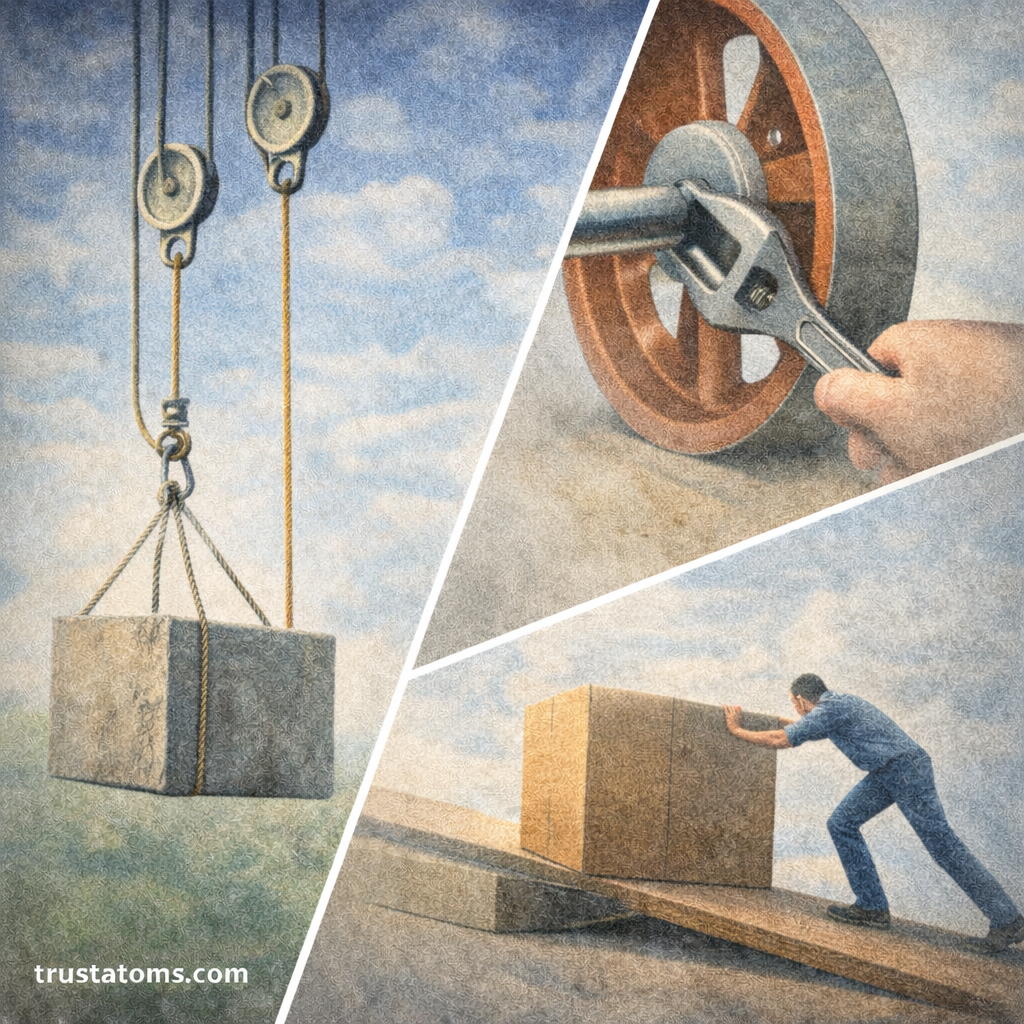
Mechanical advantage is easiest to understand through simple machines.
1. Lever
A lever uses a pivot point (fulcrum) to multiply force.
- Longer effort arm → greater mechanical advantage
- Shorter effort arm → less mechanical advantage
Examples: crowbars, seesaws, bottle openers.
2. Pulley
A pulley changes the direction of force and can reduce effort.
- Single fixed pulley → MA = 1
- Multiple pulleys → increased mechanical advantage
Used in cranes, elevators, and flagpoles.
3. Inclined Plane
An inclined plane allows you to lift objects by moving them over a longer distance.
- Longer ramp → less force required
- Shorter ramp → more force required
Examples: wheelchair ramps, loading docks.
4. Wheel and Axle
A wheel attached to a smaller axle multiplies force.
- Larger wheel → greater mechanical advantage
- Smaller axle → increased torque
Examples: doorknobs, steering wheels.
5. Screw
A screw is an inclined plane wrapped around a cylinder.
- Smaller thread spacing → greater mechanical advantage
- More turns required → less force needed per turn
Used in clamps and fasteners.
Force vs. Distance Trade-Off
Mechanical advantage does not reduce total work done.
Instead, it changes how force and distance are distributed.
If you use less force:
- You must apply it over a greater distance.
If you use more force:
- You move the object a shorter distance.
This trade-off follows the principle of conservation of energy.
Machines make tasks easier by spreading work differently — not by eliminating it.
Efficiency and Energy Loss
In real machines, energy is lost due to:
- Friction
- Heat
- Deformation
- Air resistance
Efficiency measures how much useful work output you get compared to input.
Efficiency = (Output Work ÷ Input Work) × 100%
No real machine is 100% efficient.
Real-World Applications of Mechanical Advantage
Mechanical advantage is everywhere in daily life.
Construction equipment uses levers and pulleys to lift heavy materials.
Hydraulic car jacks multiply force to raise vehicles.
Scissors combine two levers to cut efficiently.
Even the human body uses mechanical advantage — your forearm acts as a lever when lifting objects.
Key Takeaways
Mechanical advantage describes how a machine multiplies force.
Important points:
- MA = Output Force ÷ Input Force
- Machines trade force for distance
- Ideal MA ignores friction
- Actual MA reflects real-world conditions
- Simple machines increase efficiency but do not reduce total work
Mechanical advantage explains why small efforts can move large loads — and why simple tools remain powerful even in modern engineering.