Understanding why we experience seasons is one of the most important concepts in astronomy. While many people assume seasons are caused by Earth being closer or farther from the Sun, the real reason is much more interesting—and fundamental to how our planet works.
The key driver of seasonal change is Earth’s axial tilt.
What Is Axial Tilt?
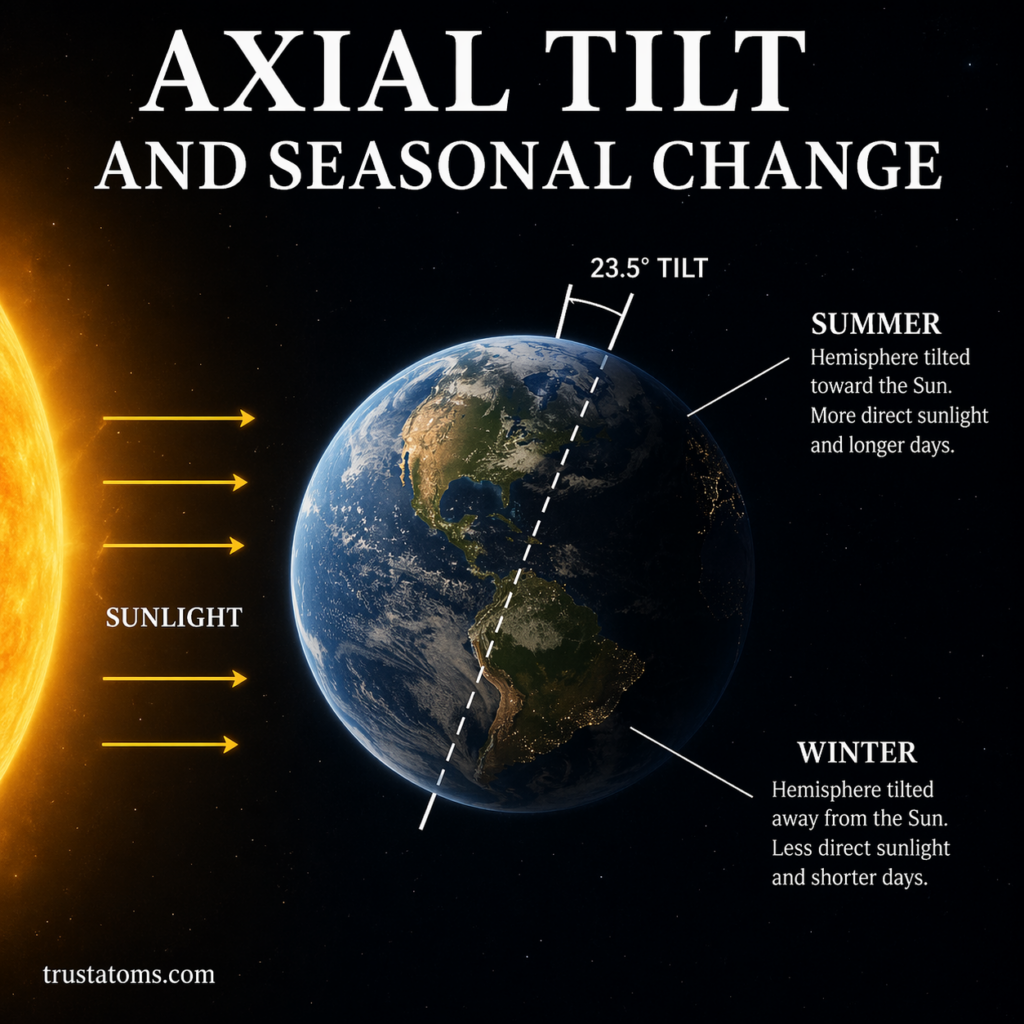
Axial tilt refers to the angle between a planet’s rotational axis and its orbital plane around the Sun.
For Earth, this tilt is about 23.5 degrees.
This means:
- Earth does not spin perfectly upright
- Instead, it leans slightly as it rotates
- This tilt remains consistent as Earth orbits the Sun
Think of it like a spinning top that is slightly tilted instead of perfectly straight.
How Axial Tilt Causes Seasons
As Earth orbits the Sun throughout the year, different parts of the planet receive varying amounts of sunlight due to its tilt.
Key idea:
It’s not distance from the Sun—it’s angle and duration of sunlight.
Here’s how it works:
When a Hemisphere Tilts Toward the Sun
- Receives more direct sunlight
- Days are longer
- Temperatures increase
- This is summer
When a Hemisphere Tilts Away from the Sun
- Receives less direct sunlight
- Days are shorter
- Temperatures decrease
- This is winter
The Four Main Seasonal Points
Earth’s orbit creates four key seasonal markers:
1. Summer Solstice
- Longest day of the year
- Sun is highest in the sky
- Occurs around June (Northern Hemisphere)
2. Winter Solstice
- Shortest day of the year
- Sun is lowest in the sky
- Occurs around December (Northern Hemisphere)
3. Spring (Vernal) Equinox
- Day and night are nearly equal
- Marks the start of spring
4. Autumn (Fall) Equinox
- Day and night are nearly equal
- Marks the start of fall
Why Sunlight Angle Matters
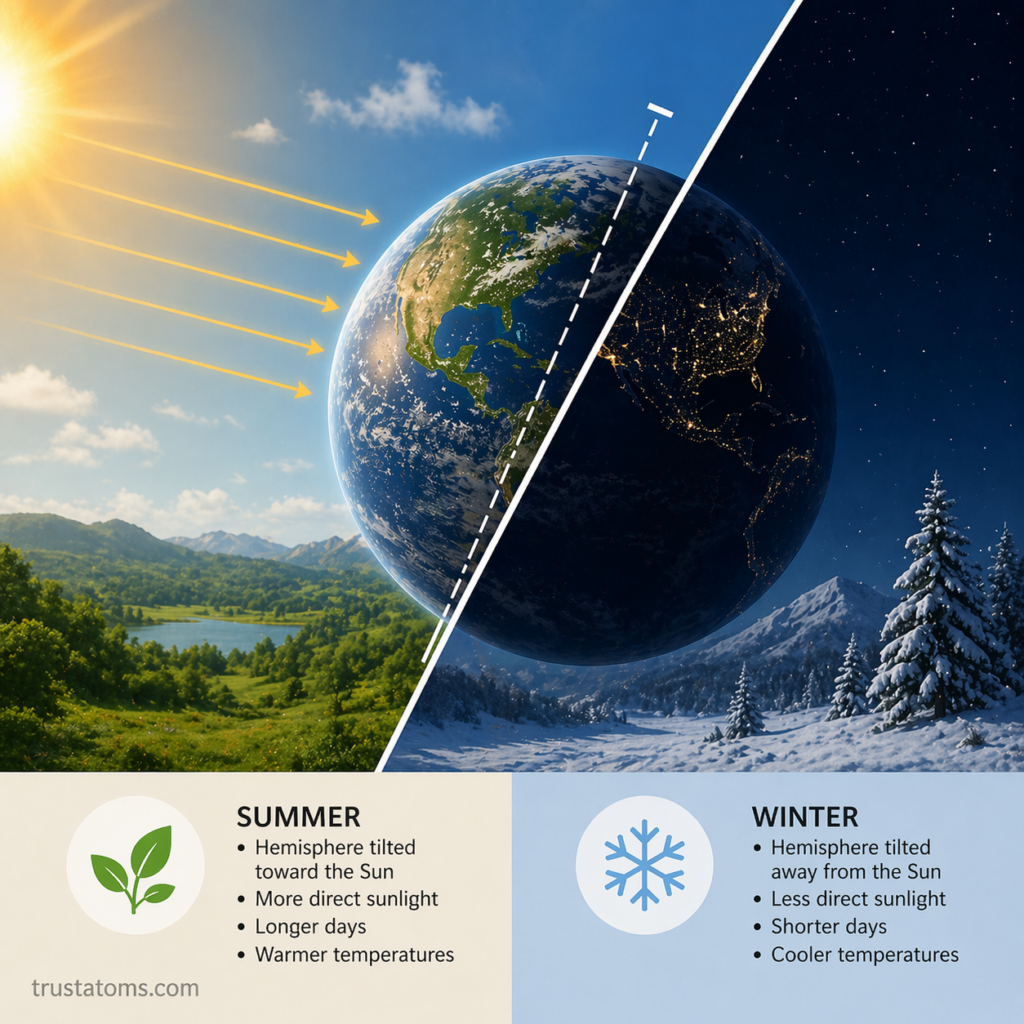
The angle at which sunlight hits Earth affects how much energy is delivered to the surface.
Direct Sunlight (Summer)
- Sun is higher in the sky
- Energy is concentrated
- Warmer temperatures
Indirect Sunlight (Winter)
- Sun is lower in the sky
- Energy spreads over a larger area
- Cooler temperatures
This difference in solar intensity is what drives seasonal temperature changes.
Opposite Seasons in Each Hemisphere
Because of Earth’s tilt:
- When it’s summer in the Northern Hemisphere, it’s winter in the Southern Hemisphere
- When it’s spring in the north, it’s fall in the south
Examples:
- United States → Summer in June
- Australia → Winter in June
Does Distance From the Sun Matter?
A common misconception is that seasons occur because Earth moves closer to or farther from the Sun.
In reality:
- Earth is actually closest to the Sun (perihelion) in early January
- And farthest (aphelion) in early July
Despite this:
- January is winter in the Northern Hemisphere
- July is summer
This proves that axial tilt—not distance—is the dominant factor.
What Would Happen Without Axial Tilt?
If Earth had no tilt:
- There would be no seasons
- Day length would remain constant year-round
- Climate zones would be more uniform
- The equator would always be warm, and poles always cold
Axial tilt is essential for:
- Seasonal weather patterns
- Ecosystem diversity
- Agricultural cycles
How Axial Tilt Affects Life on Earth
Seasonal changes influence nearly every aspect of life:
In Nature
- Animal migration patterns
- Plant growth cycles
- Breeding seasons
For Humans
- Agriculture and food production
- Energy usage (heating/cooling)
- Cultural traditions and holidays
Without axial tilt, life on Earth would be dramatically different.
Final Thoughts
Earth’s 23.5° tilt might seem small, but it has a massive impact on our planet. It determines how sunlight is distributed across the globe, shaping climates, ecosystems, and daily life.
Understanding axial tilt not only explains the seasons—it reveals how delicate and finely balanced Earth’s system truly is.