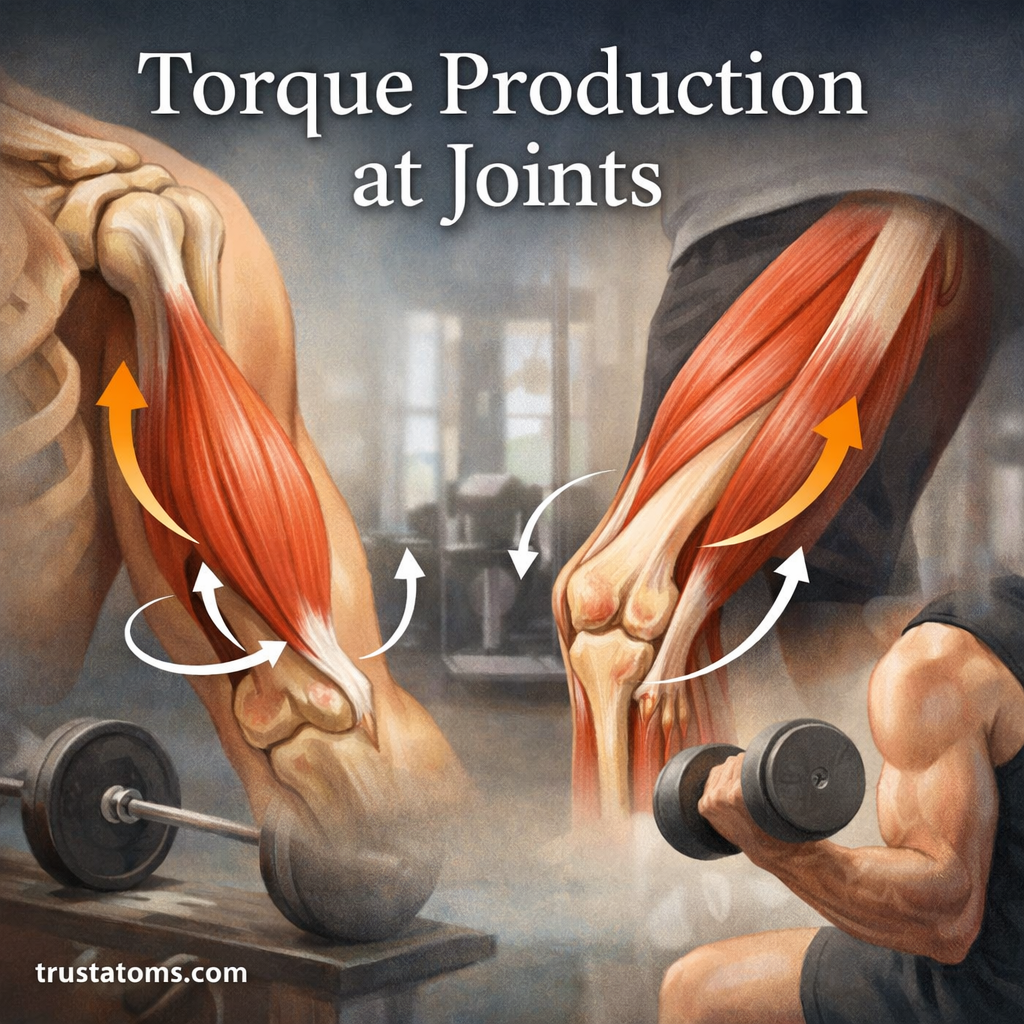
Torque production at joints occurs when muscles apply force through tendons, creating a turning effect around a joint’s axis of rotation. The amount of torque depends on muscle force, the distance between its line of action and the joint axis, and the mechanical conditions of the movement.
Everyday actions such as lifting a bag, climbing stairs, and standing from a chair require muscles to generate or resist joint torque. Understanding this relationship between force and movement connects human anatomy with the mechanical principles that explain strength, balance, and movement efficiency.
What Is Torque in Human Anatomy?
In biomechanics, torque refers to the turning effect of a force applied around a joint. It determines how effectively a muscle can cause a bone to rotate or resist rotation.
For a force acting around a fixed axis, torque can be calculated using a simple relationship: torque equals force multiplied by the perpendicular moment arm. Its standard unit is the newton-meter (N·m).
- Force: The pull generated by a muscle or applied by an external load.
- Moment arm: The shortest perpendicular distance from the joint axis to the force’s line of action.
- Force direction: Determines the effective moment arm and whether the force tends to rotate the joint clockwise or counterclockwise.
The relationship between muscle leverage and rotational force is explored further in Mechanical Advantage in Human Movement, which explains how the body’s lever arrangements influence force and movement speed.
How Muscles Produce Torque
Skeletal muscles generate force when their fibers become activated. Tendons transmit this force to bones, creating a turning effect when the line of pull passes at a distance from the joint axis.
The process follows a basic sequence:
- The nervous system activates muscle fibers.
- Muscle fibers develop tension through interactions between actin and myosin.
- Tendons transmit the resulting force to the bones.
- The force creates torque around the joint, which may cause movement or resist an external load.
For example, the biceps brachii contributes to elbow flexion torque, while the quadriceps generate knee extension torque. Several muscles often act together, and their combined effects determine the net torque at a joint. This interaction is described in Coordination Between Muscles and Joints.
How the Moment Arm Changes Torque
The moment arm determines how much rotational effect a force produces. A longer perpendicular moment arm generates greater torque when force remains constant.
Consider a simplified elbow example. If a muscle pulls with 200 newtons of force and has a perpendicular moment arm of 0.04 meters, it produces 8 N·m of torque. If the moment arm increases to 0.05 meters while force remains unchanged, torque increases to 10 N·m.
This example illustrates why leverage matters: the same muscle force can produce different amounts of torque at different joint positions. Actual muscle moment arms vary with anatomy and joint angle, and several muscles may contribute simultaneously.
Why Joint Angle Affects Torque Production
Muscles do not produce identical torque throughout a joint’s range of motion. As the joint angle changes, both muscle length and the perpendicular moment arm may change.
Muscle Length and Force Production
The length-tension relationship describes how muscle force depends partly on the overlap between actin and myosin filaments. Active force capacity is generally greatest within a favorable range of muscle lengths and decreases when the fibers become excessively shortened or stretched.
Passive tissues, including connective tissue, can also contribute tension as a muscle is stretched. The total force produced therefore reflects both active contraction and passive mechanical properties.
Changing Leverage Across a Movement
A muscle’s moment arm changes as bones rotate. Consequently, maximum joint torque does not necessarily occur at the position where muscle force alone is greatest.
The hip provides a useful example because hip muscle moment arms and force demands change during walking, squatting, and standing. Hip Joint Mechanics and Stability examines how these forces interact with joint support and movement control.
Internal Torque vs. External Torque
Joint movement depends on the combined rotational effects of internal and external forces.
| Torque Type | Source | Example |
|---|---|---|
| Internal torque | Muscles and other internal structures | Elbow flexors pulling against a dumbbell |
| External torque | Gravity, external loads, or contact forces | A dumbbell creating a downward turning effect at the elbow |
| Net torque | Combined effect of torques around the joint | Determines rotational acceleration according to the system’s mechanics |
During a slow, controlled biceps curl, muscle torque may approximately balance external torque even while the forearm moves. When net torque is not zero, it produces angular acceleration, with the resulting motion depending on the limb’s rotational inertia.
Torque also depends on the direction of a force. A load can create a large external torque in one arm position and a smaller torque in another, even when its weight remains unchanged.
Types of Muscle Contractions and Torque
Muscles can generate torque while shortening, lengthening, or maintaining approximately the same length. These contraction types describe how muscle behavior relates to movement.
- Concentric contraction: The muscle shortens while producing force, as the elbow flexors do when raising a dumbbell.
- Eccentric contraction: The muscle lengthens while producing force, helping control the descent of a dumbbell.
- Isometric contraction: Muscle length remains approximately constant while tension is maintained, such as holding a weight steady.
Muscles acting in opposite directions can also produce torque simultaneously. The relationship between these opposing actions is explained in Antagonist and Agonist Muscle Pairs, including how co-contraction can increase joint stiffness and stability.
What Determines How Much Torque a Muscle Can Produce?
Torque capacity depends on several interacting anatomical, neurological, and mechanical factors.
- Muscle size: Greater physiological cross-sectional area generally allows greater force production.
- Moment arm: Muscle attachment geometry affects the rotational effect of a given force.
- Joint position: Changes muscle length, leverage, and available force.
- Neural activation: Motor unit recruitment and firing patterns influence muscle force.
- Contraction speed: Muscle force capacity changes with shortening and lengthening velocity.
- Fatigue: Sustained activity can reduce the ability to generate force and torque.
These factors help explain why a person may generate more torque at one joint angle than another, or produce different amounts of force during slow and fast movements.
Torque in Everyday Movements and Exercise
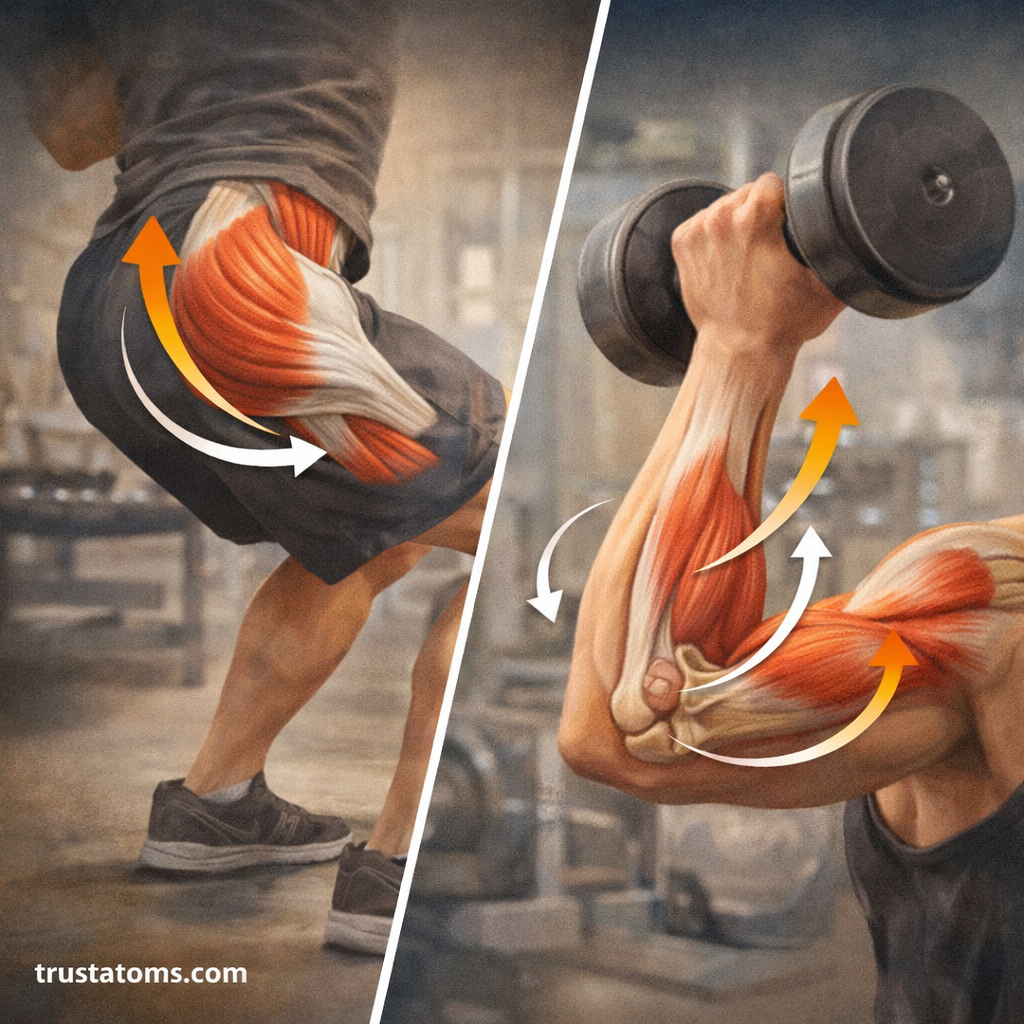
Joint torque is involved in nearly every voluntary movement, from small adjustments in posture to powerful athletic actions.
- Standing from a chair: Hip and knee extensors generate torque to raise the body against gravity.
- Walking: Hip, knee, and ankle muscles produce and resist torque throughout the gait cycle.
- Squatting: External torque demands change as the knees, hips, and trunk move relative to the body’s center of mass.
- Lifting a dumbbell: Elbow and shoulder torque demands depend on the weight’s position relative to each joint.
- Jumping: Coordinated lower-body joint torques accelerate the body upward.
Torque, Joint Loading, and Injury Risk
High torque is not automatically harmful. Joints routinely experience substantial forces during normal activity, and their tissues adapt to appropriate loading.
Problems can arise when external demands exceed a person’s current strength, control, or tissue capacity. Sudden increases in training load, fatigue, and poorly controlled movements may contribute to excessive stress on muscles, tendons, and other joint structures.
Strength training can improve torque capacity through muscular and neurological adaptations. Gradual progression, appropriate exercise technique, and training through suitable ranges of motion can help develop strength while managing joint loading.
Frequently Asked Questions
Is torque the same as muscle strength?
No. Muscle strength describes force-producing capacity, while torque describes the rotational effect of force around a joint. Two muscles producing the same force can generate different torque if their moment arms differ.
Why does a weight feel heavier at certain joint angles?
The weight itself does not change, but its perpendicular distance from the joint axis can increase or decrease. This changes external torque, while muscle leverage and force capacity may also vary with joint position.
Can muscles produce torque without moving a joint?
Yes. During an isometric contraction, muscles generate tension and joint torque without noticeable joint movement. Holding a dumbbell stationary is an example in which muscle torque balances the external turning effect.
Torque production explains how muscle force becomes a turning effect at joints and why strength changes across different positions. Moment arms, muscle length, neural activation, and external loads all influence the torque required or available during movement. Understanding these relationships helps explain how the body lifts, stabilizes, accelerates, and controls its limbs.
This article is for general education and is not medical advice. Talk to a qualified health professional about any medical concern.
Sources: Neumann, Kinesiology of the Musculoskeletal System: Foundations for Rehabilitation; Hall, Basic Biomechanics; McGinnis, Biomechanics of Sport and Exercise.