The hip joint is one of the most important structures in the human body, responsible for supporting body weight, enabling movement, and maintaining balance. Unlike the shoulder, which prioritizes mobility, the hip is designed to provide both strength and stability while still allowing a wide range of motion.
Understanding hip joint mechanics and stability helps explain how we walk, run, lift, and maintain posture—and why hip health is essential for overall movement.
Anatomy of the Hip Joint
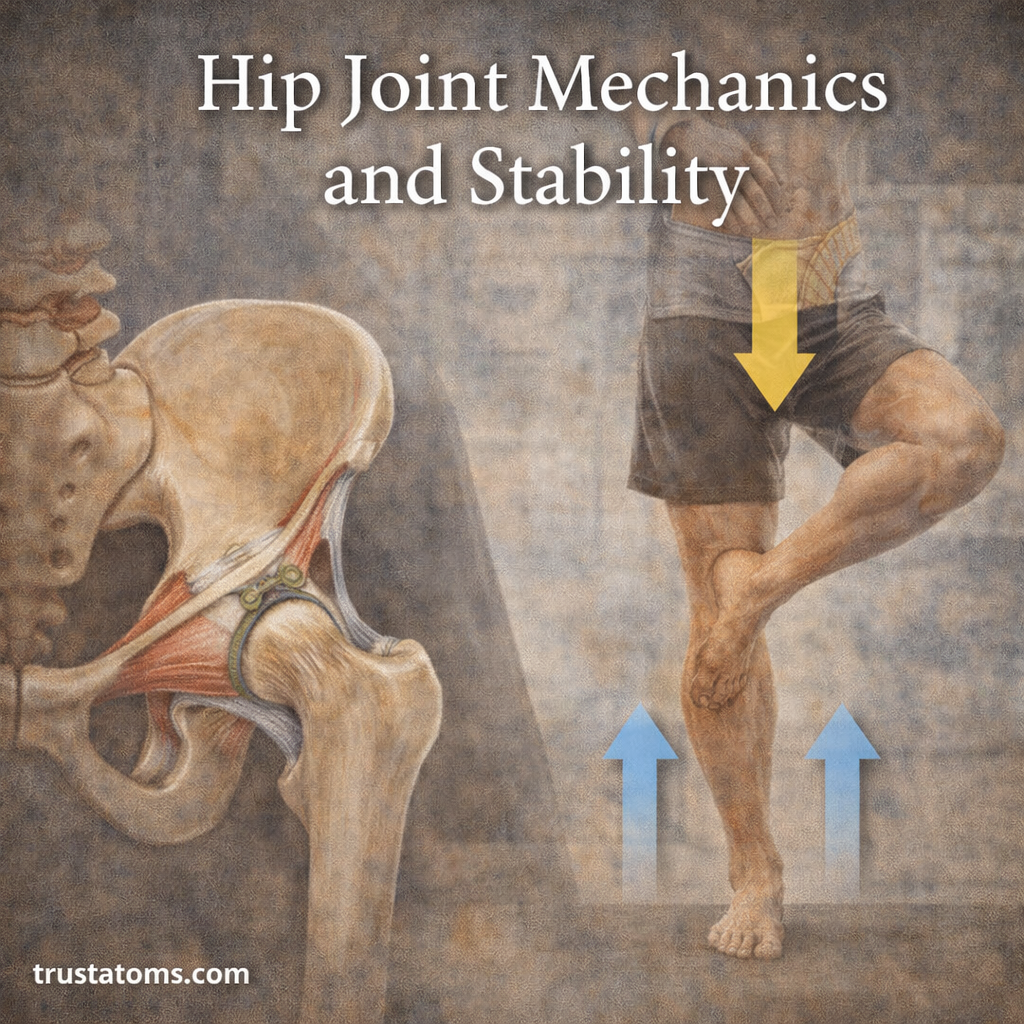
The hip is a ball-and-socket joint, similar in structure to the shoulder but much more stable.
Key Components
- Femoral head – the “ball” at the top of the thigh bone
- Acetabulum – the deep socket in the pelvis
- Articular cartilage – smooth surface that reduces friction
- Labrum – a ring of cartilage that deepens the socket
- Ligaments – strong connective tissues that reinforce stability
Bones Involved
- Femur (thigh bone)
- Pelvis (hip bone)
The depth of the acetabulum and strong surrounding tissues make the hip highly stable.
Range of Motion in the Hip
The hip allows movement in multiple directions, although less freely than the shoulder.
Primary Movements
- Flexion – lifting the thigh forward
- Extension – moving the leg backward
- Abduction – moving the leg away from the body
- Adduction – bringing the leg toward the midline
- Internal rotation – rotating the thigh inward
- External rotation – rotating the thigh outward
- Circumduction – circular movement
These movements are essential for walking, running, and changing direction.
Hip Joint Mechanics
Hip mechanics involve how forces are generated, transferred, and controlled during movement.
Load Transfer Through the Hip
The hip acts as a central hub for force transmission:
- Body weight travels down from the spine
- The pelvis distributes load to both hips
- The femur transfers forces to the legs and ground
This system allows efficient movement and balance during both static and dynamic activities.
Lever System of the Hip
The hip functions as a lever system:
- The joint acts as the pivot point
- Muscles generate force
- The leg acts as the lever
This setup allows for:
- Powerful movements (jumping, sprinting)
- Controlled movements (walking, standing)
Stability of the Hip Joint
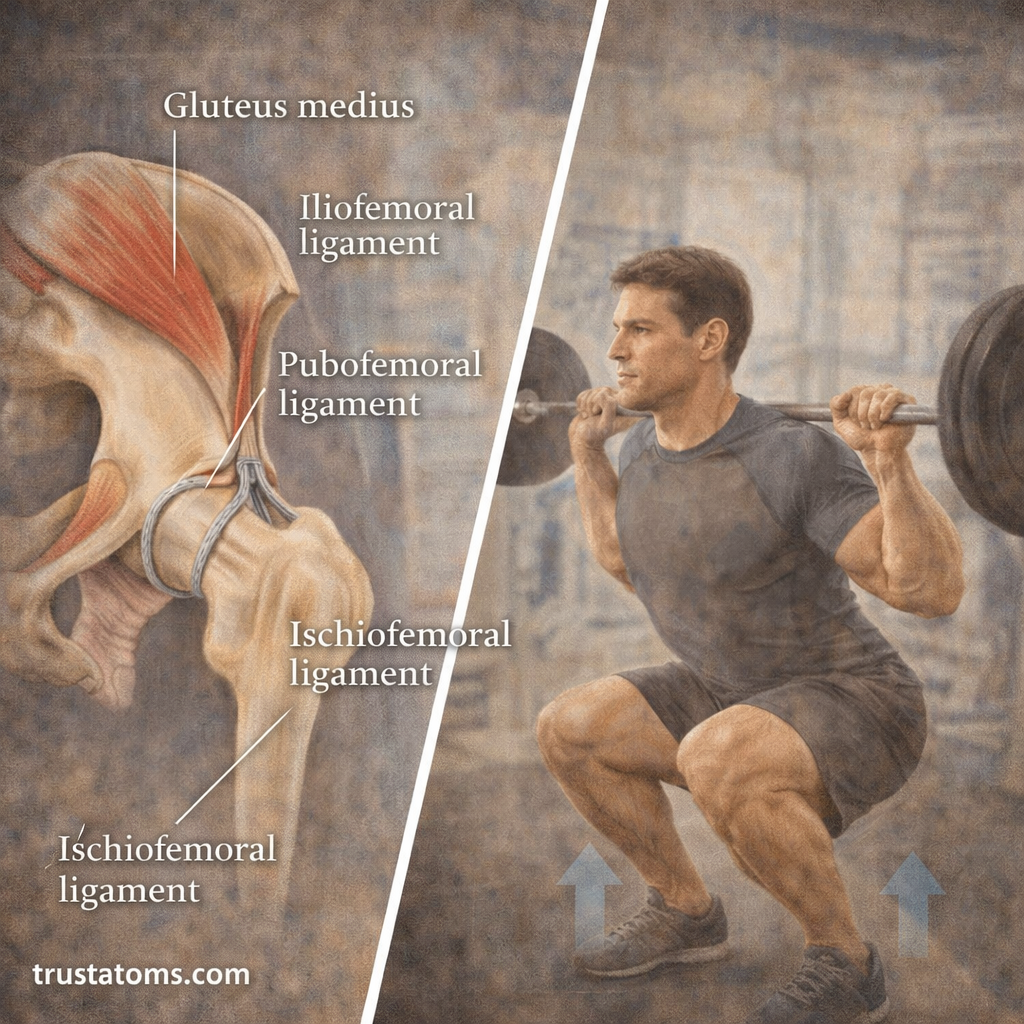
The hip is one of the most stable joints in the body.
Structural Stability
- Deep socket (acetabulum) securely holds the femoral head
- The labrum increases joint depth and stability
- Strong ligaments limit excessive movement
Dynamic Stability
- Muscles surrounding the hip provide active control
- Neuromuscular coordination keeps the joint aligned during movement
Muscles That Support Hip Stability
Several muscle groups play key roles in both movement and stability.
Primary Muscle Groups
- Gluteus maximus – powerful hip extension
- Gluteus medius and minimus – stabilize the pelvis during walking
- Hip flexors (iliopsoas) – lift the leg
- Adductors – control inward movement
- Hamstrings – assist with extension and control
Stabilization Role
- Prevent excessive joint movement
- Maintain alignment during dynamic activity
- Support balance and posture
Weak or imbalanced muscles can compromise hip stability.
Hip Stability During Movement
The hip must remain stable even during complex movements.
Examples
- Walking: One hip stabilizes while the other moves
- Running: Increased forces require greater muscle control
- Standing on one leg: Gluteus medius prevents pelvic drop
- Lifting: Hip stability supports safe force transfer
Proper coordination ensures efficient and safe movement.
Factors That Affect Hip Mechanics and Stability
Several factors influence how well the hip functions:
1. Muscle Strength
- Strong muscles improve joint control
- Weakness leads to instability
2. Flexibility
- Tight muscles restrict movement
- Balanced flexibility supports full range of motion
3. Joint Structure
- Bone shape and alignment affect stability
- Structural differences can influence movement patterns
4. Posture and Alignment
- Poor posture alters load distribution
- Misalignment increases stress on the joint
5. Activity Level
- Regular movement maintains joint health
- Sedentary behavior can weaken supporting structures
Common Hip Issues Related to Mechanics
When hip mechanics are compromised, problems can arise.
Common Conditions
- Hip impingement (FAI)
- Labral tears
- Hip instability
- Osteoarthritis
These issues often result from poor mechanics, overuse, or structural imbalances.
Improving Hip Mechanics and Stability
Maintaining strong and stable hips is essential for overall movement.
Practical Strategies
- Strengthen glute muscles (especially gluteus medius)
- Improve core stability
- Stretch tight hip flexors and hamstrings
- Practice proper movement patterns
- Incorporate balance and stability exercises
Consistency in these habits helps protect the joint and improve performance.
Hip vs Shoulder: Stability Comparison
Understanding the hip is easier when compared to the shoulder.
Key Differences
- Hip: prioritizes stability and load bearing
- Shoulder: prioritizes mobility and range of motion
Why This Matters
- The hip is less prone to dislocation
- The shoulder is more flexible but less stable
This balance reflects the different roles each joint plays in the body.
Final Thoughts
The hip joint is a powerful and stable structure designed to support body weight and enable efficient movement. Its mechanics involve a combination of strong bones, supportive ligaments, and coordinated muscle activity.
By understanding how the hip works, you can improve movement quality, reduce injury risk, and maintain long-term joint health.