Swallowing, also called deglutition, is the coordinated process of moving food, liquids, and saliva from the mouth through the pharynx and esophagus into the stomach. It combines voluntary tongue movements with automatic muscle contractions and reflexes that move food and liquids safely from the mouth to the stomach while protecting the airway.
Although swallowing usually feels effortless, it requires precise timing between muscles, nerves, and digestive structures. Understanding these movements connects human anatomy with digestion, breathing, and the nervous system’s control of movement.
What Is Swallowing?
Swallowing is the process of moving food, liquids, or saliva from the mouth into the stomach. It involves both voluntary and involuntary actions.
After chewing, the tongue gathers softened food into a mass called a bolus. The bolus then passes through the throat and enters the esophagus, a muscular tube that transports it toward the stomach.
This route is part of the larger digestive pathway described in Digestive Tract Anatomy, which follows food through the organs responsible for digestion and absorption.
Swallowing is commonly divided into three phases: oral, pharyngeal, and esophageal. The oral phase includes voluntary control, while the later phases rely heavily on automatic neural coordination.
The Three Phases of Swallowing
1. Oral Phase: Preparing and Moving the Bolus
The oral phase begins with chewing and mixing food with saliva. Saliva moistens the food, helps bind particles together, and makes the bolus easier to move.
- The teeth break food into smaller pieces while the tongue positions it for chewing.
- The tongue gathers the prepared food into a bolus.
- The tongue presses against the palate and pushes the bolus backward.
- The bolus reaches the pharynx, where the next phase begins.
Oral preparation varies with food texture. A sip of water requires little preparation, while a dry piece of bread needs chewing and mixing with saliva before swallowing.
2. Pharyngeal Phase: Protecting the Airway
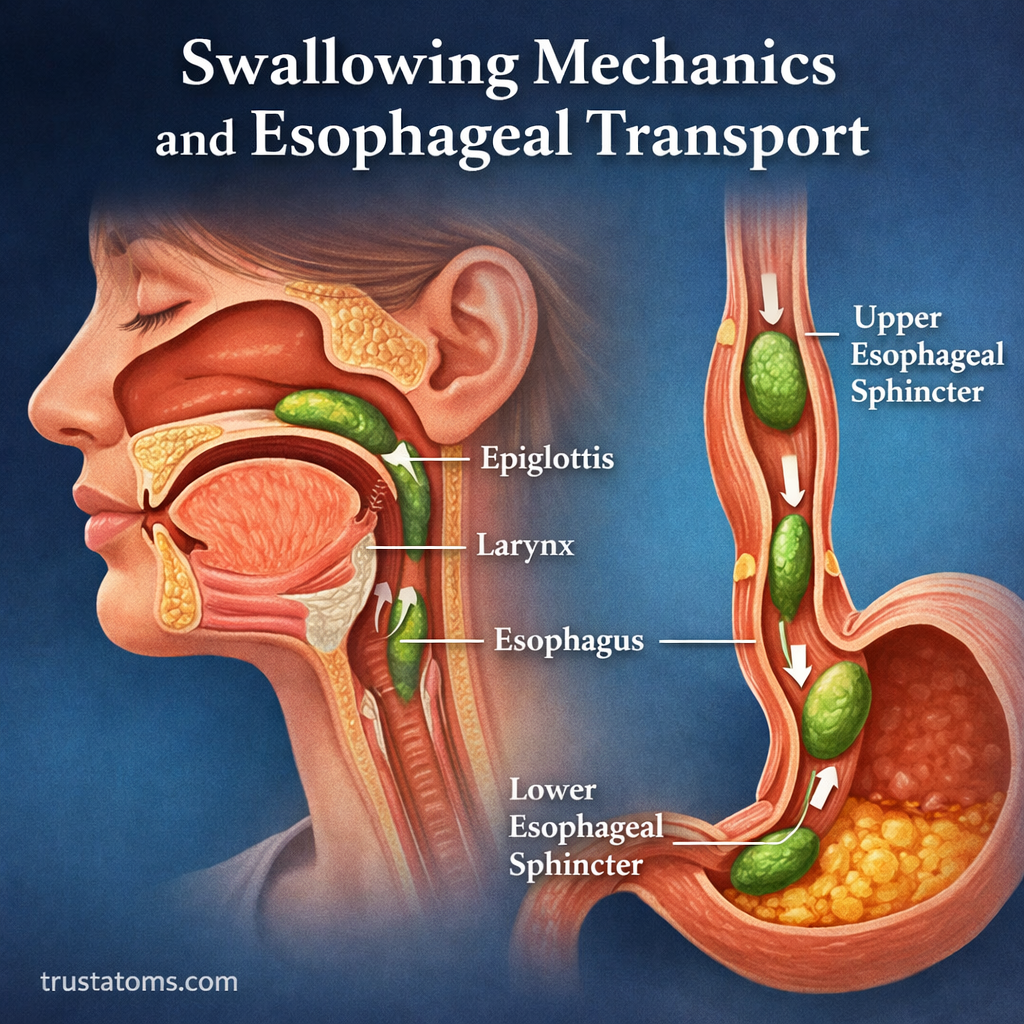
The pharyngeal phase is a rapid, largely involuntary sequence that moves the bolus through the throat while reducing the risk of material entering the airway.
- Soft palate elevation: The soft palate rises to help prevent food or liquid from entering the nasal cavity.
- Airway closure: The vocal folds close, and structures above them help protect the entrance to the larynx.
- Laryngeal movement: The larynx moves upward and forward, assisting airway protection and opening of the upper esophageal sphincter.
- Pharyngeal contraction: Muscles propel the bolus toward the esophagus.
The epiglottis also folds backward during swallowing, helping direct material away from the laryngeal opening. Airway protection depends on several coordinated mechanisms rather than the epiglottis acting as a simple lid.
Breathing briefly pauses during most swallows. This swallowing-related pause, called deglutition apnea, helps prevent food or liquid from entering the respiratory tract.
3. Esophageal Phase: Transporting Food to the Stomach
Once the bolus enters the esophagus, involuntary muscular contractions transport it toward the stomach. These contractions occur in an organized sequence called peristalsis.
The lower esophageal sphincter relaxes ahead of the approaching bolus, allowing it to enter the stomach. After passage, the sphincter returns toward its resting contracted state, helping limit reflux of stomach contents.
Esophageal transit typically takes several seconds, although timing depends on whether the swallowed material is liquid or solid, body position, and esophageal function.
How Esophageal Peristalsis Moves Food
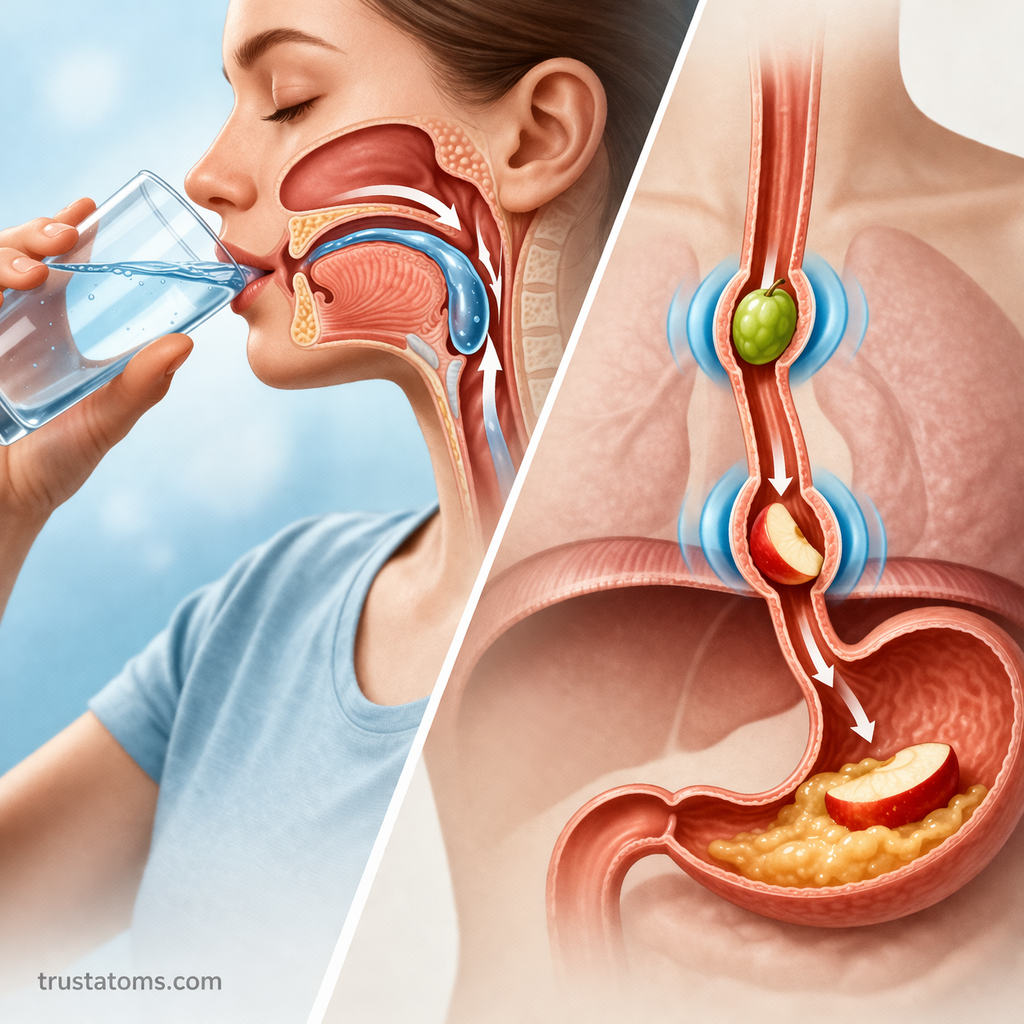
Peristalsis is a coordinated wave of muscular activity that moves material through a hollow organ. In the esophagus, circular muscles contract behind the bolus while the region ahead relaxes, creating a pressure pattern that drives transport.
Two forms of esophageal peristalsis help clear swallowed material:
- Primary peristalsis: A wave initiated by swallowing that travels from the upper esophagus toward the stomach.
- Secondary peristalsis: Additional contractions triggered by esophageal distension, helping clear material left behind without requiring another swallow.
These movements allow food to travel even when a person is lying down. Gravity may assist transport while upright, but muscular contractions provide the main propulsive mechanism for solid food.
The same general principle appears elsewhere in digestion. Gut Motility and Peristalsis explains how coordinated muscular movements transport and mix contents throughout the digestive tract.
How the Esophageal Muscles Coordinate Transport
The adult esophagus is approximately 25 centimeters long, although its length varies between individuals. Its muscular wall contains different muscle types along its course.
| Esophageal Region | Muscle Type | Control |
|---|---|---|
| Upper third | Predominantly skeletal muscle | Coordinated through brainstem motor pathways |
| Middle third | Mixture of skeletal and smooth muscle | Transition between neural control mechanisms |
| Lower third | Predominantly smooth muscle | Controlled through autonomic and enteric neural pathways |
Although skeletal muscle is present in the upper esophagus, its activity during normal swallowing is largely automatic. Smooth muscle in the lower portion is coordinated by neural circuits involving the vagus nerve and the enteric nervous system.
Upper and Lower Esophageal Sphincters
Two specialized muscular regions regulate movement into and out of the esophagus.
Upper Esophageal Sphincter
The upper esophageal sphincter (UES) separates the pharynx from the esophagus. It normally remains closed, helping prevent air from entering the esophagus during breathing and limiting the backward movement of esophageal contents into the throat.
During swallowing, the sphincter relaxes while surrounding structures move to open the passage for the bolus.
Lower Esophageal Sphincter
The lower esophageal sphincter (LES) is a region of increased muscular pressure near the junction between the esophagus and stomach. It relaxes during swallowing and normally maintains a barrier against reflux between swallows.
Proper function of these sphincters is essential for efficient and safe digestion.
How the Nervous System Controls Swallowing
Swallowing requires coordination between the cerebral cortex, brainstem, cranial nerves, and muscles of the mouth, pharynx, and esophagus.
Brainstem networks, particularly those involving the medulla, organize the timing of pharyngeal swallowing. Cranial nerves including the trigeminal, facial, glossopharyngeal, vagus, and hypoglossal nerves contribute sensory information or motor control.
Conscious control helps initiate swallowing, but much of the subsequent sequence occurs automatically. Sensory feedback allows the nervous system to adjust the response according to the bolus and surrounding conditions.
Common Swallowing and Esophageal Disorders
Disruptions in muscular coordination, nerve signaling, or esophageal structure can interfere with normal swallowing.
- Dysphagia: Difficulty swallowing, which may involve the mouth, pharynx, or esophagus.
- Aspiration: Entry of food, liquid, or secretions into the airway below the vocal folds, potentially causing respiratory complications.
- Gastroesophageal reflux: Backward movement of stomach contents into the esophagus, sometimes causing heartburn or regurgitation.
- Achalasia: An esophageal motility disorder involving impaired lower esophageal sphincter relaxation and loss of normal peristalsis.
Persistent difficulty swallowing, painful swallowing, repeated coughing during meals, or a sensation of food becoming stuck warrants medical evaluation. Inability to swallow saliva or difficulty breathing requires urgent attention.
Frequently Asked Questions
What are the three phases of swallowing?
The three phases are oral, pharyngeal, and esophageal. The oral phase prepares and moves the bolus backward, the pharyngeal phase protects the airway and directs the bolus into the esophagus, and the esophageal phase uses peristalsis to transport it into the stomach.
Can food move through the esophagus without gravity?
Yes. Peristaltic contractions generate pressure that moves food toward the stomach, even when a person is lying down. Gravity can assist swallowing in an upright position but is not required for normal esophageal transport.
What prevents food from entering the airway during swallowing?
Several coordinated actions protect the airway, including vocal fold closure, movement of the larynx, epiglottic movement, and a brief pause in breathing. These mechanisms help direct swallowed material into the esophagus rather than the trachea.
Swallowing depends on precise coordination between the tongue, throat muscles, esophageal contractions, and sphincters. The transition from voluntary oral movement to automatic airway protection and peristalsis allows food and liquids to reach the stomach while limiting aspiration and reflux. When these mechanisms become disrupted, both nutrition and respiratory safety may be affected.
This article is for general education and is not medical advice. Talk to a qualified health professional about any medical concern.
Sources: Guyton and Hall Textbook of Medical Physiology; Sleisenger and Fordtran’s Gastrointestinal and Liver Disease; National Institute on Deafness and Other Communication Disorders (NIDCD).