Why does the total momentum of colliding billiard balls remain constant?
Why can energy change form but never simply disappear?
The answer lies in one of the most powerful ideas in physics: conservation laws.
Conservation laws explain what stays constant in nature — even when everything else seems to change. In this guide, we’ll break down what conservation laws are, what an isolated system means, and why these principles are foundational to physics.
What Is a Conservation Law?
A conservation law states that a certain physical quantity remains constant over time within a defined system.
In simple terms:
Something may change form, move around, or transfer —
but the total amount stays the same.
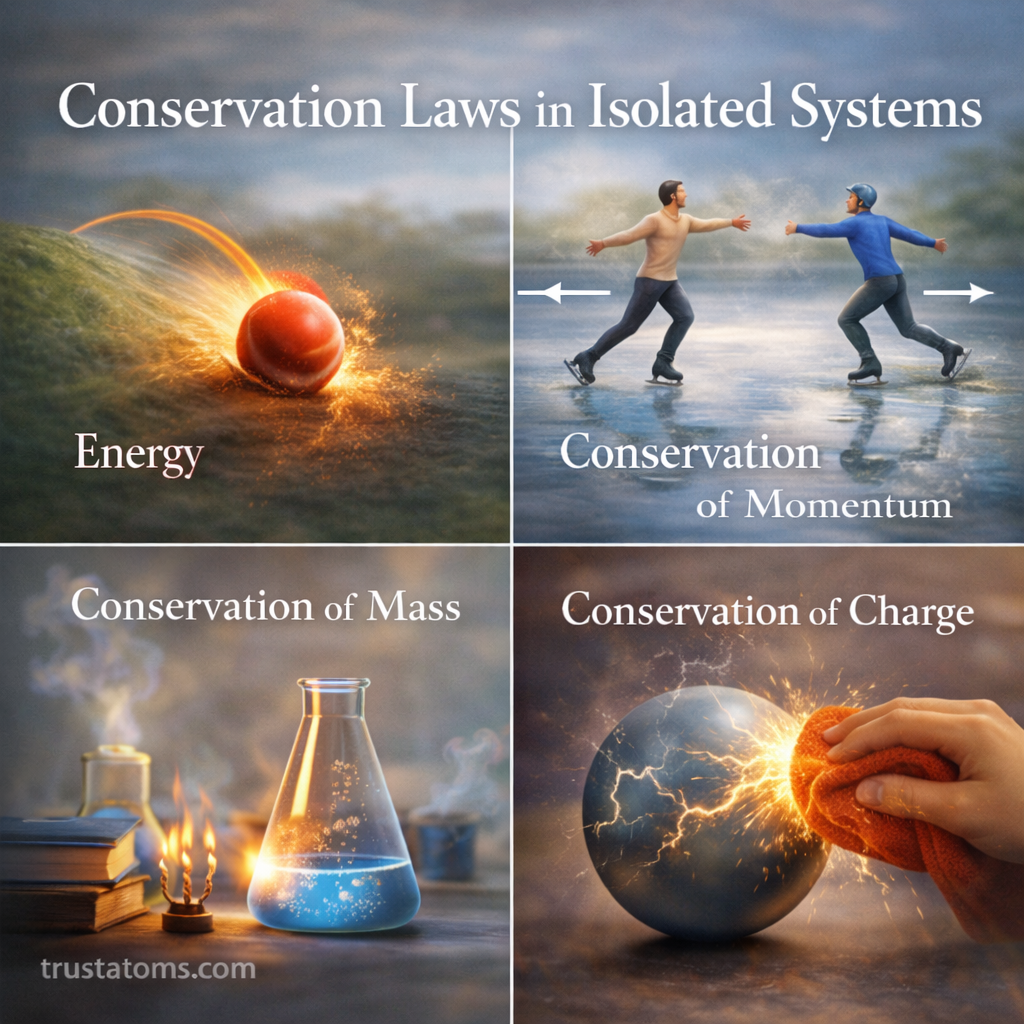
The most important conservation laws in physics include:
- Conservation of Energy
- Conservation of Momentum
- Conservation of Mass (in classical systems)
- Conservation of Electric Charge
These laws apply when we carefully define the system we are analyzing.
What Is an Isolated System?
An isolated system is one where:
- No external forces act on it
- No matter enters or leaves
- No energy is added or removed
In reality, perfectly isolated systems are rare. However, many real-world systems can be treated as isolated for short periods of time.
Examples of Nearly Isolated Systems
- Two ice skaters pushing off each other on frictionless ice
- Colliding billiard balls over a short time interval
- Objects interacting in deep space, far from other forces
When external influences are negligible, conservation laws hold extremely well.
Conservation of Energy
Energy cannot be created or destroyed — only transferred or transformed.
This is known as the Law of Conservation of Energy.
Energy can change between forms such as:
- Kinetic energy (motion)
- Potential energy (stored energy)
- Thermal energy (heat)
- Sound energy
- Chemical energy
Example: Falling Object
- At the top, the object has gravitational potential energy.
- As it falls, potential energy decreases.
- Kinetic energy increases.
- Just before impact, most energy is kinetic.
The total energy remains constant throughout the motion (ignoring small losses like air resistance).
Conservation of Momentum

Momentum is conserved in an isolated system.
This means:
Total momentum before an interaction
equals
Total momentum after the interaction.
Example: Two Skaters
If two skaters push off from each other:
- One moves left
- The other moves right
Their momenta are equal in magnitude and opposite in direction.
The total momentum of the system remains zero if it started at zero.
Momentum conservation explains:
- Recoil of a gun
- Rocket propulsion
- Collisions in sports
- Particle interactions in physics experiments
Conservation of Mass (Classical Physics)
In everyday chemical and physical processes:
Mass is conserved.
This means:
- Matter is not created or destroyed
- It simply changes form
For example:
Burning wood does not destroy mass.
The mass becomes smoke, ash, gases, and heat.
Note: In modern physics, mass and energy are related, but in classical systems, mass conservation works extremely well.
Conservation of Electric Charge
Electric charge is always conserved.
If a system starts with zero net charge, it will always remain zero unless charge enters or leaves.
For example:
- If an electron is produced, a positively charged particle must also be produced.
- Static electricity involves transfer of charge, not creation of charge.
Charge conservation is one of the most strictly obeyed laws in physics.
Why Conservation Laws Matter
Conservation laws allow physicists to:
- Predict outcomes without knowing every detail
- Solve complex problems using simple totals
- Verify whether calculations are correct
They provide shortcuts in problem-solving.
Instead of tracking every force at every moment, we can analyze total quantities before and after events.
How Conservation Laws Are Connected
Interestingly, conservation laws are tied to deep symmetries in nature.
For example:
- Conservation of energy is linked to time symmetry
- Conservation of momentum is linked to spatial symmetry
- Conservation of charge relates to fundamental field symmetries
This connection shows that conservation laws are not random rules — they are built into the structure of the universe.
When Conservation Laws Do Not Apply
Conservation laws always apply — but only when the system is properly defined.
They appear to fail when:
- External forces are ignored
- Energy leaves the system (like heat loss)
- The system boundaries are too small
For example:
If a ball slows down due to friction, momentum is not destroyed — it transfers to the Earth and surrounding environment.
The key is defining the system correctly.
Step-by-Step: Applying Conservation Laws
When solving physics problems:
- Define the system clearly.
- Identify whether it is isolated.
- Determine which quantities are conserved.
- Compare totals before and after the event.
This structured approach simplifies even complex interactions.
Real-World Applications
Conservation laws are used in:
- Engineering design
- Space exploration
- Automotive safety
- Energy systems
- Nuclear physics
Without conservation laws, modern physics and engineering would not function.
Final Takeaway
Conservation laws tell us what remains constant in a changing world.
In isolated systems:
- Energy is conserved
- Momentum is conserved
- Mass (classically) is conserved
- Electric charge is conserved
These principles provide stability, predictability, and structure to the universe.
When you understand conservation laws, you’re not just solving physics problems — you’re recognizing the deep order hidden beneath motion and change.