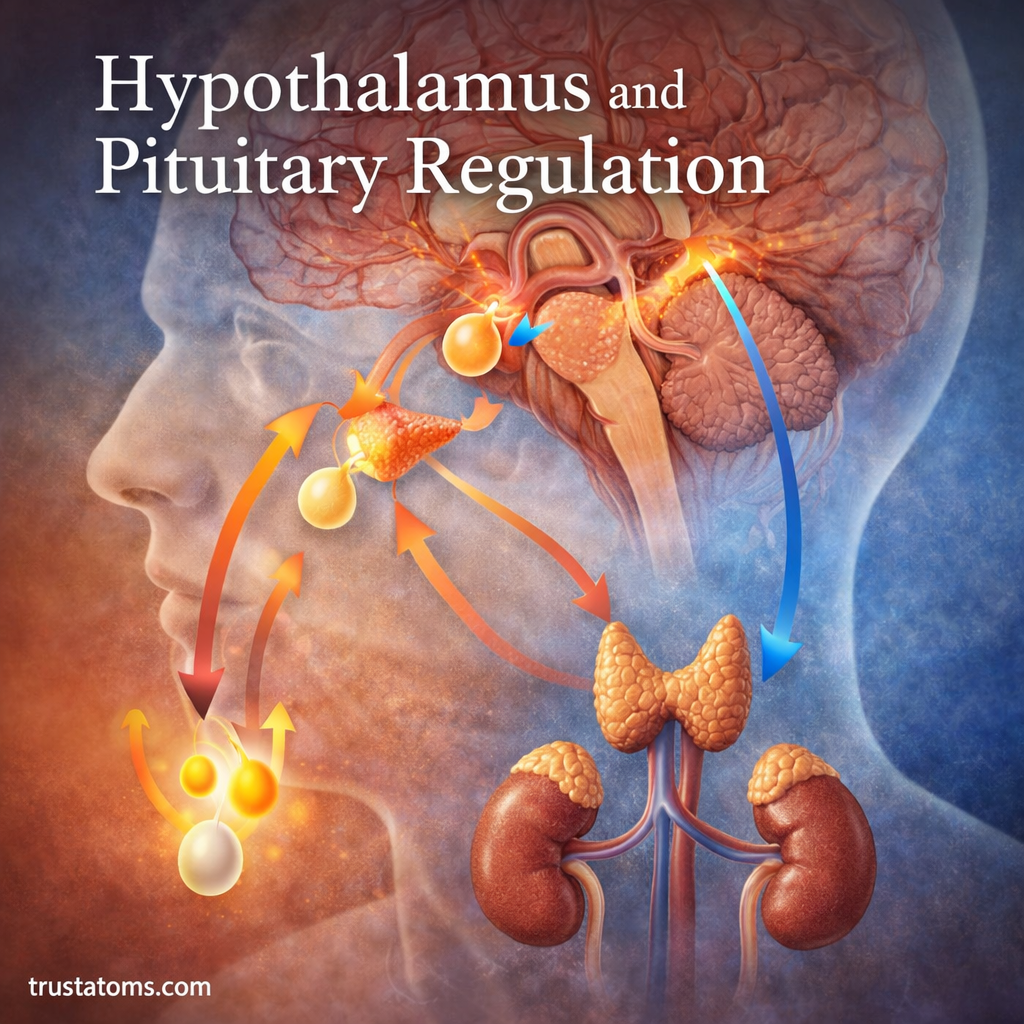
The hypothalamus and pituitary gland form one of the most important control systems in the human body. Together, they regulate hormone production, maintain internal balance, and coordinate communication between the nervous and endocrine systems.
Located near the base of the brain, these connected structures help regulate growth, metabolism, reproduction, stress responses, and water balance. Their relationship illustrates how the organs and tissues studied in human anatomy cooperate to maintain stable conditions inside the body.
What Is the Hypothalamus?
The hypothalamus is a small region of the brain located below the thalamus and directly above the pituitary gland. It receives information about internal conditions, including body temperature, fluid balance, and energy availability, and coordinates appropriate responses.
Its main functions include regulating hunger, thirst, sleep-wake cycles, body temperature, and hormone release. It also helps coordinate autonomic nervous system activity, such as changes in heart rate and digestion.
One of its major endocrine functions involves controlling thyroid activity. The hypothalamus releases thyrotropin-releasing hormone (TRH), which stimulates the pituitary to release thyroid-stimulating hormone (TSH). The relationship between thyroid hormones and metabolic rate shows how this pathway influences energy use throughout the body.
What Is the Pituitary Gland?
The pituitary is a pea-sized gland situated in a bony cavity called the sella turcica, beneath the hypothalamus. It is connected to the hypothalamus by a stalk known as the infundibulum.
Often called the “master gland,” the pituitary influences several other endocrine glands. However, it does not operate independently: the hypothalamus directs much of its activity through hormones and nerve signals.
Some pituitary hormones act directly on tissues, while others stimulate glands such as the thyroid, adrenal cortex, ovaries, and testes. This arrangement allows a relatively small brain region to influence many body functions.
How the Hypothalamus Controls Pituitary Hormones
The hypothalamus uses two distinct communication pathways to regulate the pituitary. The anterior pituitary receives chemical instructions through specialized blood vessels, while the posterior pituitary receives signals through nerve fibers extending from hypothalamic neurons.
Regulation Through the Anterior Pituitary
- The hypothalamus responds to a physiological signal, such as a change in circulating hormone levels.
- It releases stimulating or inhibiting hormones into the hypothalamic-pituitary portal blood vessels.
- These chemical signals reach the anterior pituitary and influence its hormone secretion.
- Pituitary hormones enter the general bloodstream and act on target tissues or other endocrine glands.
- Feedback signals help adjust subsequent hormone release.
The portal circulation is especially useful because it delivers hypothalamic hormones directly to the anterior pituitary without first diluting them throughout the entire bloodstream.
Anterior vs. Posterior Pituitary: Hormones and Functions
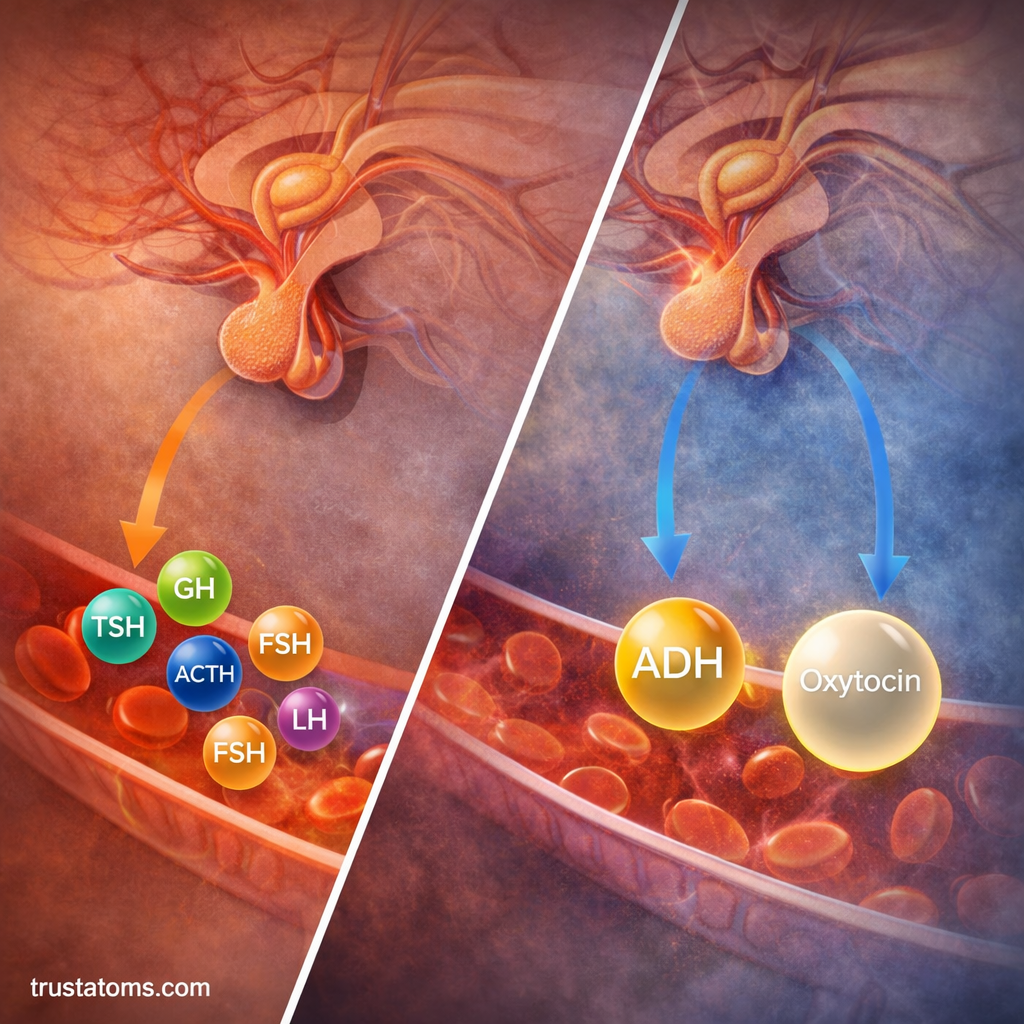
Although they are connected within one gland, the anterior and posterior pituitary differ in their structure, hormone production, and method of control.
Anterior Pituitary Hormones
The anterior pituitary synthesizes and releases several hormones in response to hypothalamic signals.
| Hormone | Main function |
|---|---|
| Growth hormone (GH) | Supports growth, tissue maintenance, and metabolism |
| Thyroid-stimulating hormone (TSH) | Stimulates thyroid hormone production |
| Adrenocorticotropic hormone (ACTH) | Stimulates cortisol production by the adrenal cortex |
| Follicle-stimulating hormone (FSH) | Supports ovarian follicle development and sperm production |
| Luteinizing hormone (LH) | Regulates ovulation and testosterone production |
| Prolactin | Stimulates milk production after childbirth |
Posterior Pituitary Hormones
The posterior pituitary does not synthesize its own hormones. Instead, it stores and releases two hormones produced by neurons in the hypothalamus:
- Antidiuretic hormone (ADH), also called vasopressin: Helps the kidneys conserve water and contributes to blood pressure regulation.
- Oxytocin: Stimulates uterine contractions during childbirth and milk ejection during breastfeeding.
These hormones travel along nerve fibers from the hypothalamus to the posterior pituitary, where nerve impulses trigger their release into the bloodstream.
How Negative Feedback Maintains Hormone Balance
Most regulation occurs through negative feedback, where the output of a system reduces or shuts down further production. This prevents hormone concentrations from rising continuously when the body has already produced an adequate response.
The hypothalamic-pituitary-thyroid axis provides a clear example:
- The hypothalamus releases TRH.
- TRH stimulates the anterior pituitary to release TSH.
- TSH stimulates the thyroid gland to produce thyroid hormones, primarily T4 and T3.
- As circulating thyroid hormone levels rise, they inhibit further TRH and TSH secretion.
If thyroid hormone concentrations decline, this inhibitory effect generally decreases, allowing the system to increase stimulation. Feedback regulation helps maintain hormone levels within a functional range rather than at one perfectly fixed value.
Everyday Example of Regulation: Responding to Stress
Imagine preparing to give an important presentation. As the brain processes the stressful situation, the hypothalamus can activate the hypothalamic-pituitary-adrenal (HPA) axis.
The hypothalamus releases corticotropin-releasing hormone (CRH), prompting the anterior pituitary to release ACTH. ACTH then stimulates the adrenal cortex to produce cortisol, which helps regulate energy availability during stress.
Cortisol release follows a daily rhythm and can increase during stressful situations. As cortisol concentrations rise, negative feedback helps reduce further stimulation of the HPA axis.
This interaction is one example of the neuroendocrine connections that allow the nervous system to influence hormone release and coordinate responses throughout the body.
A Numerical Example: Water Balance and ADH
Suppose a person drinks several glasses of water over a short period. As the blood becomes more diluted, specialized hypothalamic receptors detect the change in blood osmolality.
Normal plasma osmolality is approximately 275–295 milliosmoles per kilogram (mOsm/kg). When osmolality falls, ADH secretion is generally suppressed, allowing the kidneys to excrete more dilute urine. When osmolality rises, ADH secretion increases, helping the kidneys conserve water.
This response illustrates how the hypothalamus detects a measurable physiological change and uses the posterior pituitary to help restore fluid balance. Blood volume and pressure also influence ADH secretion, so the response depends on more than osmolality alone.
What Happens When Hypothalamic or Pituitary Regulation Fails?
Disorders affecting the hypothalamus, pituitary gland, or their connections can disrupt hormone production across multiple organs.
- Hypopituitarism: Insufficient production of one or more pituitary hormones, potentially affecting growth, metabolism, or reproduction.
- Pituitary adenomas: Usually benign tumors that may produce excess hormones or compress surrounding structures.
- Growth hormone disorders: Too little GH during childhood may impair growth, while excessive secretion can cause gigantism in children or acromegaly in adults.
- Arginine vasopressin deficiency: Formerly called central diabetes insipidus, this condition causes excessive production of dilute urine and increased thirst because ADH secretion is insufficient.
Evaluation may involve blood hormone measurements, stimulation or suppression tests, and imaging of the pituitary region. Because symptoms such as fatigue, thirst, or weight changes have many possible causes, they cannot establish a pituitary disorder on their own.
Frequently Asked Questions
Does the hypothalamus control every pituitary hormone?
The hypothalamus regulates the release of pituitary hormones, but the mechanisms differ between the two lobes. It controls anterior pituitary secretion through releasing and inhibiting hormones, while neurons in the hypothalamus directly produce the hormones released by the posterior pituitary.
Why is the pituitary called the master gland?
The pituitary is called the master gland because several of its hormones regulate other endocrine glands. The name is somewhat misleading, however, because the hypothalamus and feedback signals from target glands also control pituitary activity.
Can stress change pituitary hormone levels?
Yes. Physical and psychological stress can activate hypothalamic signaling pathways that alter pituitary hormone secretion. One example is increased ACTH release during activation of the HPA axis, which stimulates cortisol production by the adrenal cortex.
The hypothalamus and pituitary coordinate hormone regulation through specialized blood vessels, nerve connections, and feedback loops. Understanding these pathways helps explain how the body adjusts thyroid activity, responds to stress, conserves water, and maintains stable internal conditions despite changing demands.
This article is for general education and is not medical advice. Talk to a qualified health professional about any medical concern.
Sources: OpenStax, Anatomy and Physiology 2e; Hall and Hall, Guyton and Hall Textbook of Medical Physiology; National Institute of Diabetes and Digestive and Kidney Diseases (NIDDK).