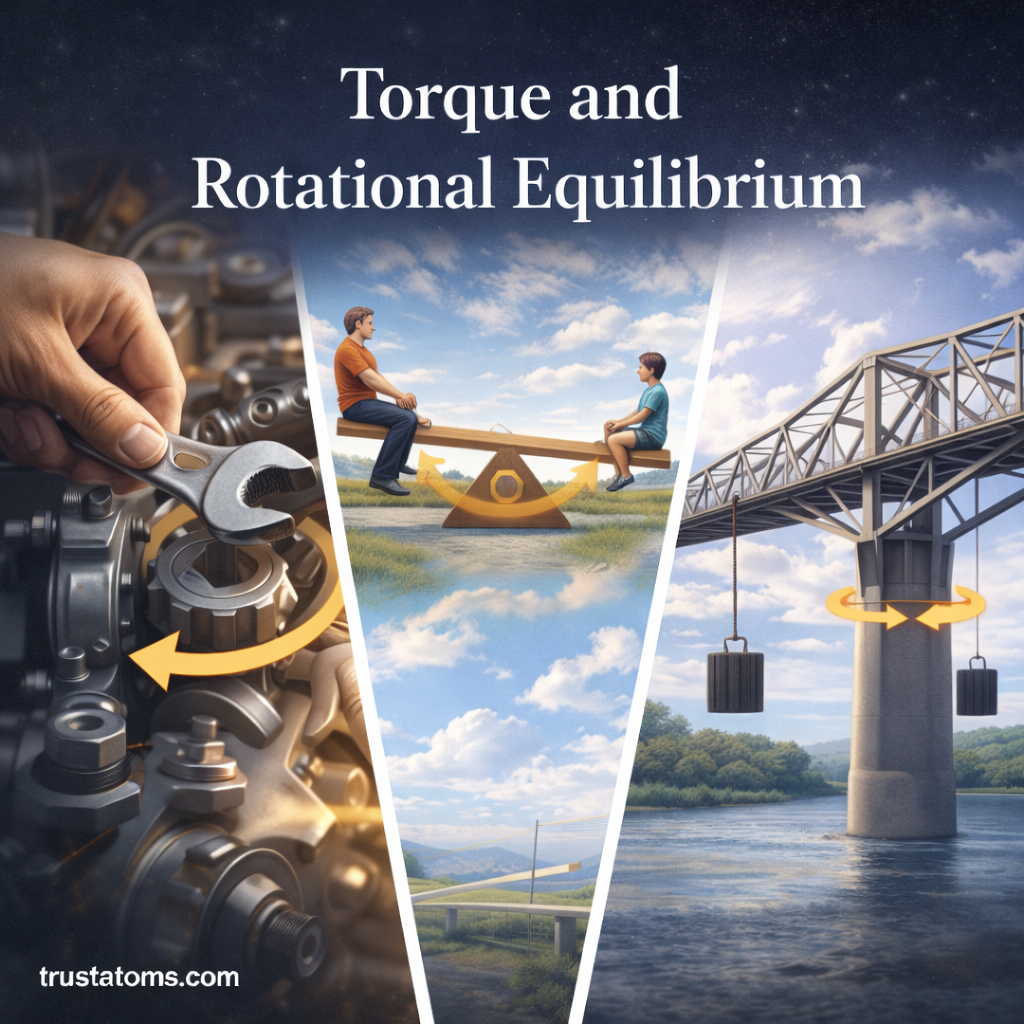
Torque is the rotational equivalent of force. Just as force causes linear acceleration, torque causes rotational motion. Understanding torque and rotational equilibrium is essential for analyzing levers, bridges, engines, and nearly every mechanical system involving rotation.
In this guide, we’ll break down what torque is, how it works, and how objects remain balanced when rotational forces cancel out.
What Is Torque?
Torque is a measure of how effectively a force causes an object to rotate around an axis.
In simple terms:
- Push on a door near the hinges → hard to rotate
- Push near the handle → easy to rotate
The difference isn’t the force itself — it’s the distance from the pivot point.
Torque depends on:
- The strength of the applied force
- The distance from the axis of rotation
- The angle at which the force is applied
Greater distance from the pivot produces greater torque.
The Lever Arm Concept
The lever arm is the perpendicular distance from the axis of rotation to the line of action of the force.
Important ideas:
- A longer lever arm increases torque.
- A force applied directly at the pivot produces zero torque.
- Only the component of force perpendicular to the lever arm contributes to rotation.
This is why wrenches are long — they increase torque without increasing force.
Direction of Torque
Torque has direction.
In physics:
- Counterclockwise torque is typically considered positive.
- Clockwise torque is considered negative.
Keeping track of direction is essential when analyzing multiple forces acting on a rotating object.
What Is Rotational Equilibrium?
An object is in rotational equilibrium when:
- The net torque acting on it equals zero.
This means:
- No angular acceleration occurs.
- The object either remains at rest or rotates at constant angular velocity.
Rotational equilibrium does not necessarily mean the object is not moving. It simply means its rotational motion is not changing.
Conditions for Complete Equilibrium
For an object to be fully balanced (static equilibrium), two conditions must be met:
- Net force equals zero (no linear acceleration).
- Net torque equals zero (no angular acceleration).
Both conditions must be satisfied simultaneously.
Example:
A book resting on a table:
- Downward gravitational force balances upward normal force.
- No net torque acts on the book.
- The system is in equilibrium.
Torque in Everyday Examples
1. Seesaws
A seesaw balances when:
- The torques on both sides are equal.
- A heavier person sits closer to the pivot.
- A lighter person sits farther from the pivot.
This balances torque even if weights differ.
2. Doors
A door rotates around its hinges.
- Pushing at the handle produces maximum torque.
- Pushing near the hinge produces minimal torque.
- Pushing directly toward the hinge produces zero torque.
This demonstrates the importance of both force and lever arm distance.
3. Wrenches and Tools
Mechanics use longer wrenches to:
- Increase torque.
- Loosen tight bolts.
- Apply less force for the same rotational effect.
Longer lever arms reduce required effort.
Balanced vs Unbalanced Torque

Balanced Torque
- Clockwise torque equals counterclockwise torque.
- Net torque is zero.
- No change in rotational motion.
Unbalanced Torque
- One direction dominates.
- Net torque is non-zero.
- Angular acceleration occurs.
This principle explains why objects begin rotating when torques are unequal.
Center of Mass and Stability
The location of an object’s center of mass affects its rotational stability.
An object remains stable when:
- Its center of mass is above its base of support.
- Net torque from gravitational force does not tip it over.
If the center of mass shifts outside the base:
- Gravity produces torque.
- The object rotates and falls.
This concept is essential in:
- Architecture
- Vehicle design
- Robotics
- Human balance
Torque and Mechanical Advantage
Torque plays a central role in mechanical advantage.
Machines like:
- Levers
- Pulleys
- Gear systems
Use torque to:
- Multiply force
- Reduce effort
- Increase efficiency
By increasing lever arm length or changing rotational ratios, machines optimize torque output.
Solving Torque and Equilibrium Problems
To analyze rotational equilibrium:
- Identify the pivot point.
- List all forces acting on the object.
- Determine each force’s lever arm distance.
- Assign torque direction (clockwise or counterclockwise).
- Set the sum of torques equal to zero.
- Solve for the unknown variable.
Choosing the correct pivot point often simplifies calculations.
Common Mistakes
Students often:
- Forget to consider direction (sign) of torque.
- Use incorrect lever arm distances.
- Confuse force balance with torque balance.
- Ignore angle of applied force.
Remember:
Even if net force is zero, torque may not be — and the object can still rotate.
Why Torque and Rotational Equilibrium Matter
These principles are essential for:
- Structural engineering
- Bridge construction
- Aircraft stability
- Robotics
- Industrial machinery
- Biomechanics
Engineers rely on torque analysis to ensure:
- Safety
- Structural balance
- Controlled rotation
- Stable system performance
Without torque equilibrium, systems would tip, spin uncontrollably, or collapse.
Key Takeaways
- Torque is the rotational equivalent of force.
- Torque depends on force magnitude and distance from the pivot.
- Direction matters in torque calculations.
- Rotational equilibrium occurs when net torque equals zero.
- Static equilibrium requires both zero net force and zero net torque.
- Balanced torque prevents angular acceleration.
Final Thoughts
Torque and rotational equilibrium provide a powerful framework for understanding how objects rotate, balance, and remain stable. From simple levers to complex engineering systems, torque governs rotational behavior in the physical world.
Mastering these principles builds a strong foundation for advanced mechanics, structural analysis, and real-world problem solving in physics and engineering.