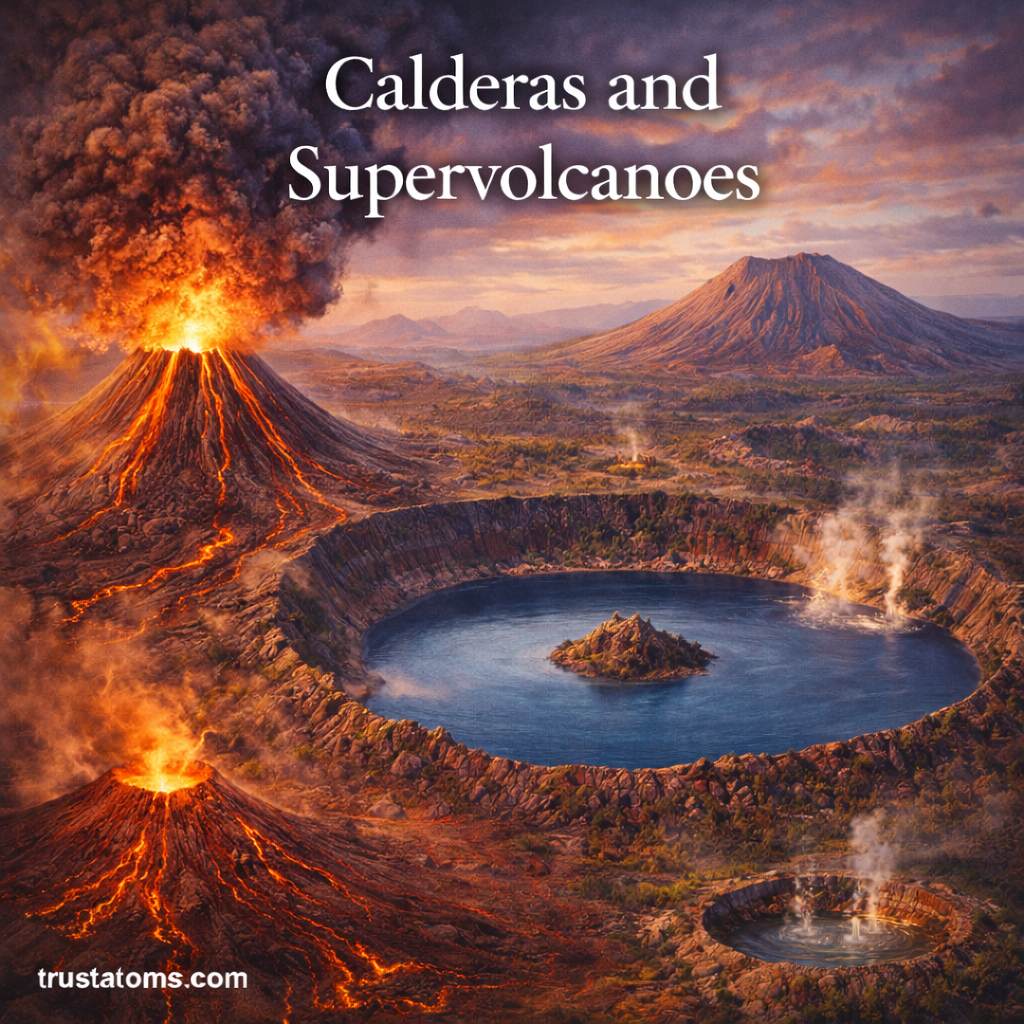
Some volcanic eruptions are so powerful that they don’t just create cones or craters—they collapse entire regions of the Earth’s surface. These massive features are known as calderas, and when associated with extremely large eruptions, they are often linked to supervolcanoes.
Understanding calderas and supervolcanoes is essential for grasping the largest and most impactful volcanic events in Earth’s history.
What Is a Caldera?
A caldera is a large, basin-shaped depression that forms when a volcano collapses after a major eruption.
Unlike a typical volcanic crater, which is relatively small and sits at the summit, a caldera can span several kilometers.
Key Characteristics:
- Formed by collapse, not just explosion
- Much larger than standard craters
- Often circular or oval in shape
- May fill with water to form lakes
How Calderas Form
Caldera formation involves a sequence of powerful geological events.
Step-by-Step Process:
- Magma accumulates in a large underground chamber
- Pressure builds over time
- A massive eruption releases huge volumes of magma
- The magma chamber empties partially or completely
- The ground above collapses inward
- A large depression (caldera) forms
This process can dramatically alter the landscape in a short period.
What Is a Supervolcano?
A supervolcano is not a specific type of volcano but a term used to describe a volcanic system capable of producing extremely large eruptions.
These eruptions are measured using the Volcanic Explosivity Index (VEI).
Supervolcano Criteria:
- Typically VEI 8 eruptions (the highest category)
- Eject more than 1,000 cubic kilometers of material
- Cause widespread environmental and climate effects
Supervolcanoes are often associated with large calderas.
Differences Between Calderas and Supervolcanoes
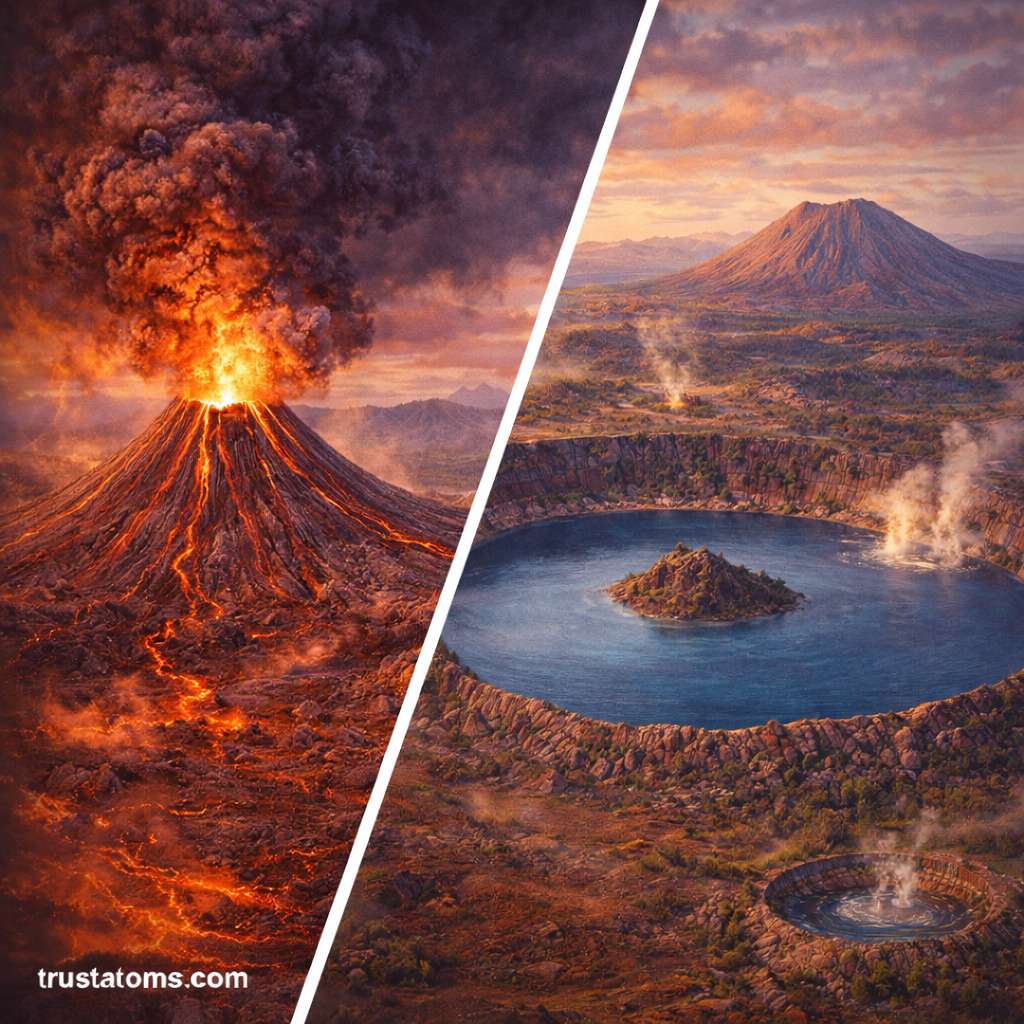
While closely related, these terms are not identical.
Caldera:
- A physical landform
- Created by collapse after an eruption
Supervolcano:
- A classification based on eruption size
- Refers to the scale and impact of volcanic activity
In many cases, a supervolcano eruption creates a caldera.
Famous Calderas and Supervolcanoes
Several well-known examples help illustrate these concepts.
Yellowstone Caldera (USA)
- One of the most famous supervolcano systems
- Experienced massive eruptions in the past
- Currently monitored closely for activity
Toba Caldera (Indonesia)
- Formed by a massive eruption about 74,000 years ago
- Created one of the largest volcanic lakes in the world
- Likely had global climate impacts
Santorini Caldera (Greece)
- Formed by a powerful eruption in ancient times
- Associated with the decline of the Minoan civilization
- A well-preserved example of caldera structure
Impacts of Supervolcanic Eruptions
Supervolcano eruptions are rare but can have global consequences.
Immediate Effects:
- Massive ash clouds covering large مناطق (regions)
- Pyroclastic flows destroying nearby areas
- Widespread destruction of ecosystems
Long-Term Effects:
- Global temperature drops (volcanic winter)
- Disruption of agriculture
- Changes in atmospheric composition
These effects can last for years or even decades.
How Scientists Monitor Supervolcanoes
Although supervolcanoes are not expected to erupt frequently, monitoring is essential.
Key Monitoring Methods:
- Seismic activity tracking
- Ground deformation measurements
- Gas emission analysis
- Satellite observations
Agencies like the United States Geological Survey continuously monitor systems such as Yellowstone.
Are Supervolcanoes Dangerous Today?
While the idea of a supervolcano eruption is alarming, the risk in the near future is considered low.
Important Points:
- Supervolcanic eruptions are extremely rare
- Most monitored systems show no signs of imminent eruption
- Scientists would likely detect warning signs well in advance
However, understanding these systems helps prepare for long-term risks.
Common Misconceptions
“Supervolcanoes erupt regularly”
In reality, eruptions are separated by tens of thousands to hundreds of thousands of years.
“A supervolcano eruption would end life on Earth”
While severe, such an event would not cause total extinction, but it could significantly impact global systems.
“Calderas are inactive”
Many calderas remain geologically active, even if they do not erupt frequently.
Lessons From Calderas and Supervolcanoes
Studying these features provides important insights:
- The Earth is capable of extremely large-scale changes
- Rare events can have global consequences
- Monitoring and research improve preparedness
Final Thoughts
Calderas and supervolcanoes represent the most powerful volcanic forces on Earth. Though rare, their potential impact makes them a critical area of study in Earth science.
By understanding how they form, how they behave, and how they are monitored, scientists can better assess risks and help societies prepare for even the most extreme natural events.