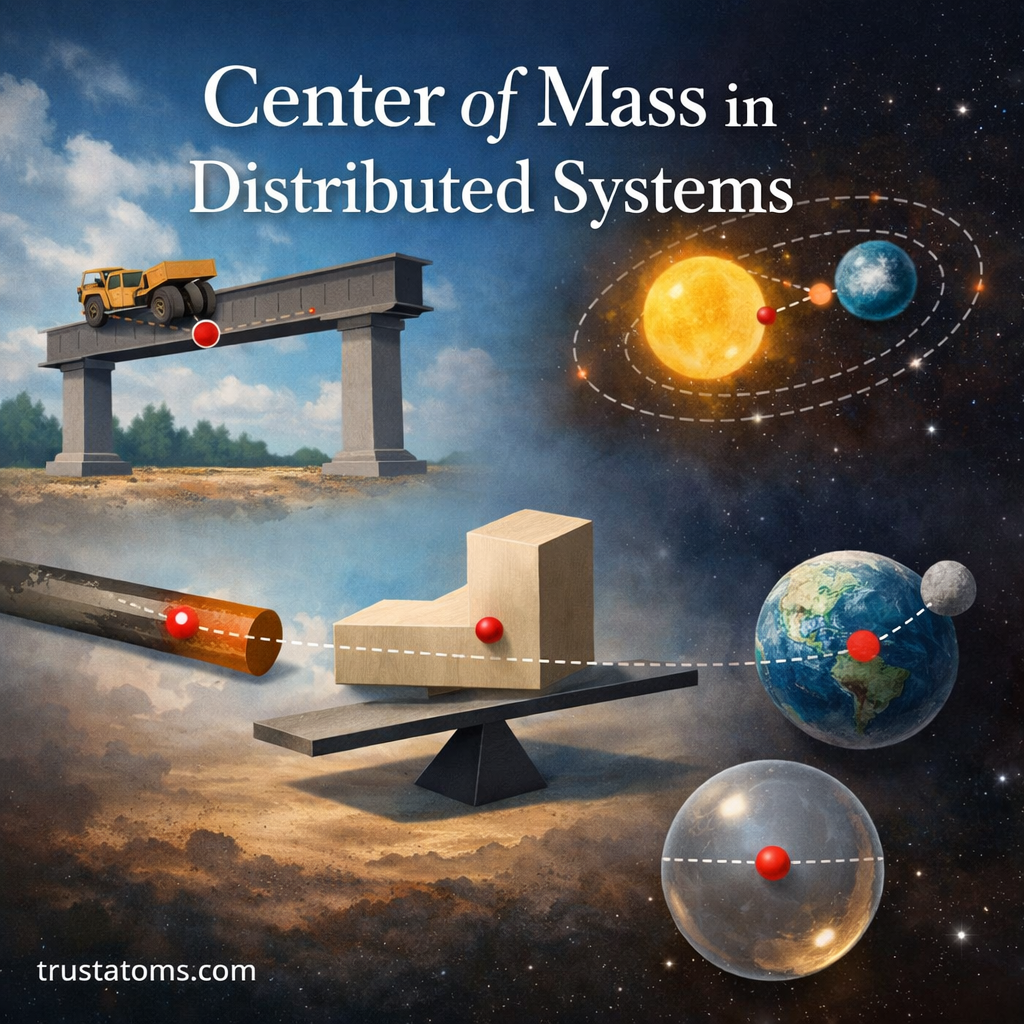
Understanding the center of mass in distributed systems is essential in physics, engineering, astronomy, and real-world problem solving. From balancing a bridge to predicting planetary motion, the concept explains how mass is effectively “averaged” across an object or system.
In this guide, we’ll break down what the center of mass is, how it works in distributed systems, how to calculate it, and why it matters in practical applications.
What Is the Center of Mass?
The center of mass (COM) is the point where the total mass of a system can be considered to be concentrated for analyzing motion.
For a single particle, this is trivial — the mass is located at that point.
For a rigid object or distributed system, mass is spread across space. The center of mass gives us one effective location that represents the entire distribution.
In simple terms:
- If you could balance the object perfectly on a point, that point would be the center of mass.
- If external forces act uniformly (like gravity), the object behaves as though all its mass were located at that point.
What Is a Distributed System in Physics?
A distributed system in physics refers to an object or structure where mass is continuously spread out over a length, area, or volume.
Examples include:
- A metal rod
- A spinning disk
- A bridge
- A planet
- A cloud of gas
- A system of connected particles
Unlike discrete point masses, distributed systems require integration to determine their center of mass.
Mathematical Definition of Center of Mass
For Discrete Particles
If we have point masses, the center of mass is calculated as:xcm=∑mi∑mixi
Where:
- mi = mass of each particle
- xi = position of each particle
This is essentially a weighted average of positions.
For Continuous (Distributed) Systems
When mass is continuously distributed, we use calculus.
In one dimension:xcm=M1∫xdm
Where:
- M = total mass
- dm = infinitesimal mass element
Since mass may depend on density:dm=ρ(x)dx
Then:xcm=M1∫xρ(x)dx
This method extends into two and three dimensions.
Center of Mass in One-Dimensional Systems
Consider a thin rod lying along the x-axis.
Case 1: Uniform Density
If density is constant:
- The center of mass is at the geometric center.
- For a rod of length L, COM is at L/2.
Case 2: Non-Uniform Density
If density varies (for example, heavier toward one end):
- The center of mass shifts toward the heavier region.
- Integration accounts for the varying density.
This principle explains why uneven objects don’t balance at their midpoint.
Center of Mass in Two-Dimensional Systems
For flat objects like plates or sheets:xcm=M1∫xdm ycm=M1∫ydm
Applications include:
- Designing stable furniture
- Balancing machinery
- Structural engineering analysis
For symmetric objects (like a circle or square with uniform density), the center of mass lies at the geometric center.
Center of Mass in Three-Dimensional Systems
For volumes like spheres or cylinders:xcm=M1∫xρ(x,y,z)dV
Similarly for y and z coordinates.
For uniform density spheres:
- The center of mass is exactly at the center.
- This is true even though mass exists throughout the volume.
This is why planets orbit each other around a shared center of mass (called the barycenter).
Why the Center of Mass Matters
The center of mass simplifies complex systems.
Instead of analyzing thousands (or trillions) of mass elements individually, we can:
- Treat the system as a single particle located at its COM
- Apply Newton’s laws to that point
- Predict translational motion accurately
This dramatically simplifies physics problems.
Real-World Applications
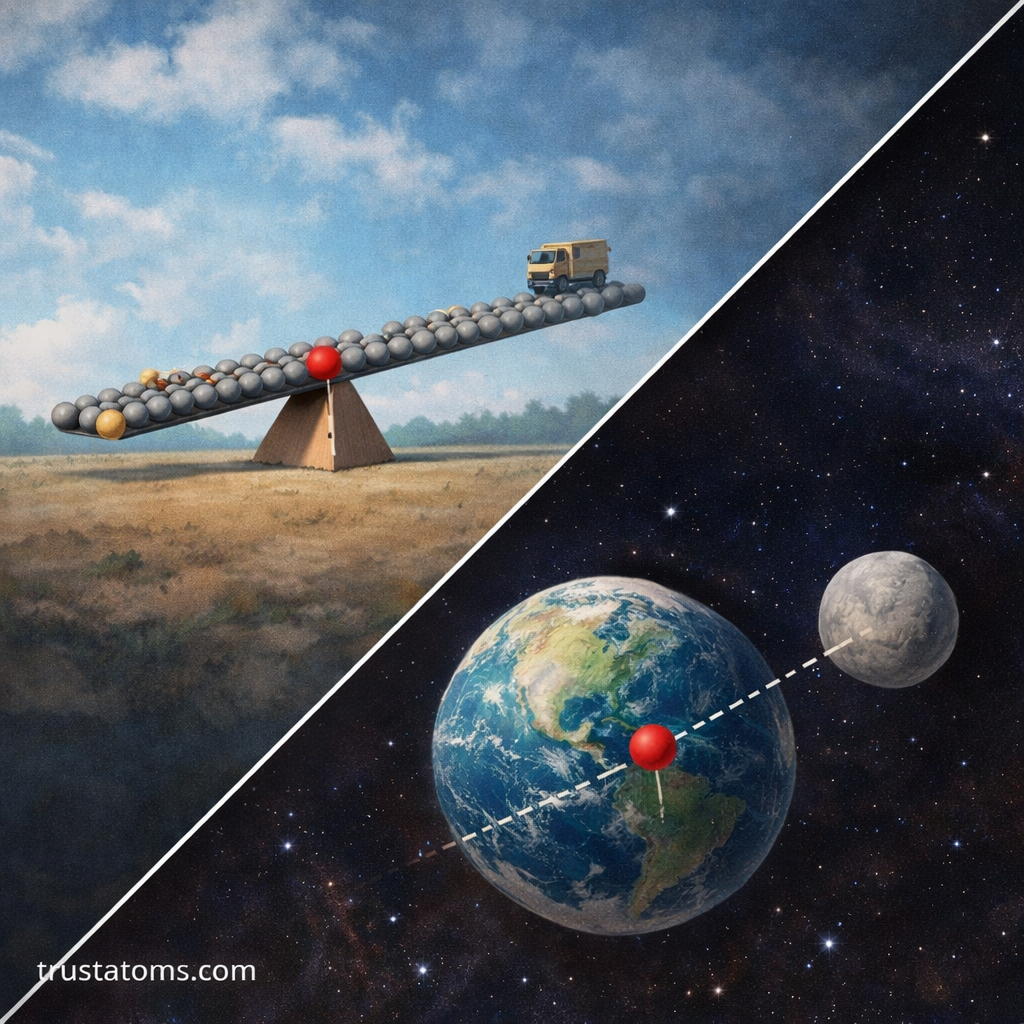
Engineering and Construction
- Bridge stability calculations
- Crane load balancing
- Vehicle safety design
- Structural stress analysis
Sports and Human Movement
- Gymnasts control their center of mass during flips
- High jumpers arch their bodies to shift COM below the bar
- Dancers maintain balance through COM control
Astronomy
- Binary star systems orbit a shared center of mass
- The Earth–Moon system rotates around a barycenter inside Earth
- Galaxies interact gravitationally via their mass centers
Robotics
- Walking robots constantly adjust their COM
- Drones stabilize themselves around their mass center
Symmetry and the Center of Mass
Symmetry is a powerful shortcut.
If an object has:
- Mirror symmetry → COM lies along symmetry axis
- Rotational symmetry → COM lies at geometric center
- Uniform density → geometric center = center of mass
Physicists use symmetry to avoid complicated integrals whenever possible.
Center of Mass vs Center of Gravity
In uniform gravitational fields (like near Earth’s surface):
- Center of mass = center of gravity
In non-uniform gravitational fields:
- They may differ slightly
- Important in astrophysics and orbital mechanics
For most everyday physics problems, the two are treated as the same.
Common Mistakes Students Make
- Confusing geometric center with center of mass in non-uniform systems
- Forgetting to account for varying density
- Mixing up total mass in the denominator
- Ignoring symmetry when it simplifies the problem
- Using discrete formulas for continuous systems
Recognizing whether a system is discrete or distributed is the first key step.
Example: Two-Mass System
Suppose:
- 2 kg at x = 0
- 6 kg at x = 4
Using the weighted average:xcm=2+6(2)(0)+(6)(4) xcm=824=3
The center of mass lies closer to the heavier mass — exactly what we expect physically.
How to Approach Center of Mass Problems
Follow this structured method:
- Identify whether the system is discrete or continuous
- Determine if density is uniform or variable
- Look for symmetry
- Write the appropriate formula
- Compute total mass
- Perform weighted average or integration
- Check whether the answer makes physical sense
Physics intuition matters as much as algebra.
Final Thoughts
The center of mass in distributed systems is one of the most powerful simplifying tools in physics. It allows us to reduce complex, extended bodies into single effective points for motion analysis.
Whether you’re studying mechanics, designing structures, analyzing athletic performance, or exploring planetary systems, understanding center of mass gives you deeper insight into how matter behaves in motion.
Mastering this concept strengthens your grasp of Newtonian mechanics and builds the foundation for advanced topics like rotational dynamics, orbital mechanics, and continuum physics.