X-ray astronomy is one of the most exciting branches of modern astronomy, allowing scientists to observe some of the most extreme and energetic phenomena in the universe. Unlike visible light astronomy, which shows us stars and galaxies as we typically imagine them, X-ray astronomy reveals violent cosmic events like black holes, neutron stars, and supernova explosions.
Because Earth’s atmosphere blocks X-rays, this field relies heavily on space-based telescopes. Thanks to missions from organizations like NASA and ESA, we can now study the universe in ways that were impossible just decades ago.
What Is X-Ray Astronomy?
X-ray astronomy is the study of celestial objects that emit X-rays—a form of high-energy electromagnetic radiation.
X-rays are produced in environments where temperatures reach millions of degrees or where particles are accelerated to near light speed. These conditions are far more extreme than what we observe in most visible-light astronomy.
Key characteristics of X-rays in space:
- Very short wavelengths (about 0.01 to 10 nanometers)
- Extremely high energy
- Produced in violent or high-temperature environments
- Invisible to the human eye
Why X-Rays Matter in Astronomy
X-rays provide a completely different view of the universe. While visible light shows structure and composition, X-rays reveal energy, motion, and extreme physics.
What X-rays help scientists study:
- Black holes and their accretion disks
- Neutron stars and pulsars
- Supernova remnants
- Hot gas in galaxy clusters
- High-energy jets from active galaxies
These observations help astronomers understand how matter behaves under intense gravity, pressure, and temperature.
How X-Ray Astronomy Works
Since Earth’s atmosphere absorbs X-rays, telescopes must be placed above it—typically in orbit.
Major X-ray observatories include:
- Chandra X-ray Observatory
- XMM-Newton
- NuSTAR
These telescopes use specialized mirrors designed to reflect X-rays at very shallow angles, allowing them to focus this high-energy radiation.
Basic process:
- X-rays from space enter the telescope
- Grazing-incidence mirrors redirect them
- Detectors capture and measure energy levels
- Data is converted into images and spectra
What Objects Emit X-Rays?
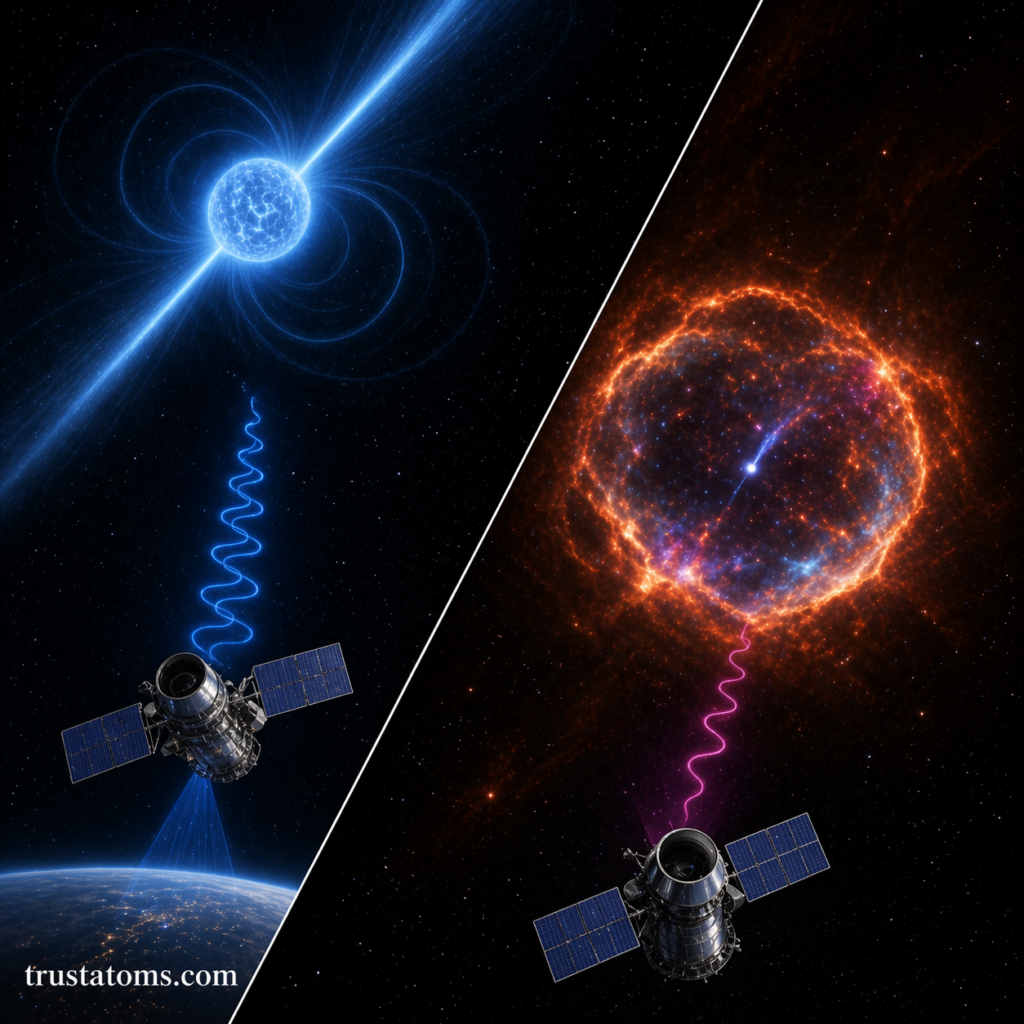
Not all objects in space emit X-rays. Only the most energetic environments produce them.
Common X-ray sources:
Black Holes
- Matter falling into a black hole heats up to millions of degrees
- This creates intense X-ray radiation before crossing the event horizon
Neutron Stars
- Extremely dense stellar remnants
- Strong magnetic fields accelerate particles, producing X-rays
Supernova Remnants
- Exploding stars release shock waves
- These heat surrounding gas to X-ray-emitting temperatures
Galaxy Clusters
- Massive clusters contain hot gas between galaxies
- This gas emits X-rays due to its extreme temperature
Discoveries Made Through X-Ray Astronomy
X-ray astronomy has revolutionized our understanding of the universe.
Major discoveries:
- Evidence of black holes in binary star systems
- Mapping hot gas in galaxy clusters
- Detection of cosmic X-ray background radiation
- Insights into dark matter distribution
- Observations of stellar explosions and their aftermath
These discoveries have helped confirm theories in astrophysics and opened new questions about the universe.
Challenges of X-Ray Astronomy
Studying X-rays comes with unique technical challenges.
Key difficulties:
- X-rays cannot penetrate Earth’s atmosphere
- Requires expensive space missions
- Instruments must withstand harsh space conditions
- Data interpretation is complex
Despite these challenges, advances in technology continue to improve our ability to observe high-energy phenomena.
How X-Ray Astronomy Differs from Other Types
Each type of astronomy focuses on a different part of the electromagnetic spectrum.
Comparison:
- Radio astronomy: studies long wavelengths and cold gas
- Infrared astronomy: detects heat and dust-obscured objects
- Visible astronomy: observes stars and galaxies as seen by the human eye
- X-ray astronomy: reveals high-energy, extreme environments
By combining these methods, astronomers gain a more complete picture of the universe.
The Future of X-Ray Astronomy
The next generation of X-ray observatories aims to go even deeper into the high-energy universe.
Upcoming advancements:
- More sensitive detectors
- Higher-resolution imaging
- Improved spectroscopy
- Longer observation missions
Projects like ATHENA are expected to dramatically enhance our understanding of black holes, galaxy formation, and cosmic evolution.
Final Thoughts
X-ray astronomy allows us to explore the most extreme and energetic parts of the universe—places where matter is stretched, compressed, and heated beyond imagination.
By studying X-rays, scientists uncover the hidden forces shaping galaxies, stars, and cosmic structures. As technology advances, this field will continue to reveal new mysteries and deepen our understanding of the universe.