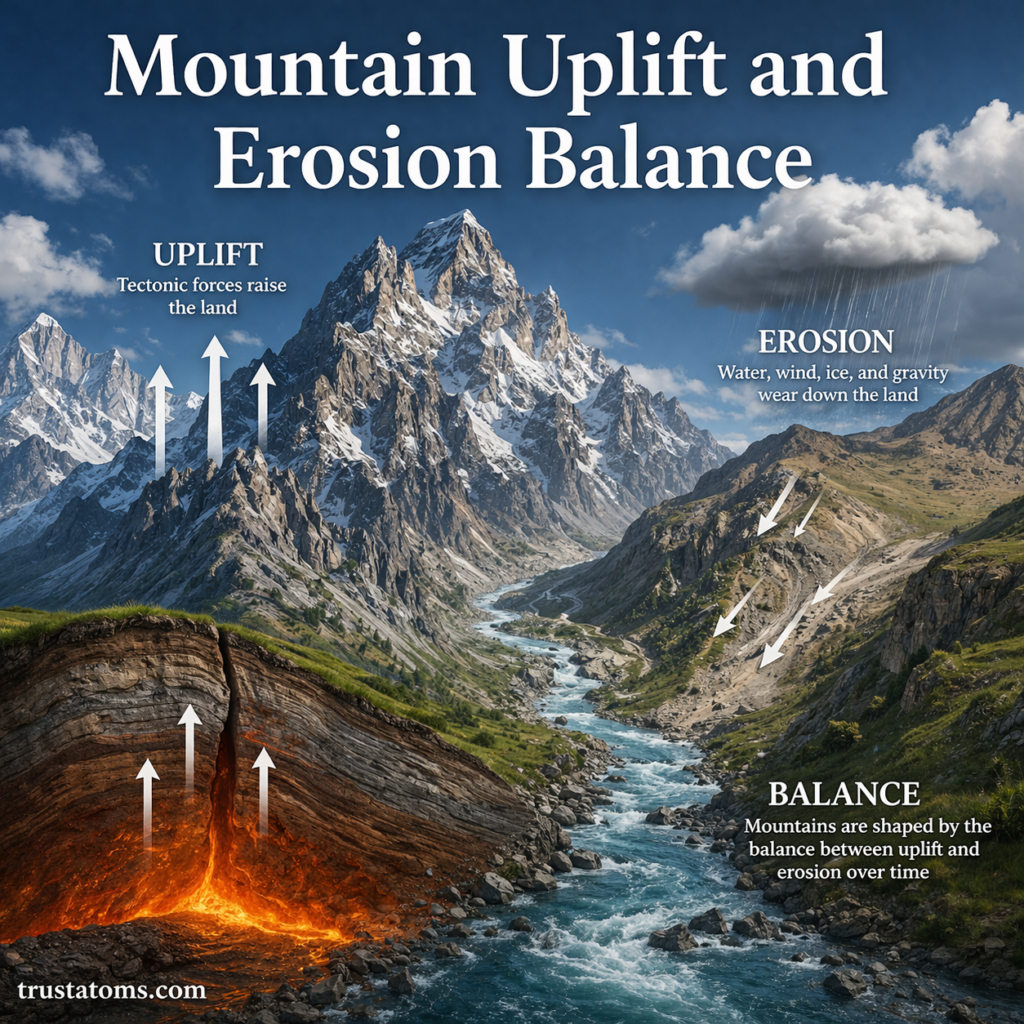
Mountains are not static features — they are constantly being built up and worn down. The balance between uplift (the process that raises land) and erosion (the process that wears it away) shapes the landscapes we see today.
Understanding this balance helps explain why some mountain ranges grow taller while others slowly disappear over millions of years.
What Is Mountain Uplift?
Mountain uplift refers to the processes that push sections of Earth’s crust upward. This is primarily driven by plate tectonics.
Main Causes of Uplift
- Tectonic Plate Collision
When two continental plates collide, the crust crumples and thickens, forming mountain ranges. - Volcanic Activity
Magma rising from beneath Earth’s surface can build volcanic mountains over time. - Isostatic Uplift
When weight is removed from the crust (like melting glaciers), the land slowly rises back up.
Example
The Himalayas are still rising today due to the collision between the Indian and Eurasian tectonic plates.
What Is Erosion?
Erosion is the process that breaks down and removes rock and soil from Earth’s surface.
Main Agents of Erosion
- Water (rivers, rainfall)
- Wind
- Ice (glaciers)
- Gravity (landslides)
These forces gradually wear down mountains, transporting sediments to valleys, rivers, and oceans.
The Balance Between Uplift and Erosion
Mountain landscapes are shaped by a dynamic balance between two opposing forces:
- Uplift builds elevation
- Erosion reduces elevation
Three Possible Outcomes
- Uplift > Erosion
Mountains grow taller over time. - Uplift = Erosion
Mountains maintain a relatively stable height. - Erosion > Uplift
Mountains shrink and eventually become low hills or plains.
How This Balance Shapes Landscapes
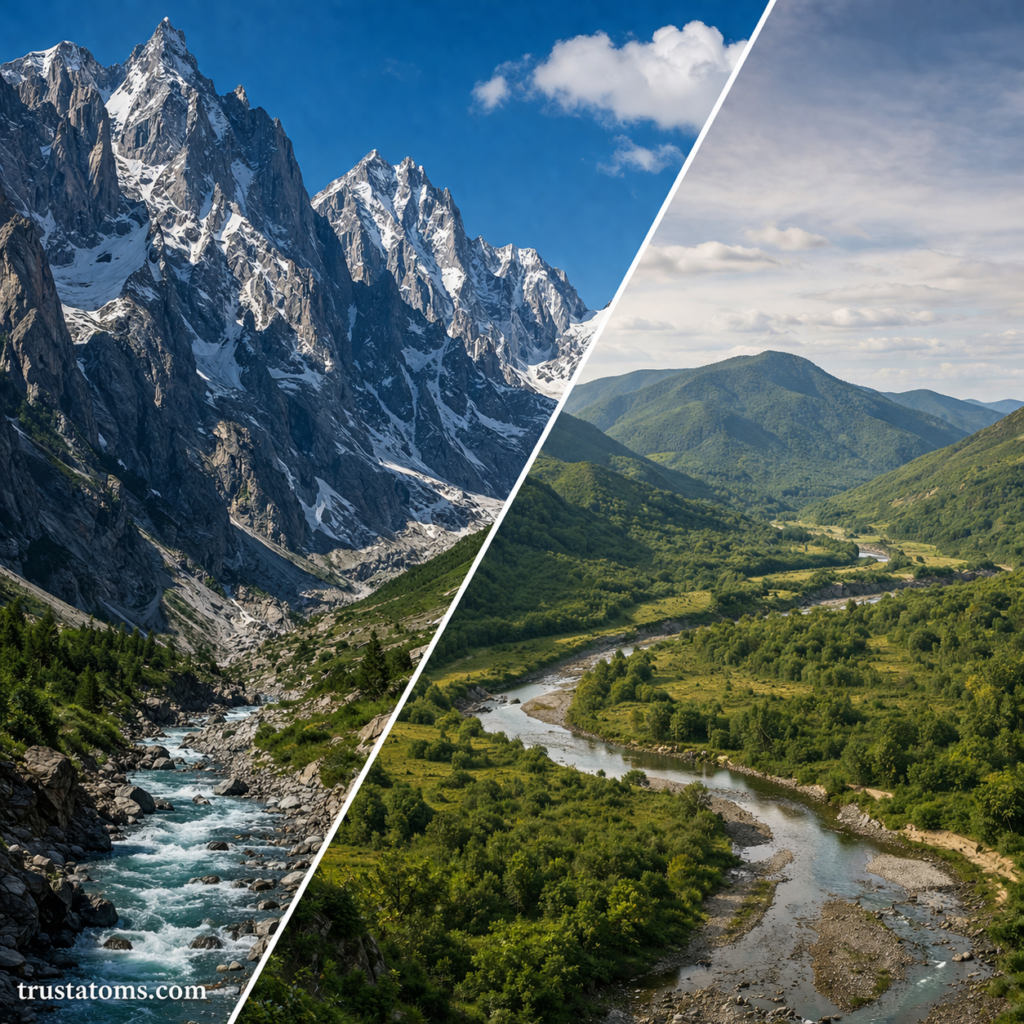
The interaction between uplift and erosion determines the appearance and lifespan of a mountain range.
Young Mountain Ranges
- Steep slopes
- Jagged peaks
- High rates of uplift
Example: The Andes Mountains
Old Mountain Ranges
- Rounded peaks
- Lower elevation
- Dominated by erosion
Example: The Appalachian Mountains
Factors That Influence the Balance
Several variables affect whether uplift or erosion dominates:
Climate
- Heavy rainfall accelerates erosion
- Cold climates promote glacial carving
Rock Type
- Hard rocks (granite) resist erosion
- Soft rocks (sedimentary layers) erode quickly
Tectonic Activity
- Active plate boundaries increase uplift rates
- Stable regions experience little to no uplift
Vegetation
- Plant roots stabilize soil and reduce erosion
- Bare landscapes erode faster
The Role of Isostasy
Isostasy is a key concept in understanding long-term mountain evolution.
As erosion removes material from a mountain:
- The crust becomes lighter
- It rises upward in response (like a floating object)
This creates a feedback loop:
- Erosion removes mass
- Land rises slightly
- Erosion continues
This process helps maintain mountain elevations longer than expected.
Why Mountains Don’t Last Forever
Even the tallest mountains eventually erode away if uplift slows or stops.
Over millions of years:
- Peaks become rounded
- Elevation decreases
- Sediments are deposited elsewhere
Ancient mountain ranges that once rivaled modern peaks are now barely visible due to prolonged erosion.
Real-World Impacts of Uplift and Erosion
This balance affects more than just scenery — it has practical consequences:
Natural Hazards
- Landslides in steep, rapidly uplifting regions
- Flooding from sediment-filled rivers
Soil Formation
- Erosion creates fertile soils in valleys
Resource Distribution
- Minerals and sediments are redistributed across regions
Final Thoughts
Mountain uplift and erosion are part of a continuous cycle shaping Earth’s surface. While tectonic forces build mountains upward, erosion works just as persistently to wear them down.
The landscapes we see today represent a snapshot in time — a temporary balance between construction and destruction that has been ongoing for hundreds of millions of years.