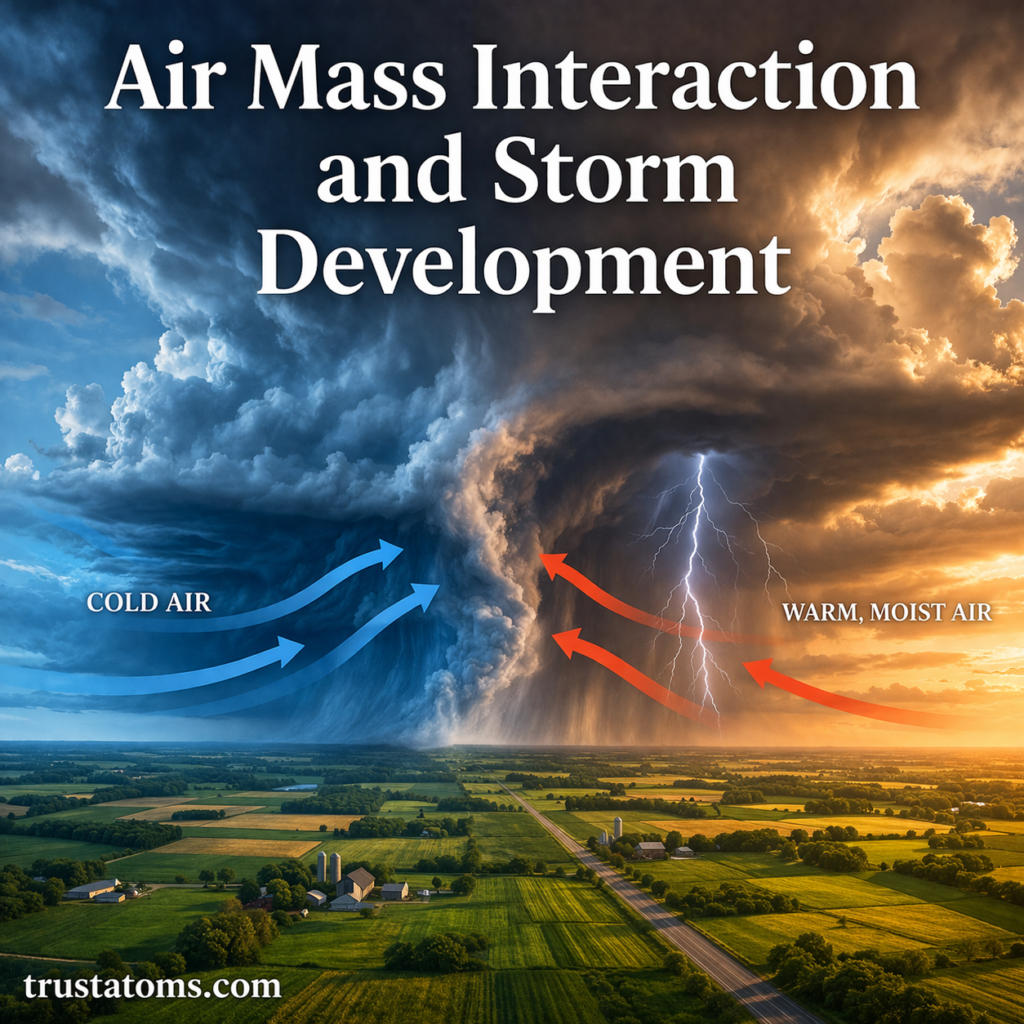
Weather doesn’t happen randomly—many storms form because of how different air masses interact. When large bodies of air with different temperatures and moisture levels collide, they create the perfect conditions for clouds, precipitation, and sometimes severe storms.
Understanding air mass interaction is key to explaining why storms form, how they intensify, and where they are most likely to occur.
What Is an Air Mass?
An air mass is a large volume of air that has relatively uniform temperature and humidity throughout.
Air masses form over specific regions called source regions, such as oceans, deserts, or polar areas, where they take on the characteristics of that surface.
Common Types of Air Masses
Air masses are typically classified based on temperature and moisture:
- Continental Polar (cP): Cold and dry
- Maritime Polar (mP): Cold and moist
- Continental Tropical (cT): Hot and dry
- Maritime Tropical (mT): Warm and humid
Each type plays a different role in weather patterns and storm formation.
What Happens When Air Masses Meet?
When two different air masses come into contact, they do not mix easily due to differences in density. Instead, they form a boundary called a front.
Why They Don’t Mix Easily
- Cold air is denser and sinks
- Warm air is lighter and rises
- Moist air adds instability to the atmosphere
This imbalance leads to vertical motion—one of the key ingredients for storm development.
Types of Fronts and Their Effects
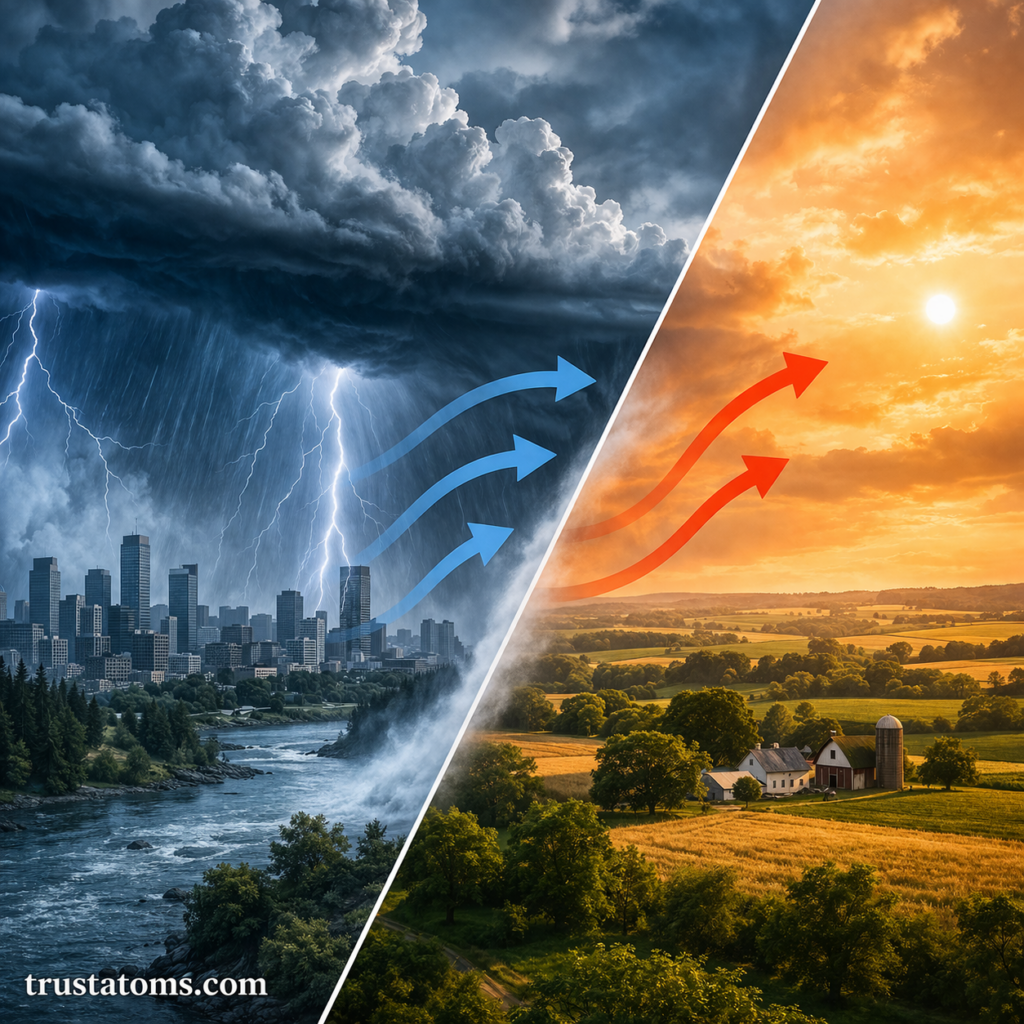
Different types of fronts produce different weather conditions depending on how air masses interact.
1. Cold Front
A cold front occurs when a cold air mass pushes into a warmer air mass.
What happens:
- Cold air forces warm air to rise quickly
- Rapid uplift leads to cloud formation
- Often produces short, intense storms
Common weather:
- Thunderstorms
- Heavy rain
- Gusty winds
- Sudden temperature drops
2. Warm Front
A warm front forms when warm air moves over a retreating cold air mass.
What happens:
- Warm air rises gradually over cold air
- Clouds form slowly and spread out
- Precipitation tends to be steady and widespread
Common weather:
- Light to moderate rain
- Overcast skies
- Gradual temperature increase
3. Stationary Front
A stationary front occurs when neither air mass moves significantly.
What happens:
- Air masses remain in place
- Weather conditions can persist for days
Common weather:
- Extended periods of rain
- Cloudy conditions
- Potential for flooding
4. Occluded Front
An occluded front forms when a cold front overtakes a warm front.
What happens:
- Warm air is lifted off the ground
- Complex cloud and precipitation patterns develop
Common weather:
- Mixed precipitation
- Cooler temperatures
- Prolonged storm activity
How Air Mass Interaction Leads to Storms
Storm development depends on three main atmospheric ingredients:
1. Moisture
Moist air provides the water vapor needed for cloud formation and precipitation.
2. Instability
Instability occurs when warm air rises rapidly into cooler air above, creating turbulence and vertical motion.
3. Lift
Lift is the force that pushes air upward. Fronts are one of the most common sources of lift in the atmosphere.
Step-by-Step Storm Formation
- Warm, moist air accumulates near the surface
- A front forces the warm air upward
- Rising air cools and condenses into clouds
- Clouds grow and release precipitation
- If instability is strong, thunderstorms may develop
Severe Storm Development
When conditions are especially favorable, air mass interactions can produce severe weather.
Key Factors for Severe Storms
- Strong temperature contrasts between air masses
- High humidity levels
- Fast-moving cold fronts
- Wind shear (changes in wind speed and direction with height)
Types of Severe Storms
- Thunderstorms: Lightning, heavy rain, and strong winds
- Supercells: Highly organized storms capable of producing tornadoes
- Tornadoes: Rotating columns of air extending from storms to the ground
- Hailstorms: Ice pellets formed in strong updrafts
Where Air Mass Interactions Commonly Occur
Some regions are more prone to storm development due to frequent air mass collisions.
Examples
- Mid-latitudes (like the United States): Frequent clashes between polar and tropical air
- Coastal regions: Interaction between maritime and continental air
- Plains regions: Open landscapes allow air masses to move freely and collide
Real-World Example: Storms in the Central United States
The central U.S. is often called “Tornado Alley” because:
- Warm, moist air from the Gulf of Mexico meets
- Cold, dry air from Canada
- Dry air from the western deserts
This combination creates highly unstable conditions, making the region one of the most active storm zones in the world.
Air Mass Interaction and Climate Patterns
Air mass behavior is influenced by larger climate systems.
- Seasonal changes shift air mass boundaries
- Climate change may alter temperature contrasts
- Changing ocean temperatures affect moisture levels
These factors can influence the frequency and intensity of storms over time.
Key Takeaways
- Air masses are large bodies of air with similar temperature and moisture
- When they meet, they form fronts that drive weather changes
- Storms develop when warm air rises, cools, and condenses
- Cold fronts often produce intense storms, while warm fronts bring steady rain
- Severe storms require moisture, instability, and lift
- Certain regions experience more storms due to frequent air mass interactions
Final Thoughts
Air mass interaction is one of the most important processes in Earth’s atmosphere. It explains everything from gentle rain to powerful thunderstorms and tornadoes.
By understanding how air masses move and interact, we gain insight into weather patterns, storm risks, and the dynamic nature of our planet’s atmosphere.