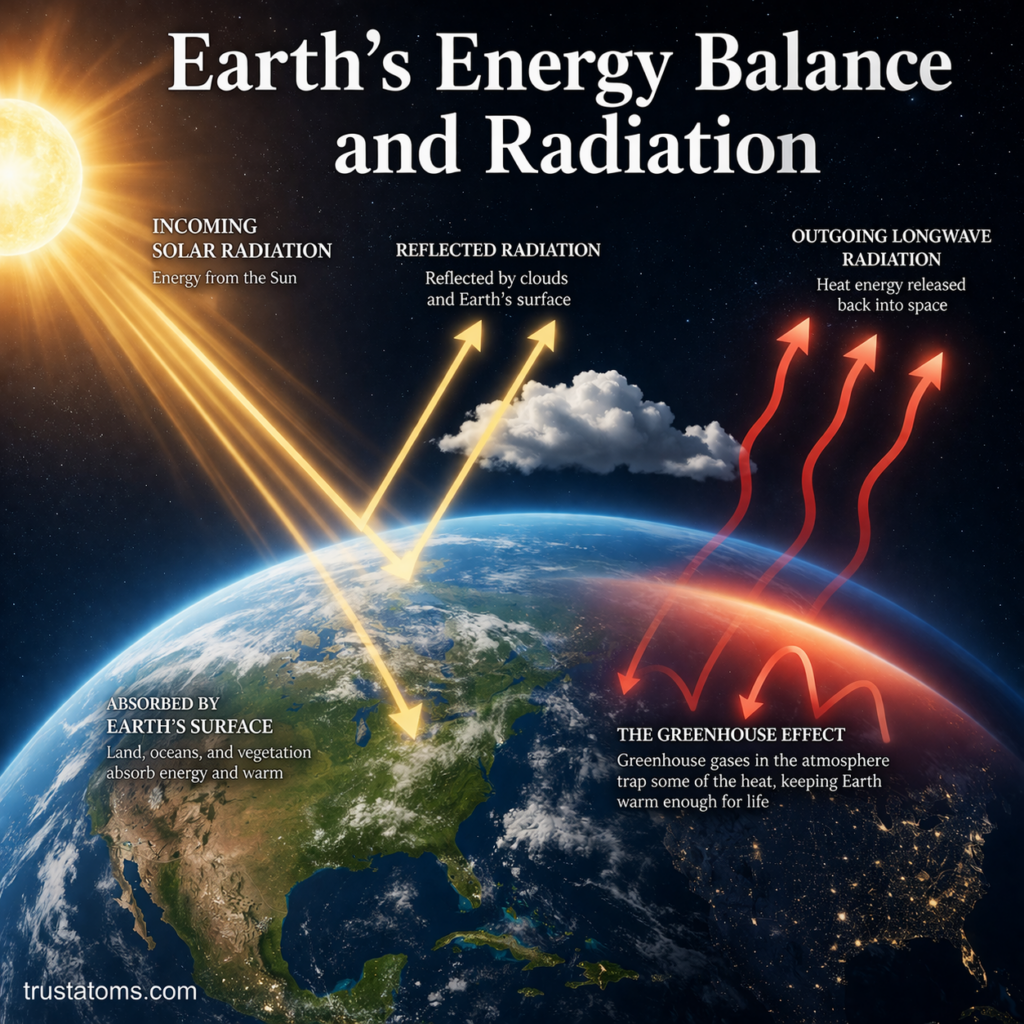
Earth’s energy balance is one of the most important concepts in Earth science. It explains how energy from the Sun enters the planet, how it is absorbed or reflected, and how it eventually leaves back into space.
This balance determines global temperatures, drives weather systems, and plays a central role in climate change.
What Is Earth’s Energy Balance?
Earth’s energy balance refers to the relationship between:
- Incoming energy from the Sun
- Outgoing energy radiated back into space
When incoming and outgoing energy are equal, Earth’s temperature remains relatively stable. If this balance is disrupted, the planet either warms or cools.
Incoming Solar Radiation
The Sun is the primary source of energy for Earth.
This energy arrives as solar radiation, also known as shortwave radiation.
Key characteristics
- Travels through space as electromagnetic waves
- Includes visible light, ultraviolet (UV), and some infrared energy
- Provides heat and light necessary for life
When solar radiation reaches Earth:
- Some is reflected back into space
- Some is absorbed by the atmosphere
- The rest is absorbed by land, water, and vegetation
Reflection and Albedo
Not all incoming solar energy is absorbed. A portion is reflected back into space.
This reflectivity is called albedo.
Examples of albedo differences
- Ice and snow → high albedo (reflect more energy)
- Deserts → moderate albedo
- Oceans and forests → low albedo (absorb more energy)
Why it matters:
- High albedo cools the planet
- Low albedo increases heat absorption
Changes in ice coverage can significantly impact global temperatures due to albedo shifts.
Absorption of Energy
The energy that is not reflected is absorbed by Earth’s surface and atmosphere.
Where energy is absorbed
- Oceans (store large amounts of heat)
- Land surfaces
- Atmosphere (gases and clouds)
Oceans play a major role because they:
- Absorb heat slowly
- Release heat gradually
- Help regulate global climate
Outgoing Longwave Radiation
After absorbing energy, Earth releases it back into space.
This is known as longwave (infrared) radiation.
Key points
- Emitted by Earth’s surface and atmosphere
- Occurs continuously
- Helps cool the planet
If all outgoing radiation escaped freely, Earth would be much colder than it is today.
The Greenhouse Effect
The atmosphere plays a critical role in Earth’s energy balance through the greenhouse effect.
Certain gases trap some of the outgoing heat, keeping the planet warm enough to support life.
Major greenhouse gases
- Carbon dioxide (CO₂)
- Methane (CH₄)
- Water vapor
- Nitrous oxide (N₂O)
How it works
- Sunlight reaches Earth and warms the surface
- Earth emits infrared radiation
- Greenhouse gases absorb and re-radiate some of this heat
- Heat is retained in the lower atmosphere
Without this natural effect, Earth would be too cold for most life.
Factors That Influence Energy Balance
Several factors affect how energy flows through Earth’s system.
Latitude
- Equatorial regions receive more direct sunlight
- Polar regions receive less concentrated energy
Cloud Cover
- Reflects incoming sunlight (cooling effect)
- Traps outgoing heat (warming effect)
Surface Type
- Ice reflects energy
- Oceans absorb energy
Atmospheric Composition
- More greenhouse gases increase heat retention
- Changes can alter global temperatures
Energy Imbalance and Climate Change
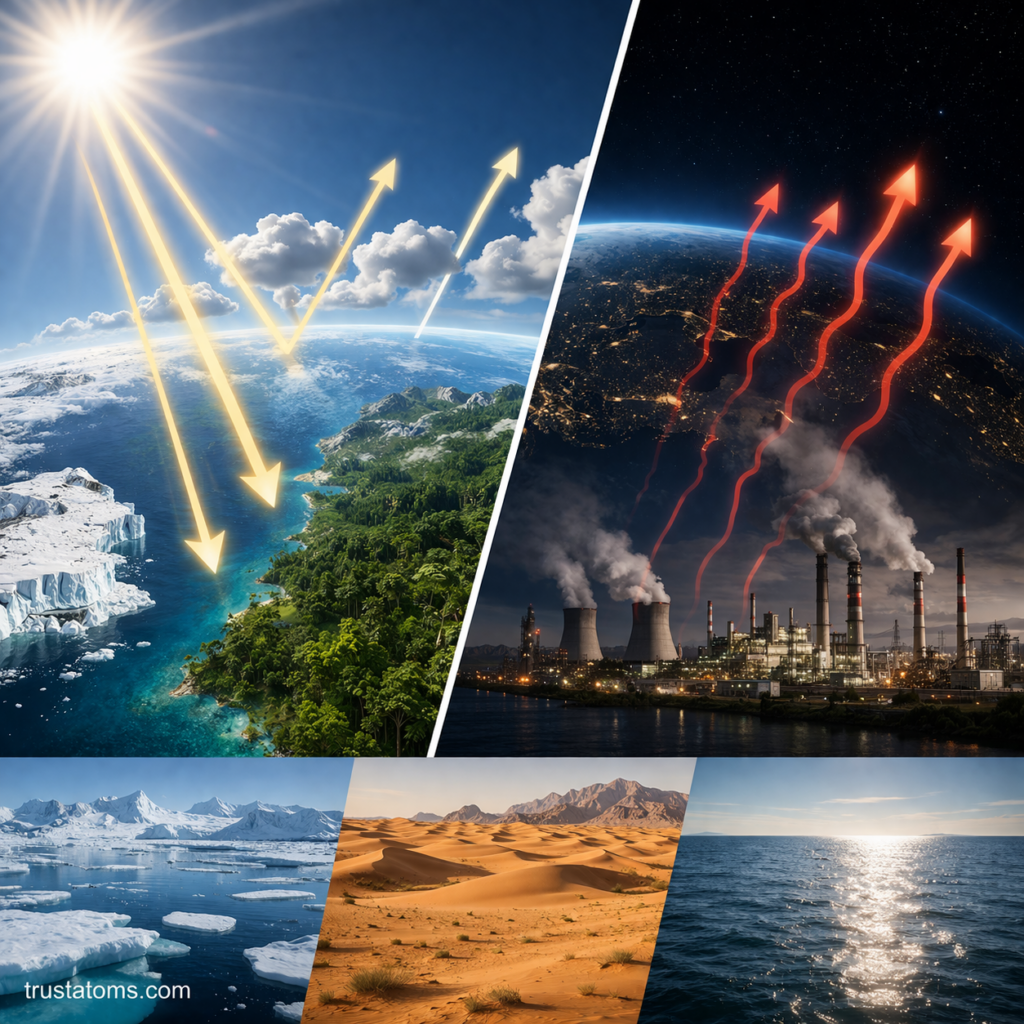
Earth’s energy balance is currently shifting.
Human activities—especially the burning of fossil fuels—have increased greenhouse gas concentrations.
What happens during imbalance
- More energy is retained than released
- Global temperatures rise
- Climate patterns shift
Observable impacts
- Rising global temperatures
- Melting ice caps and glaciers
- Sea level rise
- More extreme weather events
Even small imbalances can have long-term effects on the climate system.
Why Earth’s Energy Balance Matters
Understanding energy balance helps explain:
Climate Systems
- Drives atmospheric circulation
- Influences ocean currents
Weather Patterns
- Affects storms, rainfall, and seasonal changes
Environmental Stability
- Maintains conditions suitable for life
It also provides the foundation for predicting future climate changes and making informed environmental decisions.
Energy Balance in Simple Terms
You can think of Earth’s energy system like a budget:
- Incoming energy = energy earned
- Outgoing energy = energy spent
If more energy comes in than goes out, Earth warms.
If more energy leaves than enters, Earth cools.
Final Thoughts
Earth’s energy balance and radiation processes are essential to understanding how the planet works. From sunlight entering the atmosphere to heat escaping into space, every step plays a role in maintaining global temperatures.
As human activity continues to influence this balance, understanding these processes becomes increasingly important for predicting and managing climate change.